
Conops
Conops
Description
How to identify
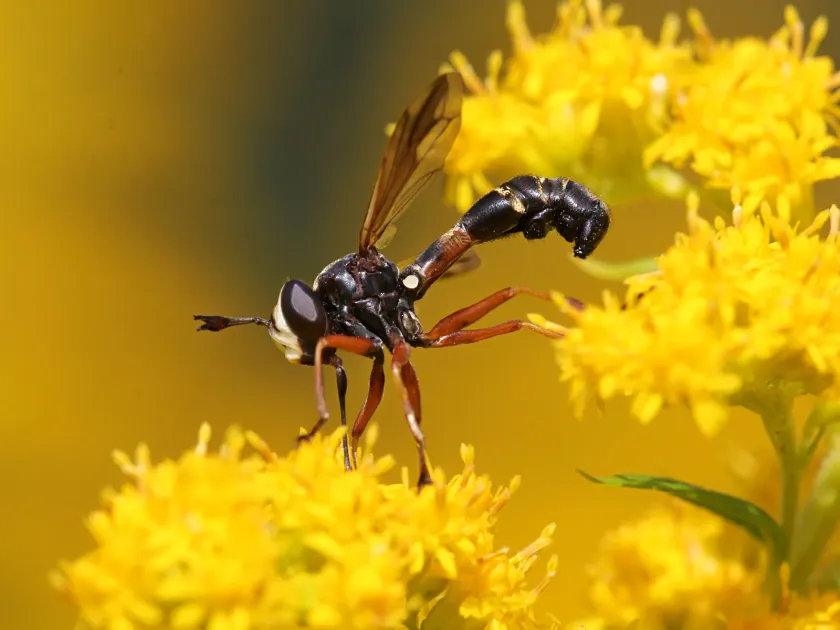
Conops is a genus of flies belonging to the family Conopidae, commonly known as thick-headed flies. They are easily recognizable by their large, prominent heads and long, often forward-pointing antennae.
Many species in this genus display Batesian mimicry, resembling wasps or bees with their yellow-and-black abdominal markings and slender, wasp-like waists. They range in size and are frequently observed feeding on nectar from flowers.
Adult flies possess a long, retractable proboscis used for sipping nectar. Despite their striking appearance, they are essential parts of the ecosystem, albeit with a parasitic lifestyle that impacts other insect populations.
The taxonomic classification places them within the order Diptera. While not herbivores, their role as parasitoids makes them significant in agricultural entomology regarding the health of beneficial insect communities.
Their distribution is worldwide, with various species inhabiting different temperate and tropical climates, often found in gardens, meadows, and agricultural border areas.
What it damages
The "damage" caused by Conops is indirect but significant for agriculture. These flies are internal parasitoids that target bees, bumblebees, and other hymenopterans by injecting eggs into their bodies while in flight.
The larvae hatch and develop inside the host, feeding on its internal organs, which eventually leads to the death of the pollinator. This directly reduces the population of insects necessary for crop pollination.
Crops that rely on cross-pollination, such as fruit trees, berries, and various vegetables, may suffer from reduced yields if the local pollinator population is suppressed by high levels of parasitism.
In agricultural settings, a high density of Conops could theoretically disrupt the efficiency of natural pollination services. Therefore, managing them involves ensuring that host populations remain robust and healthy.
Because they target the very insects farmers want to protect, understanding their behavior is crucial for integrated pest management (IPM) strategies that prioritize pollinator health.
When it appears
Adult Conops are typically seen during the summer months, usually from June through August. Their activity period is closely linked to the availability of floral resources and warm weather conditions.
During these months, adults are most active on sunny days when they are likely to encounter foraging bees and bumblebees. This is the period when they seek out hosts for oviposition.
The life cycle encompasses four stages: egg, larva, pupa, and adult. The larval stage is entirely internal, providing the fly with a stable environment for development while consuming the host.
Overwintering typically occurs in the pupal stage, often in the soil or protected debris near the host's nesting site. As temperatures rise in spring, the next generation of adults emerges.
The number of generations per year depends on the specific species and the local climate, with some species being univoltine (one generation) and others potentially producing two broods.
Control measures
Direct chemical control of Conops is generally not recommended, as any non-selective insecticide application would inadvertently kill the pollinators the farmer aims to protect.
Effective management focuses on creating high-quality habitats for wild bees and bumblebees, allowing these populations to remain large enough to withstand natural parasitism pressure.
Reducing the use of broad-spectrum pesticides is the most effective way to ensure that pollinator populations remain healthy and resilient against parasitic pressures like those from Conops flies.
Providing wildflower strips and maintaining hedgerows can support diverse populations of pollinators and predators, potentially tempering the population spikes of parasitic flies.
- Prioritize pollinator-friendly farming practices.
- Avoid insecticide sprays during the flowering season.
- Enhance floral diversity to support robust bee populations.
Taxonomy
- Latin name
- Conops
- Order
- Diptera (flies)
- Family
- Conopidae
- EPPO code
- CNPSSP
Discussion
No discussions yet — be the first.