
Conops quadrifasciata
Conops quadrifasciata
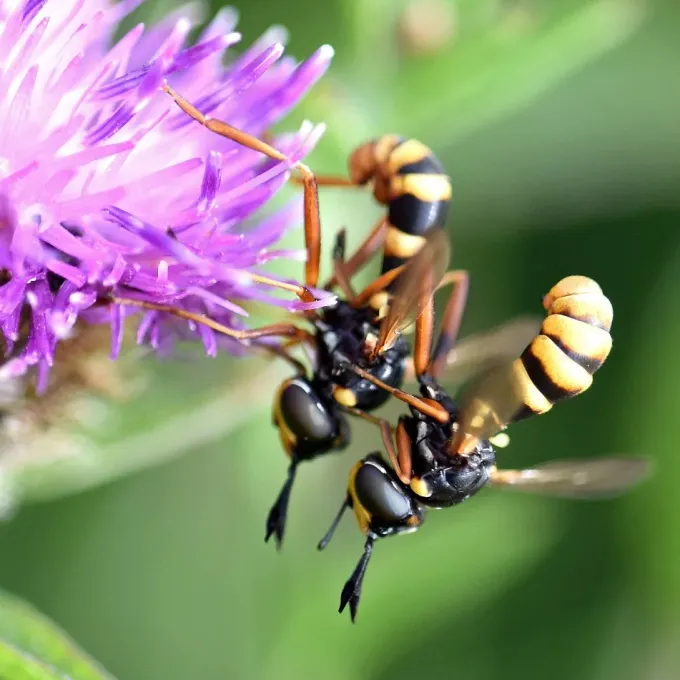
Description
How to identify
Conops quadrifasciata is a species of thick-headed fly belonging to the family Conopidae and the order Diptera. These flies are widely recognized for their Batesian mimicry, as they resemble wasps or bees.
The adult fly typically measures between 10 and 14 millimeters in length. Its abdomen is dark with four distinct yellow transverse bands, which gives the species its specific scientific and common names.
The head is relatively large with prominent compound eyes, and it features a long, slender proboscis adapted for feeding on nectar from various flowering plants.
These flies are strong fliers often found in sunny environments, such as meadows, forest edges, and gardens, where they actively seek out hosts while visiting flowers.
The body structure is slim with a narrow base of the abdomen, contributing to the wasp-like appearance that helps them evade predation by birds and other insectivores.
What it damages
The larval stage of Conops quadrifasciata is strictly endoparasitic. The larvae develop inside the bodies of living social insects, most notably bumblebees and occasionally some wasp species.
While the fly itself does not feed on crops, it impacts agricultural productivity by reducing the population of bumblebees, which are essential pollinators for many fruits, legumes, and vegetables.
The larvae consume the internal tissues of the bumblebee, ultimately leading to the death of the host. This parasitic relationship can significantly reduce the efficiency of local pollination.
No direct damage to plant vegetative tissues (roots, stems, or leaves) occurs, as the entire developmental cycle is confined within the body of the host insect.
Agricultural damage is therefore categorized as indirect, manifested as a decrease in crop yield due to the diminished number of active bumblebee foragers during the flowering season.
When it appears
Adult activity of Conops quadrifasciata typically occurs during the summer months, spanning from mid-June through early September, depending on the climatic zone.
The life cycle is synchronized with the activity of bumblebees. The flies emerge and become active at the same time that bumblebee colonies are reaching peak foraging activity.
Mating occurs in flight, and the female is highly adept at striking bumblebees while they are either in flight or resting on a flower to oviposit an egg onto their abdomen.
The larval stage develops inside the host throughout the summer, eventually pupating either within the remains of the host or in the soil near the nesting site.
The species overwinters in the pupal stage, staying in the soil or protected nesting debris to emerge as adults the following spring or early summer.
Signs of infestation
One of the primary indicators of Conops quadrifasciata presence is the observation of bumblebee behavioral changes, including lethargy or erratic flight patterns near foraging grounds.
Visually identifying an infected bumblebee in the field is difficult, as the parasite remains internal for the duration of its development, showing no external signs until the host's death.
A noticeable decline in the number of bumblebees visiting specific crops during peak flowering periods may indicate a high prevalence of these parasitic flies.
Entomological monitoring using yellow sticky traps or sweep nets during the summer can confirm the presence and density of adult flies in an agricultural area.
Reduced bumblebee nest activity, such as a drop in the number of workers returning to the nest, is a potential sign of parasite-driven mortality within the colony.
Control measures
There are no chemical control measures specifically directed at Conops quadrifasciata, as it is considered part of the natural regulatory ecosystem rather than a crop pest.
To protect bumblebee populations, farmers should minimize or strictly avoid the use of systemic insecticides during crop blooming periods, as this is the most critical time for pollinator safety.
Promoting a healthy environment for bumblebees by planting hedgerows and wildflower strips helps maintain strong colonies that can withstand moderate parasitic pressure.
Integrated Pest Management (IPM) practices focus on preserving biodiversity, which allows for natural checks and balances on parasite populations without resorting to eradication.
Overall, management centers on protecting pollinator habitats, which indirectly ensures that parasitic flies do not lead to a catastrophic decline in crop pollination services.
Taxonomy
- Latin name
- Conops quadrifasciata
- Order
- Diptera (flies)
- Family
- Conopidae
- EPPO code
- CNPSQU
Discussion
No discussions yet — be the first.