
Nettle caterpillar
Setora nitens
Description
How to identify
Setora nitens, commonly known as the nettle caterpillar, is a moth species belonging to the Limacodidae family, widespread in Southeast Asia.
The adult moth is medium-sized with a yellowish-brown appearance and a wingspan that typically reaches 35 to 40 mm.
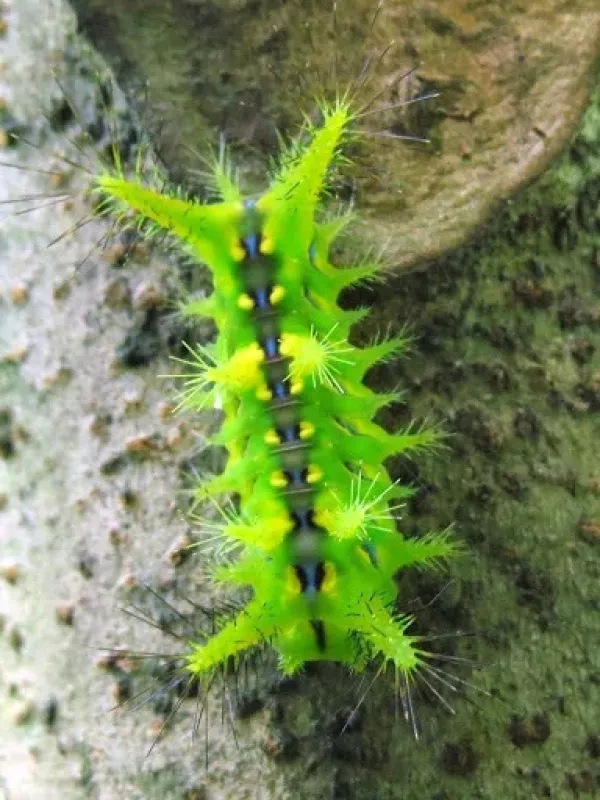
The larvae are highly distinctive, possessing a fleshy, slug-like body adorned with stinging hairs and venomous spines that cause intense pain if touched.
The life cycle involves an egg stage, a larval stage consisting of several instars, a pupal stage within a hard cocoon, and the adult moth phase.
Their coloration serves as a warning, featuring vibrant green to yellow hues with striking blue or purple dorsal lines to deter predators.
What it damages
This pest primarily attacks oil palms (Elaeis guineensis), causing severe economic losses in the palm oil industry across tropical regions.
Beyond oil palms, it targets a variety of other crops, including cocoa, coffee, coconuts, and various fruit-bearing orchard trees.
Young larvae feed gregariously on the undersides of leaves, whereas older larvae disperse and consume entire leaf blades, including the margins.
Heavy infestations can lead to massive defoliation, which severely stunts plant growth and significantly reduces the yield of fruit bunches.
In cases of extreme outbreaks, the palms remain skeletonized, becoming highly susceptible to secondary pests and various plant diseases.
Signs of infestation
Early symptoms include characteristic light-colored patches on the leaves caused by young larvae scraping the leaf surface.
Visible defoliation patterns, where leaves appear tattered or completely stripped down to the veins, are key indicators of a mature larval infestation.
Dark, granular frass accumulation at the base of the palm or on lower fronds indicates the presence of an active caterpillar population above.
The discovery of spherical, brown, leathery cocoons attached to the trunk or leaf bases is a clear sign of the pupal stage.
A general decline in the green color of the palm canopy often signals that the trees are suffering from severe stress due to loss of leaf tissue.
Control measures
Integrated Pest Management (IPM) is essential, prioritizing biological controls such as the use of nuclear polyhedrosis viruses (NPV) to target larvae.
Conserving natural enemies, including predatory bugs and parasitic wasps, significantly suppresses pest population outbreaks in sustainable plantations.
Chemical control should be applied strictly when monitoring reveals that population thresholds have been exceeded, favoring selective insecticides.
Manual collection and destruction of larval clusters on young palms can be effective in smaller fields to prevent the spread of the pest.
Regular field scouting and pheromone trap usage are crucial components of an early warning system to time interventions accurately.
Taxonomy
- Latin name
- Setora nitens
- Order
- Lepidoptera (butterflies)
- Family
- Limacodidae
- EPPO code
- SETRNI
Discussion
No discussions yet — be the first.