
Setora
Setora
Description
How to identify
Setora is a genus of moths belonging to the Limacodidae family, also known as slug moths. The most notorious species is Setora nitens, a significant pest of various tropical crops.
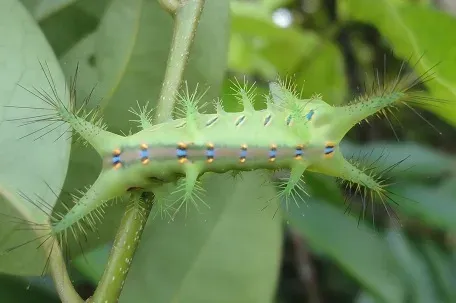
Adult moths are stout-bodied with brownish or ochre-colored wings. The larvae have a distinctive appearance: they are flattened and lack visible legs, resembling small slugs, which is the origin of the common name.
The body of the larvae is covered in tubercles and tufts of stinging hairs. These hairs contain toxins that cause severe burning and irritation upon contact with human skin.
Larval coloration varies from light green to bright lime, often featuring contrasting stripes or spots that act as a warning signal to potential predators.
Pupation occurs inside dense, hard cocoons, which are commonly attached to the underside of leaves or within the junctions of branches.
What it damages
The primary hosts of Setora include coconut palms, oil palms, and various fruit trees such as cacao, coffee, and certain citrus species.
Significant economic losses occur in coconut plantations, where severe outbreaks can lead to total defoliation of the trees.
The larvae feed primarily on the leaves, consuming the blade and leaving only the tough midribs behind, which drastically reduces the plant's photosynthetic capacity.
Heavy infestations stunt tree growth, reduce fruit yields, and in extreme cases, can cause the death of young seedlings.
Young shoots and flower buds may also be targeted, negatively impacting the overall quality and quantity of commercial production.
When it appears
Setora activity is highly dependent on the climatic conditions of the tropical regions, where high humidity and temperature favor rapid population development.
The life cycle includes multiple generations per year, allowing the population to increase exponentially during favorable weather conditions.
Females deposit eggs in clusters on the underside of leaves, which hatch after a few days into young, gregarious larvae.
The larval feeding stage typically lasts between three and six weeks before they move to pupate on the host plant.
Adult moths are nocturnal and short-lived, making them difficult to detect during the initial stages of a pest invasion.
Signs of infestation
The first signs of infestation include characteristic skeletonized patches on the foliage, where the leaf tissue has been consumed by the larvae.
The presence of larvae clustered on the undersides of leaves is a primary indicator of an active infestation.
Dark, granular droppings (frass) accumulate under the affected trees, providing further evidence of the pest's presence.
The hard, brown cocoons attached to the plant are a clear visual indicator of established pest colonies in the field.
- skeletonized leaf patches and irregular holes;
- gregarious stinging caterpillars on foliage;
- accumulation of dark frass under the tree canopy;
- presence of dense, hard brown cocoons.
Control measures
Regular plantation scouting and monitoring are essential for detecting localized outbreaks before they develop into widespread infestations.
Biological control strategies involving entomopathogenic fungi and viruses are highly effective in suppressing larval populations without disrupting the local ecosystem.
Chemical control with insecticides is reserved for severe outbreak scenarios, ensuring that application is targeted precisely at the infested areas.
Natural predators, such as parasitoid wasps and tachinid flies, play a crucial role in maintaining the balance of the pest population.
Agrotechnical practices, including sanitary pruning of infested branches and the physical removal of cocoons, help to mechanically curb the spread of the pest.
Taxonomy
- Latin name
- Setora
- Order
- Lepidoptera (butterflies)
- Family
- Limacodidae
- EPPO code
- SETRSP
Discussion
No discussions yet — be the first.