
Black-and-white shield bug
Sehirus cinctus
Description
How to identify
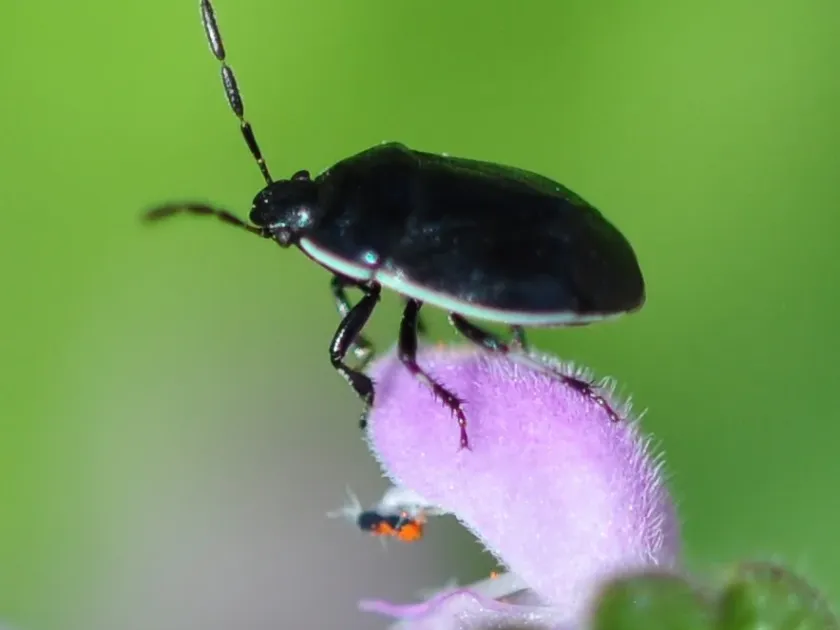
The black-and-white shield bug (Sehirus cinctus) belongs to the family Cydnidae, known as burrower bugs. Adult insects are characterized by a glossy, black, oval-shaped body with a distinct white or light-colored margin around the edges.
Adults typically reach a length of 6 to 8 millimeters. Their head is relatively broad, and the antennae consist of five segments, which serves as a key identifying morphological feature in the field.
The larvae progress through several developmental stages. In their early instars, they differ significantly in color from the adults, often displaying brownish tones and prominent abdominal segmentation.
This species is largely secretive, spending much of its time in the upper layer of soil, under plant debris, or at the very base of the host plants, which makes detection challenging.
Agronomists often use sweep nets or direct inspection of the soil surface near the plant crown during early morning or late evening hours to confirm the presence of this pest.
What it damages
The black-and-white shield bug causes damage by utilizing its piercing-sucking mouthparts to feed on plant sap. By puncturing stems and young shoots, the insect disrupts the plant's vascular system.
Feeding activities result in nutrient depletion, which significantly slows down the growth and development of the host plant, particularly affecting young, tender tissues.
Puncture sites often become entry points for secondary infections, such as bacterial or fungal diseases, which can further exacerbate the health decline of the crop.
In cases of high population density, these bugs can cause severe stunting or even the death of young seedlings that are unable to recover from extensive sap loss.
Reproductive organs, including flowers and developing fruit, are also frequently targeted, leading to deformed yields and reduced seed quality, which significantly lowers the market value of the crop.
When it appears
The pest overwinters as an adult, primarily in the soil or under layers of leaf litter, where it remains in a state of diapause until environmental conditions become favorable.
Activity usually begins in the spring when soil temperatures rise. The bugs emerge from their overwintering sites and initially feed on weeds before migrating to agricultural crops.
The life cycle is heavily influenced by regional weather patterns; warm and dry summers typically accelerate the development of generations and contribute to population spikes.
By mid-summer, populations often reach their peak, as conditions become optimal for reproduction and larval growth on both wild and cultivated plants.
As autumn approaches and temperatures drop, adults begin the process of seeking hibernation spots, moving deeper into the ground or into dense vegetation to survive the winter.
Signs of infestation
The earliest signs of infestation include the yellowing and wilting of leaves, especially in the upper parts of the plant where the insects frequently congregate to feed.
Small, pale spots on stems indicate where the bugs have pierced the plant tissues. If left unchecked, these spots may expand and eventually lead to local tissue necrosis.
A general lack of vigor and slower development compared to surrounding healthy plants often serve as a strong indicator of a localized pest colony.
Premature abscission (dropping) of flowers and fruits is a severe sign of infestation, directly impacting the final harvest volume and quality.
- Pale spotting and yellowing of foliage.
- Deformation of succulent stems.
- Reduced plant vigor and stunted growth.
- Unexpected loss of floral buds and fruit.
Control measures
Effective management begins with robust agronomic practices, such as the removal of crop residues and deep autumn plowing to disturb and destroy overwintering sites.
Consistent weed management is crucial, as weeds from the Lamiaceae family often act as secondary hosts, supporting the bug population before they move onto the main crop.
Chemical control via insecticides should be reserved for scenarios where economic damage thresholds are exceeded. Products must be selected with minimal impact on beneficial predatory insects.
Adherence to pre-harvest intervals is essential to ensure food safety and prevent the accumulation of chemical residues in the final agricultural product.
Regular field scouting using pheromone traps or systematic inspection helps in early detection, allowing for localized treatments that reduce the need for widespread pesticide application.
Taxonomy
- Latin name
- Sehirus cinctus
- Order
- Hemiptera (bugs, aphids, leafhoppers)
- Family
- Cydnidae
- EPPO code
- SEHICI
Discussion
No discussions yet — be the first.