
Hawthorn moth
Scythropia crataegella
Description
How to identify
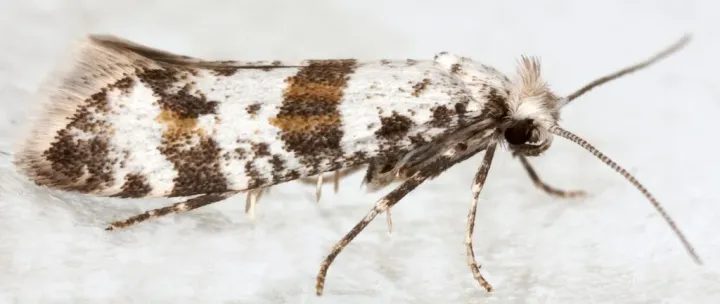
The hawthorn moth (Scythropia crataegella) belongs to the Yponomeutidae family. The adult moth has a wingspan of approximately 15–18 mm, featuring white forewings marked with distinct brown or dark spots, giving it a subtle appearance when resting on bark.
The larvae are approximately 10–12 mm long when fully grown. They possess a yellowish-green body covered in small dark spots and bristles, which helps them maneuver effectively across the host plant's foliage during their feeding phase.
The life cycle consists of the egg, larval, pupal, and adult stages. This species typically produces one generation per year, making it essential to monitor for the presence of larvae during the late spring months to prevent significant infestation.
The species overwinters as second-instar larvae within tough, silken webs or cocoons located in crevices of the bark or twig forks. As spring temperatures rise, these larvae emerge to feed on the developing buds of the host trees.
Pupation occurs in late spring or early summer. The larvae spin loose, white, spindle-shaped cocoons in groups within the foliage or near the site of their final feeding, where they undergo metamorphosis before emerging as adults.
What it damages
This moth primarily targets members of the Rosaceae family, including hawthorn, apple, pear, plum, and bird cherry. It can cause localized but severe defoliation in orchards and nurseries if left unchecked.
Larvae feed on leaves, often starting by skeletonizing the leaf blade, which results in the destruction of the photosynthetic tissue. This severely weakens the tree, leading to reduced vigor and stunted growth in affected branches.
During the spring, the emerging larvae bore into expanding buds, consuming the developing leaves and flower structures. This direct damage significantly reduces the potential fruit yield of the tree for the current season.
Massive infestations result in large, interconnected webbing nests that cover entire clusters of shoots. These nests protect the colony but cause visible, aesthetic, and structural damage to the branch architecture of the host plant.
Extensive leaf loss reduces the tree's ability to store energy for the following year. Weakened trees become increasingly susceptible to secondary pests, wood-boring insects, and various bark diseases that capitalize on the host's low vitality.
Signs of infestation
Early warning signs include the presence of small, gray overwintering cocoons on the branches. In early spring, look for damaged buds that fail to open or show signs of larval excrement upon close inspection.
The formation of webbed nests is the most obvious sign during the feeding stage. These nests are often found on the terminals of branches and contain multiple larvae that are actively feeding on the enclosed leaves.
Skeletonized leaves that appear as translucent webs indicate initial larval damage. Over time, these leaves turn brown, become brittle, and drop prematurely, leading to sparse or patchy foliage throughout the tree's canopy.
Clusters of white pupal cocoons on the leaves or bark surfaces signal the end of the larval stage. Finding these indicates that the damage for the season is mostly complete, yet they represent the source of next year’s population.
General poor performance of the tree, characterized by a lack of new terminal growth and thin foliage coverage, is a reliable indicator that the tree has been heavily infested by the hawthorn moth during the growing season.
Control measures
Mechanical control involves the removal and destruction of the webbed nests in early spring. This is a highly effective method for small orchards or gardens, as it removes the larvae before they can disperse and damage more foliage.
Biological control using formulations based on Bacillus thuringiensis can be effective against young larvae. It is crucial to apply these treatments during the larval emergence phase to ensure high mortality before damage spreads.
Chemical control measures typically involve the application of systemic insecticides at the first signs of bud burst. Proper timing is key, as the larvae are most vulnerable before they establish their protective webbing.
Cultural practices, such as winter pruning to remove dead or infested wood, play a significant role in reducing the population density. Maintaining good overall tree health also helps plants withstand minor infestations.
Encouraging natural predators, such as parasitic wasps, is essential for sustainable management. Avoiding broad-spectrum pesticides during the peak activity of beneficial insects helps maintain the ecological balance in the orchard.
Taxonomy
- Latin name
- Scythropia crataegella
- Order
- Lepidoptera (butterflies)
- Family
- Yponomeutidae
- EPPO code
- SCYOCR
Discussion
No discussions yet — be the first.