
Scutellera perplexa
Scutellera perplexa
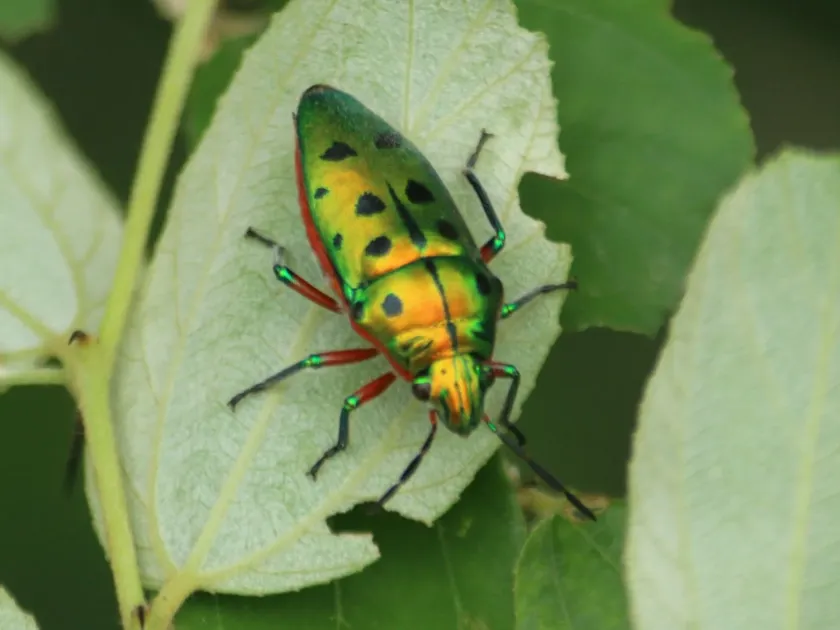
Description
How to identify
Scutellera perplexa belongs to the Scutelleridae family, commonly known as shield-backed bugs. These insects are distinguished by a large, hardened scutellum that covers the entire abdomen and folded wings, providing them with a distinct, armored appearance.
Adult specimens typically measure between 8 and 12 millimeters in length and feature a robust, oval body shape. Their coloration often includes metallic or mottled patterns that serve as camouflage within their natural vegetation habitats.
The head of the pest is relatively small and equipped with a specialized piercing-sucking proboscis. This mouthpart is perfectly evolved for penetrating plant tissues to extract sap and nutrients efficiently.
The life cycle encompasses several stages: egg, nymph, and adult. Nymphs pass through multiple instars, looking like smaller, wingless versions of the adults, gradually developing until they reach sexual maturity.
These insects prefer environments with stable temperatures and sufficient vegetation cover, where they can reproduce effectively during the growing season while seeking sheltered spots to overwinter.
What it damages
Scutellera perplexa is recognized as a polyphagous pest, meaning it feeds on a variety of hosts including cereal crops, grasses, and occasionally broad-leaved plants, causing significant physiological stress to the hosts.
The most severe damage occurs when these bugs pierce the developing kernels of cereal crops. This feeding activity removes essential fluids, leading to reduced grain weight, shriveled kernels, and a significant drop in crop quality.
The feeding process often causes leaves to develop yellowish or whitish necrotic spots, which can spread and cause premature wilting of the affected plant tissues, hindering overall development.
Secondary infections are a major concern, as the wounds created by the bug's proboscis serve as entry points for various pathogenic fungi and bacteria, further weakening the plant's structural integrity.
In cases of high infestation, the cumulative loss in yield can be substantial, making it a critical pest to monitor in areas where intensive agriculture is practiced.
When it appears
The activity cycle of Scutellera perplexa begins in early spring, as rising temperatures signal the end of the diapause period for overwintered adults, prompting them to move to host plants.
The summer months constitute the peak period for reproduction and active feeding, during which both nymphs and adults are found in large numbers across agricultural fields and nearby weeds.
As autumn approaches and temperatures drop, the bugs begin searching for overwintering sites, such as the base of trees, hedge rows, or under thick layers of leaf litter and organic residue.
Effective monitoring should be continuous throughout the growing season, with an emphasis on the stages of crop development that are most susceptible to damage, such as flowering and grain filling.
The number of generations per year is largely determined by local climatic conditions, with warmer regions often supporting multiple life cycles within a single growing season.
Signs of infestation
Visual identification of an infestation starts with observing discolored, necrotic spots on leaves and stems. As the feeding continues, these spots may coalesce, causing the leaf to dry out and curl.
A common indicator of a large population is the characteristic pungent, unpleasant odor released by the bugs when disturbed, which often precedes the discovery of the insects themselves.
Deformation of the grain spikes and the presence of abnormally underdeveloped kernels are clear signs that the pest has been feeding during the critical reproductive stage of the plant.
- Chlorotic or pale spots on the leaf surface.
- Stunting of the main stems and terminal growth.
- Presence of empty or thin, shriveled grains in the head.
- Visible clusters of nymphs on the undersides of leaves.
Field scouting using an entomological net in the early morning is the most reliable method for detecting the presence and estimating the density of the pest population before visible damage occurs.
Control measures
Cultural control measures, such as the systematic removal of weeds and debris in and around fields, are essential for eliminating potential breeding and overwintering grounds.
Implementing a proper crop rotation strategy helps to break the life cycle of the pest, making it harder for localized populations to establish themselves permanently on the same land.
Biological control options, including the preservation of natural predators and parasitoids, provide a sustainable way to manage population spikes without relying solely on chemical inputs.
Chemical intervention should be considered only when economic thresholds are exceeded. Systemic insecticides are generally effective, provided they are applied during the stage when young nymphs are most vulnerable.
Precision in timing is vital; ensuring that the application coincides with the peak emergence of early-instar nymphs maximizes the impact of the treatment while minimizing the potential for crop damage.
Taxonomy
- Latin name
- Scutellera perplexa
- Order
- Hemiptera (bugs, aphids, leafhoppers)
- Family
- Scutelleridae
- EPPO code
- SCURPE
Discussion
No discussions yet — be the first.