
Rice black bug
Scotinophara scutellata
Description
How to identify
Scotinophara scutellata, commonly referred to as the rice black bug, belongs to the order Hemiptera and the family Pentatomidae.
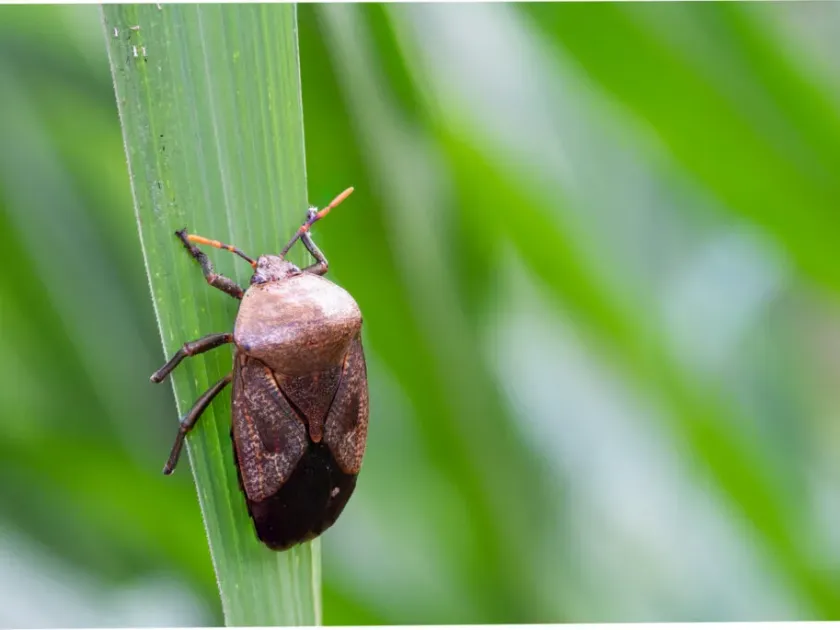
Adult insects are characterized by a dark brown or black body, typically measuring between 8 and 10 mm in length.
The body is flattened and oval-shaped, an evolutionary adaptation that facilitates movement within the tight leaf sheaths of host plants.
The scutellum is well-developed and covers most of the abdomen, while the head possesses distinct serrated edges.
The nymphs go through five developmental stages, appearing lighter in color and lacking the functional wings of adult specimens.
What it damages
Rice (Oryza sativa) is the primary host for this pest, although it can occasionally feed on other cereal crops under high population pressure.
The insect utilizes its piercing-sucking mouthparts to penetrate the plant tissues, extracting essential sap from stems and leaves.
Young seedlings are particularly vulnerable, with infestations often leading to stunted growth or total mortality of the plant.
During the reproductive phase, bugs feed on the developing panicles, which results in the formation of empty or "chaffy" grains.
Severe infestations can lead to a condition known as "bug burn," where entire fields turn brown and wither due to extreme sap loss.
When it appears
The pest reaches its peak activity during the warmer, humid months, which are optimal for rapid reproduction and population growth.
Adult bugs overwinter in a state of diapause, residing in soil cracks, weeds, or underneath organic debris in and around the rice fields.
As temperatures rise in the spring, the overwintered adults migrate to the rice fields to begin feeding and laying eggs.
The duration of the lifecycle is highly dependent on ambient temperature, with high-temperature regimes accelerating development cycles.
Migration back to overwintering sites typically occurs as the crop reaches maturity or when environmental conditions become unfavorable.
Signs of infestation
Initial signs include the appearance of yellow or brown spots on the leaves, which eventually turn into necrotic stripes.
A distinctive odor, typical of pentatomid bugs, is often detected in fields where the population density is high.
Clusters of bugs can be found at the base of the rice stalks during daylight hours, as they tend to avoid direct sunlight.
Panicles that appear empty and discolored upon close inspection indicate that the bugs have successfully fed on the developing grain.
Withered leaves and a general decline in the vitality of the crop are clear indicators that immediate intervention is required.
Control measures
Water management is a key cultural control; draining and reflooding fields can disrupt the bug's habitat and force them into the open.
Field sanitation is critical, as removing weeds from borders reduces the availability of secondary host plants during the off-season.
Chemical control involving systemic insecticides is recommended when pest populations exceed economic thresholds for crop injury.
Optimizing nitrogen fertilization rates helps prevent excessive succulent growth, which is known to be highly attractive to the black bug.
The use of light traps is an effective monitoring tool to track adult flight patterns and determine the optimal timing for pesticide applications.
Taxonomy
- Latin name
- Scotinophara scutellata
- Order
- Hemiptera (bugs, aphids, leafhoppers)
- Family
- Pentatomidae
- EPPO code
- SCOTSU
Discussion
No discussions yet — be the first.