
Black rice bug
Scotinophara coarctata
Description
How to identify
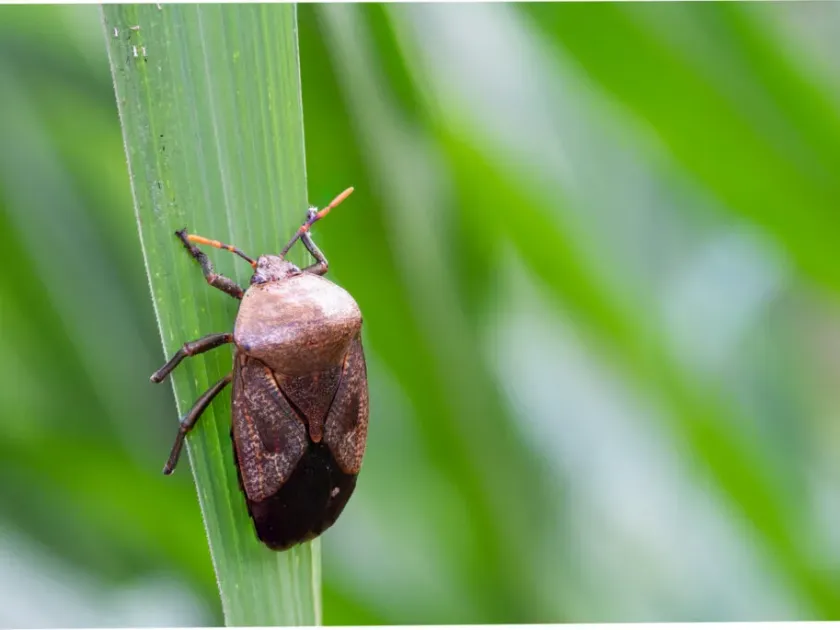
The Black rice bug is a member of the Pentatomidae family, known for its distinct dark coloration and shield-shaped body, typically measuring 8–10 mm in length.
These insects possess a specialized piercing-sucking mouthpart, which allows them to penetrate the tough stems of rice plants to reach the nutrient-rich sap.
Eggs are laid in clusters on the undersides of leaves, usually arranged in neat, geometric patterns, which serves as a key indicator during field scouting.
Nymphs undergo five developmental instars, gradually transitioning from a lighter brown or orange hue to the dark, adult-like appearance of the mature bug.
Adults are strong fliers and are highly attracted to light sources at night, a behavior frequently exploited by farmers to monitor the onset of pest outbreaks.
What it damages
The primary host for this pest is rice, although it may occasionally infest other grasses and cereals if suitable conditions and proximity allow for it.
The bugs feed by inserting their stylets into the plant stems, causing localized injury that disrupts the flow of water and nutrients to the upper plant parts.
The most severe damage occurs during the vegetative and reproductive stages of the rice plant, leading to stunted growth and reduced vigor of the tillers.
Feeding damage often results in the characteristic condition known as "bug burn," where leaves turn brown and wither, mimicking the effect of severe drought.
As a result of significant sap loss and secondary infections at the feeding sites, rice yields are severely compromised, leading to empty or deformed grains.
When it appears
The life cycle and activity of the Black rice bug are heavily influenced by environmental humidity and the presence of standing water in rice fields.
Under optimal conditions, the insect can complete its generation cycle within approximately 30 to 40 days, allowing for multiple overlapping generations per season.
Colonization of rice fields typically begins during the early tillering phase, as insects migrate from overwintering sites toward the succulent new growth.
Population peaks are usually observed during the heading and flowering stages, when the plant is most vulnerable and sap is abundant for the insects to consume.
At the end of the cropping season, bugs migrate to drier areas, such as surrounding grasses or soil crevices, to enter a period of dormancy during winter.
Signs of infestation
Initial signs include the appearance of small, yellowish-brown lesions or spots on stems and leaves, which are direct consequences of the bug's feeding stylets.
Plants may show signs of yellowing and premature drying at the tips, often resulting in a patchy distribution across the field where infestation is heaviest.
The presence of stunting in young plants, coupled with empty panicles at harvest, is a strong indicator of an unchecked infestation of the Black rice bug.
During a field inspection, one can often find clusters of eggs or nymphs concealed within the leaf sheaths, particularly near the base of the plant stem.
The nocturnal stridulation or buzzing sound produced by large aggregations of adults is often a notable sign that the pest population has reached high density.
Control measures
Cultural control is a cornerstone of management, involving the destruction of weed hosts and the periodic draining of fields to disrupt the insect's life cycle.
Biological control, utilizing natural enemies like egg parasitoids, plays a crucial role in maintaining populations below the economic injury level.
Chemical control should be implemented based on scouting data, focusing on applying contact or systemic insecticides during the peak of nymphal emergence.
Light trapping provides a sustainable method for tracking pest migration patterns and timing management efforts for maximum effectiveness in the field.
Integrated Pest Management programs emphasize the importance of synchronized planting and proper water management to limit the overall buildup of bug populations.
Taxonomy
- Latin name
- Scotinophara coarctata
- Order
- Hemiptera (bugs, aphids, leafhoppers)
- Family
- Pentatomidae
- EPPO code
- SCOTCO
Discussion
No discussions yet — be the first.