
Rice bug
Scotinophara cinerea
Description
How to identify
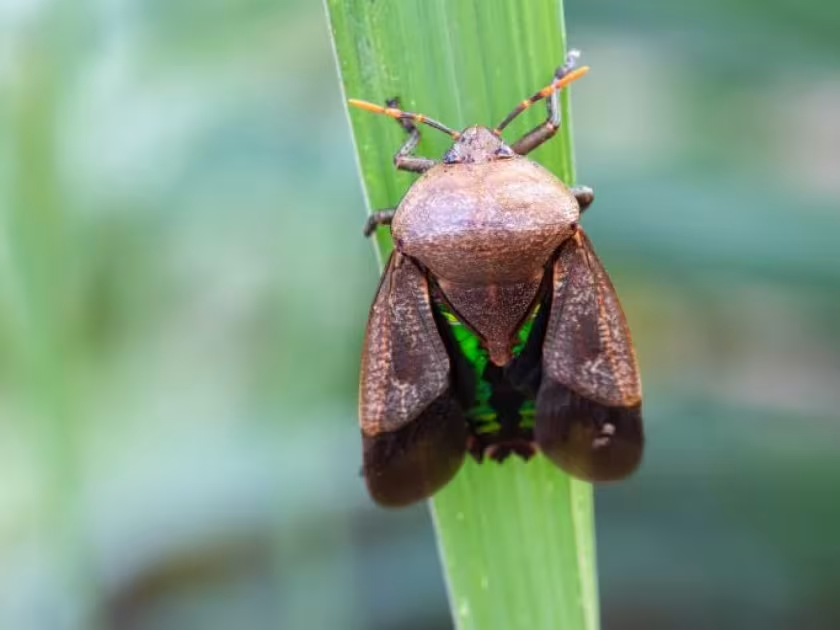
The rice bug (Scotinophara cinerea) belongs to the Pentatomidae family, order Hemiptera. Adult specimens are characterized by an oval, slightly flattened body ranging from 7 to 9 mm in length.
The coloration of the insect typically varies from dark brown to almost black, providing camouflage against the stems of rice plants. The head has a specific shape with protruding edges, and the scutellum covers a significant part of the abdomen.
Nymphs resemble the adults in appearance but are smaller in size and lack fully developed wings. Their coloration is usually lighter, often exhibiting reddish or yellowish tints during the early stages of their development.
This insect is primarily nocturnal or crepuscular, hiding at the base of rice clumps or in the surface soil layer during the day. This secretive behavior makes the identification of initial infestation sites challenging for agronomists.
Adults overwinter in a state of diapause in sheltered areas, such as under plant debris, in soil cracks, or in dry grass along irrigation canals. When temperatures rise, they migrate to young rice crops.
What it damages
The primary host for this species is rice (Oryza sativa). In the absence of the main crop, these bugs can feed on various grassy weeds growing near rice paddies and irrigation systems.
The pest possesses piercing-sucking mouthparts, which it uses to puncture the stems and leaves of the plant. As a result of sap extraction, the physiological development of the crop is severely disrupted.
The pest poses a particular threat during the booting stage and the formation of the panicle. Damage to the reproductive organs results in underdeveloped spikelets and a significant reduction in overall yield.
During mass outbreaks, the rice bug causes a condition known as "dead heart," where the central leaf withers and dies. This critically reduces the productivity of the rice paddy.
Grain quality also suffers; fungal infections often develop at the puncture sites, and the grain itself becomes shriveled, losing market value and germination capacity, leading to substantial economic losses.
When it appears
The activity of the rice bug is directly dependent on temperature regimes and moisture levels. Mass emergence from overwintering sites usually coincides with the tillering phase of rice when a dense canopy is formed.
The life cycle involves egg-laying on the underside of rice leaves. A single female can lay several dozen eggs, typically arranged in characteristic clusters.
Depending on climatic conditions, the development of one generation takes from 30 to 45 days. In tropical and subtropical climates, several generations can develop throughout a single season.
The peak population of the pest is often observed during the wet season, as high humidity promotes the survival of nymphs. Regular field monitoring is essential during this period.
Toward the end of the season, as the rice matures, adults gradually abandon the fields and move to overwintering sites, completing their annual developmental cycle.
Signs of infestation
The first visual sign of infestation is the appearance of white or yellowish spots on rice leaves at the puncture sites. Over time, these areas become necrotic and turn a brownish color.
A characteristic sign of damage is "whiteheads"—the emergence of empty, bleached panicles that fail to form full grains. This is a direct consequence of stem damage during the floral development stage.
Plants show general stunting, reduced tillering, and an overall sickly yellowish appearance. The field may appear patchy or uneven during the infestation phase.
Upon careful inspection of the plant base, clusters of insects can be found, especially during the early morning or late evening. Exuviae (molted skins) are also often visible on the stems.
Adults may exhibit activity at night and respond to light sources, a behavior sometimes utilized by using light traps to estimate population density within the plot.
Control measures
Agronomic practices include maintaining appropriate water levels in the paddies to prevent bugs from hiding at the base of the stems. Timely weeding also helps reduce alternative host plants.
Crop rotation and the destruction of post-harvest crop residues are crucial, as these serve as the primary overwintering sites for adults. Autumn plowing helps to significantly reduce the overwintering population.
Biological control measures, such as the use of natural entomophagous predators (parasitic wasps), can help maintain the bug population below economic threshold levels.
Chemical control is implemented only when the economic injury level is reached. Systemic insecticides are generally used to effectively target the insects upon application to the crop foliage.
- Monitoring using light traps
- Early diagnostic scouting for leaf punctures
- Limiting broad-spectrum insecticide use to conserve natural enemies
- Water level management in paddies as a regulatory factor
Taxonomy
- Latin name
- Scotinophara cinerea
- Order
- Hemiptera (bugs, aphids, leafhoppers)
- Family
- Pentatomidae
- EPPO code
- SCOTCI
Discussion
No discussions yet — be the first.