
Mediterranean centipede
Scolopendra cingulata
Description
How to identify
The Mediterranean centipede (Scolopendra cingulata) is a predatory myriapod belonging to the Scolopendridae family, found in warm, temperate regions.
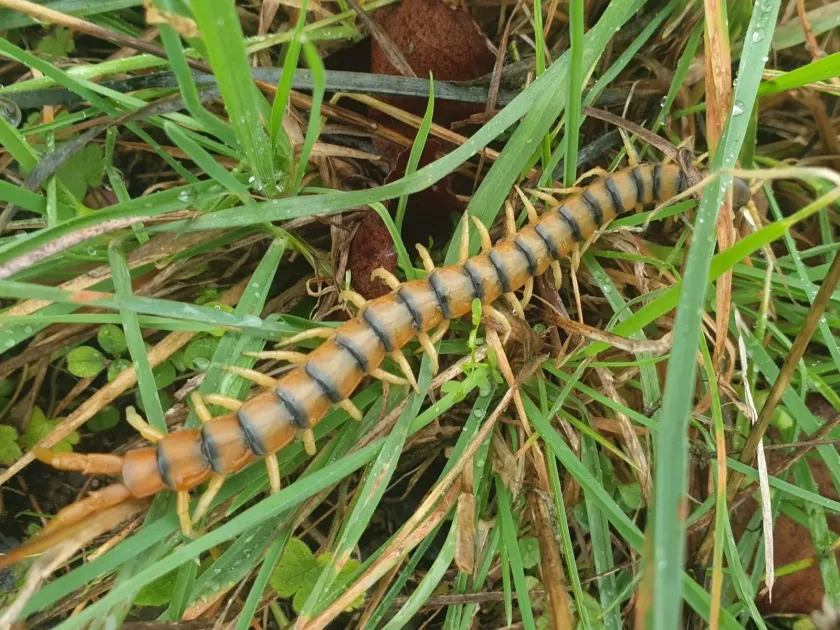
The body is typically yellowish-brown with distinct dark transverse bands on each segment, which serves as its identifying morphological characteristic.
It possesses powerful forcipules (modified legs) connected to venom glands, used primarily for subduing prey such as small insects and worms.
This species is strictly nocturnal, spending the daylight hours in cool, dark, and humid refuges like rock crevices, under logs, or deep in the soil.
They are extremely fast-moving organisms capable of navigating complex soil structures to locate food or moisture sources.
What it damages
Although primarily insectivorous, these centipedes can cause incidental damage to garden plants when their nesting or hunting activity overlaps with root zones.
Damage often occurs when they tunnel through loose soil, disrupting the root systems of seedlings or damaging succulent stems resting on the ground.
Greenhouses are particularly vulnerable as the consistent irrigation and moist environment provide ideal conditions for their establishment.
Injured roots are prone to secondary soil-borne pathogens, leading to fungal infections and rot that can quickly decimate young transplants.
Plants affected by centipede activity show sudden wilting, stunted growth, and in severe cases, complete tissue necrosis at the base.
When it appears
Activity begins in early spring as ground temperatures rise, triggering the metabolic processes of these cold-blooded arthropods.
The summer months represent the peak of their lifecycle, characterized by active hunting, mating, and the protection of young offspring.
As temperatures drop in the autumn, they seek out sheltered microhabitats, often migrating into greenhouses or storage sheds to overwinter.
Their reproduction depends heavily on moisture levels, as females carefully tend to egg clutches in humid soil chambers.
The developmental period is lengthy, requiring sustained favorable environmental conditions throughout the growing season to ensure population growth.
Signs of infestation
Look for winding, irregular burrow patterns in the soil surface, especially near the base of high-moisture-need plants or under mulch layers.
Unexpected wilting of seedlings, despite adequate soil moisture, is a primary indicator of root disturbance by underground pests.
Discovering individual centipedes during weeding, tilling, or moving garden equipment confirms their presence in the immediate vicinity.
Small, chewed lesions on the lower stem or roots are characteristic signs of feeding or mechanical damage caused by these predators.
Evidence of dark, narrow cavities under stones, boards, or debris near the garden beds points to established nesting sites.
Control measures
Sanitation is the most effective management strategy: remove all clutter, wood piles, and loose stones that provide daytime harborages.
Improve drainage systems in greenhouses to prevent the development of excessively moist microclimates that attract centipedes.
Regular soil cultivation helps break up nesting tunnels and destroys the subterranean chambers where centipedes reproduce.
Utilize physical traps such as moistened boards or burlap sacks placed overnight to gather and dispose of individuals the next morning.
- Maintain clear perimeters around planting beds.
- Remove excess organic matter and mulch near stems.
- Apply soil-based insecticides only in cases of severe infestation.
Taxonomy
- Latin name
- Scolopendra cingulata
- Family
- Scolopendridae
- EPPO code
- SCOECI
Discussion
No discussions yet — be the first.