
Centipede
Scolopendra
Description
How to identify
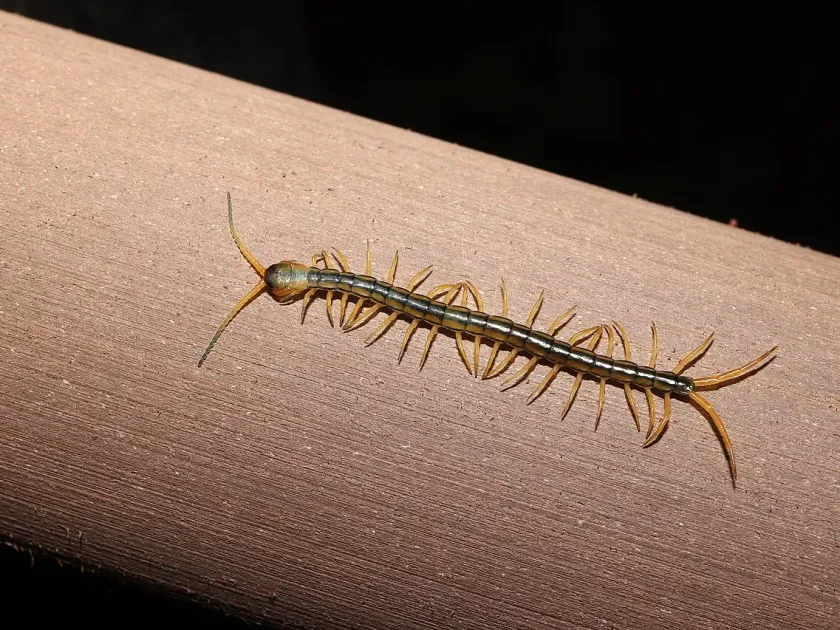
The centipede (Scolopendra) belongs to the class Chilopoda, family Scolopendridae, and is a large predatory arthropod known for its elongated and segmented body.
Each segment of its body bears a pair of legs, which allows these organisms to move with remarkable speed across different substrates in the garden.
Their bodies are protected by a hard, chitinous exoskeleton, typically ranging in color from reddish-brown to olive-green, providing camouflage in their environment.
A distinctive feature of the centipede is its pair of modified front legs, called forcipules, which are equipped with venom glands used to paralyze prey.
These pests are primarily nocturnal, preferring dark, moist, and protected habitats such as under rocks, organic mulch, or deep within the soil structure.
What it damages
While centipedes are mainly carnivores feeding on insects and small invertebrates, they may cause accidental damage to plants when searching for food.
In greenhouses or during periods of prey scarcity, they may gnaw on the delicate roots or the lower stems of seedlings, leading to structural damage.
This feeding activity often creates open wounds on the plant tissue, which can serve as entry points for secondary fungal or bacterial infections.
The disturbance of the root zone by burrowing activities can disrupt the plant's ability to uptake water and nutrients, resulting in stunted growth.
Young, tender plants such as leafy greens or nursery transplants are particularly vulnerable to such damage during the initial establishment phase.
When it appears
Centipede activity is closely linked to soil moisture levels and warm temperatures, with peak activity occurring during the spring and summer months.
During heavy rains, soil saturation often forces them to move to the surface or enter structures, increasing the frequency of sightings in gardens.
In controlled environment agriculture like greenhouses, they can remain active throughout the entire growing season due to the stable microclimate.
As nocturnal animals, their most destructive behavior occurs at night, making it difficult to detect them during standard daytime garden inspections.
The cold autumn and winter months trigger a dormant phase where they retreat deep into the soil or under debris to survive the low temperatures.
Signs of infestation
Identifying centipede presence often involves finding their physical remains or observing characteristic damage to the lower stems of vulnerable seedlings.
Uneven wilting of plants despite adequate irrigation can be a sign that roots are being damaged or disturbed by centipede burrowing underground.
The discovery of adult centipedes underneath mulch, wooden boards, or plastic greenhouse covers is a clear indicator of a established population.
Small, irregular gnaw marks on the roots or root collar area often serve as physical evidence of their feeding attempts on plant tissues.
- Gnaw marks at the base of young stems.
- Unexplained plant wilting or sudden death.
- Observation of rapid-moving creatures under debris.
- Tunneling marks in loose, damp greenhouse soil.
Control measures
Effective management begins with sanitation: clearing away excess mulch, garden debris, and wood piles that provide optimal hiding spots for centipedes.
Modifying the irrigation regime to prevent constant moisture in the top layer of soil can make the area less attractive for these moisture-loving pests.
Deep cultivation or tilling of the soil during the pre-planting phase can disrupt their habitats and expose them to natural predators and weather extremes.
Implementing physical barriers or traps, such as moistened cardboard or burlap left overnight, allows for the manual collection and removal of individuals.
Chemical control is rarely the primary solution, but localized use of contact-based insecticides can be considered if populations reach damaging levels.
Taxonomy
- Latin name
- Scolopendra
- Family
- Scolopendridae
- EPPO code
- SCOESP
Discussion
No discussions yet — be the first.