
Central American locust
Schistocerca piceifrons
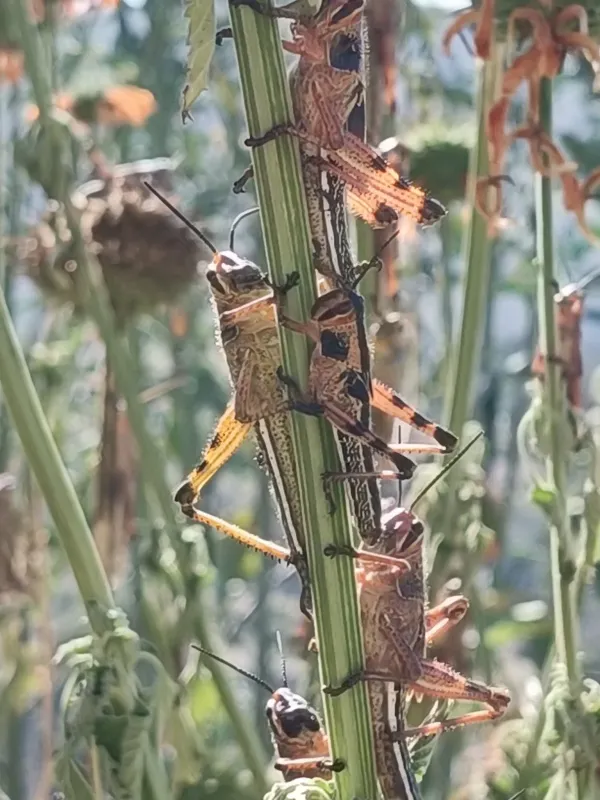
Description
How to identify
The Central American locust (Schistocerca piceifrons) belongs to the order Orthoptera and the family Acrididae. It is a highly destructive pest known for its phase-changing behavior.
Individuals exhibit phenotypic plasticity, appearing as solitary insects under low population densities or as gregarious individuals that form large, migrating swarms.
In their gregarious phase, these locusts are characterized by bold color patterns and strong, long-distance flight capabilities, which facilitate rapid colonization of new areas.
The insect possesses a robust chewing mouthpart, designed for consuming large quantities of plant tissue, and strong hind legs for jumping.
Distinguishing S. piceifrons from other related species is vital, primarily involving the observation of pronotal morphology and specific anatomical markers.
What it damages
This species is a major threat to agricultural stability in Central America, capable of destroying vast tracts of cropland in a very short period.
Preferred hosts include cereal crops such as maize, sorghum, and rice, which are essential for food security, as well as banana plantations and pasture grasses.
Both nymphs and adults feed voraciously; while nymphs (hoppers) target tender leaves and stems, adults can consume bark and tough stalks of mature plants.
Total defoliation is the most common sign of infestation, often leaving behind only the vascular structure of the plant, which leads to total crop failure.
The economic impact involves not only the loss of raw produce but also significant investments in large-scale aerial and ground-based insecticide applications.
When it appears
The development and activity of Schistocerca piceifrons are heavily influenced by meteorological conditions, particularly the onset of the rainy season.
Soil moisture plays a critical role in the reproduction cycle, as females require damp, friable soil to deposit their egg pods safely.
The hatching of nymphs is synchronized with the growth of natural vegetation and agricultural crops, providing immediate food sources for the developing insects.
Swarming activity typically peaks during periods when food resources become scarce in breeding areas, triggering migratory flights in search of greener pastures.
Depending on local environmental conditions, multiple generations may occur within a single year, necessitating persistent surveillance and management.
Signs of infestation
The primary indication of a locust outbreak is the presence of large "hopper bands," where thousands of nymphs move in unison to consume vegetation.
Adult swarms are highly visible, often darkening the sky and creating a distinct buzzing sound, followed by the sight of decimated fields upon landing.
Signs of feeding include ragged leaf edges, stripped stalks, and significant amounts of locust frass accumulating at the base of the damaged crops.
Early warning systems utilize pheromone-based traps and satellite imagery to monitor the habitat and detect population spikes before swarms migrate.
- Presence of dense bands of nymphs on the ground.
- Sudden and rapid disappearance of foliage in fields.
- Visible swarms landing on or near crops.
Control measures
Effective control of the Central American locust relies on an integrated pest management (IPM) approach that focuses on early detection at breeding sites.
Chemical control using authorized insecticides is standard practice to suppress population surges and prevent the formation of massive swarms.
Mechanical control techniques, such as deep plowing of breeding grounds, can destroy egg pods in the soil, effectively reducing the next generation's numbers.
Biological control agents, particularly entomopathogenic fungi like Metarhizium acridum, offer a more sustainable and selective method of suppressing populations.
Regional cooperation between countries and agricultural agencies is essential for the monitoring and timely management of locust movements across borders.
Taxonomy
- Latin name
- Schistocerca piceifrons
- Order
- Orthoptera (locusts)
- Family
- Acrididae
- EPPO code
- SHICUR
Discussion
No discussions yet — be the first.