
Schistocerca nitens
Schistocerca nitens
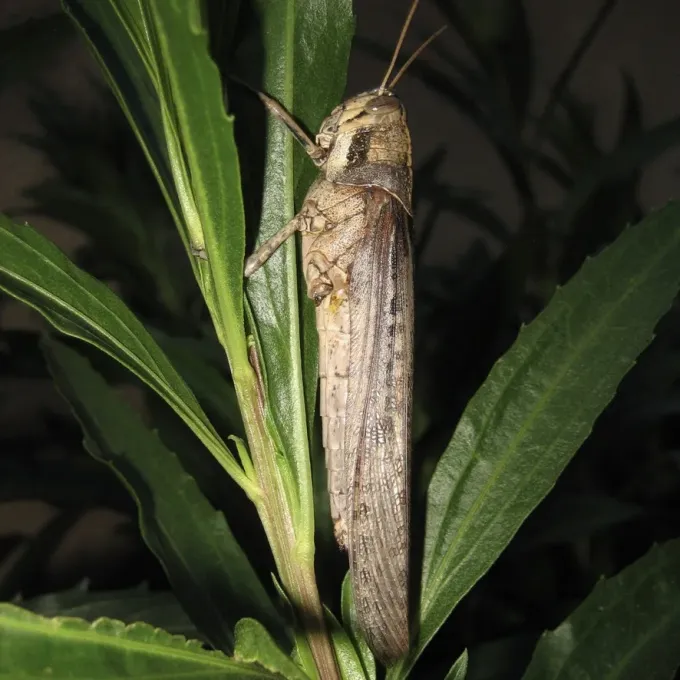
Description
How to identify
Schistocerca nitens belongs to the order Orthoptera and the family Acrididae (grasshoppers). It is a large insect, visually resembling the American desert locust, and possesses powerful chewing mouthparts adapted for consuming tough plant tissues.
Adults typically exhibit coloration ranging from light brown to olive, providing excellent camouflage against dry vegetation. Their body size is substantial, which is a common characteristic for species within this genus.
The biology of this species is closely tied to warm climates where these insects can reproduce rapidly. The life cycle consists of the egg, nymph (larva), and adult stages, with nymphs passing through several instars while gradually increasing in size.
Unlike some other grasshopper species, Schistocerca nitens can exhibit both solitary and gregarious behaviors. Their capacity for long-distance flight in search of food sources makes this species a significant threat to agricultural ecosystems.
Development is heavily dependent on temperature and soil moisture levels, which are critical for successful egg-laying by females. Optimal environmental conditions lead to massive outbreaks that cause severe damage to commercial crops.
What it damages
This pest is a polyphage and affects a wide range of agricultural crops. Major groups at risk include cereals, legumes, and various vegetable crops grown in regions where this species is prevalent.
Invasions on citrus plantations and vineyards are particularly dangerous, as the insects consume leaves, young shoots, and even plant bark. This leads to a drastic reduction in photosynthetic capacity and overall weakening of the trees.
During mass outbreaks, locust swarms can completely destroy fodder grass fields, causing significant losses for livestock farming. Damage to vegetative mass during active growth stages leads to severe yield losses and degradation of product quality.
The pest does not spare ornamental plants in gardens and parks, extending its economic impact. High population density allows the insects to strip most of the green foliage from plants in a very short period.
When food is scarce, Schistocerca nitens will feed on weeds, but it always shows a strong preference for lush cultivated plants. Crop losses can reach 100 percent on affected fields if no control measures are implemented.
Signs of infestation
The first sign of an infestation is the appearance of large groups of insects in fields, which are easily noticeable during visual inspections. Damaged plants are characterized by large jagged holes in the leaves and chewed-off edges of leaf blades.
In cases of severe damage, skeletonization of leaves is observed, where only the hard veins remain. Another typical indicator is the presence of insect excrement, which accumulates around the base of the affected plants.
During the day, walking through the field often triggers a characteristic noise and the sudden flight of insect swarms. Damage to shoots is frequently accompanied by deformation or complete death of the terminal parts due to disrupted nutrient transport.
The agitation of local bird populations, which actively hunt for large swarms, serves as an indirect sign of an infestation. It is also recommended to inspect the soil for shallow depressions, which are left behind by females after laying egg pods.
The rapid disappearance of vegetation on the borders of a field is a strong signal that a swarm is approaching. Detecting nymphs early in the vegetation allows for intervention before they mature into adults capable of long-distance migration.
Control measures
The primary control method involves the use of contact-stomach insecticides that are effective against orthopterans. Treatments should be applied during periods of peak vulnerability, typically targeting the early nymph stages.
Agrotechnical methods include deep plowing of the soil in areas where mass egg-laying has been observed, which effectively kills the eggs. It is also essential to maintain good agricultural practices, such as timely weeding, to eliminate habitats that serve as reservoirs for the pest.
Biological control focuses on utilizing natural enemies of the locust, such as entomopathogenic fungi or parasitic insects. In some regions, the encouragement of birds to hunt in agricultural fields is used to suppress population growth.
Monitoring population numbers using pheromone traps or regular field surveys helps identify hotspots at an early stage. Coordinating monitoring efforts with neighboring farms is crucial to prevent the migration of swarms.
Insecticide application requires strict adherence to regulations and dosage guidelines to minimize impact on non-target beneficial insects and pollinators. An integrated approach combining regular monitoring and targeted chemical intervention remains the most effective protection strategy.
Taxonomy
- Latin name
- Schistocerca nitens
- Order
- Orthoptera (locusts)
- Family
- Acrididae
- EPPO code
- SHICNN
Discussion
No discussions yet — be the first.