
Desert locust
Schistocerca gregaria
Description
How to identify
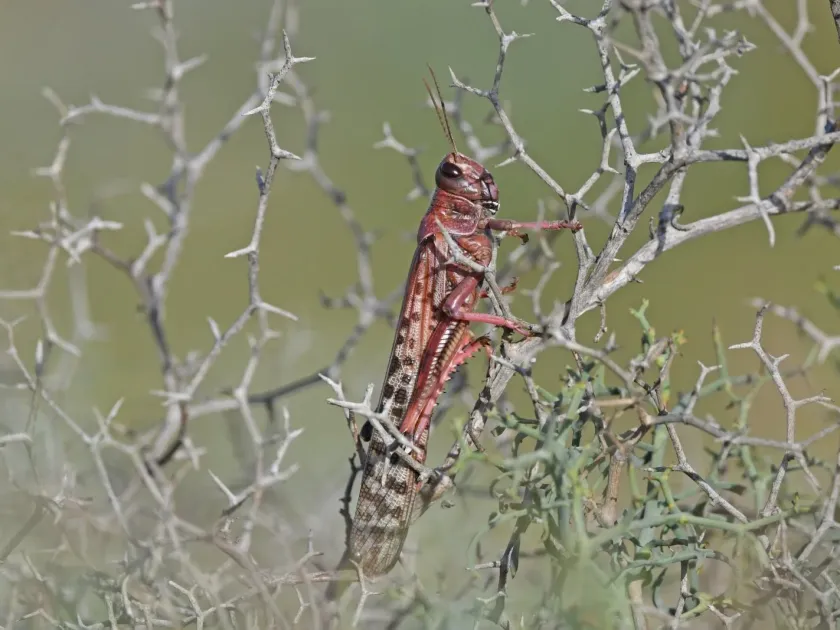
The desert locust (Schistocerca gregaria) belongs to the order Orthoptera, family Acrididae. Adult specimens measure between 40 and 80 mm and range in color from pale yellow to pinkish.
The appearance changes significantly depending on the phase. In the gregarious phase, adults develop strong wings and vibrant colors, enabling them to migrate over vast distances.
Nymphs, known as hoppers, go through five developmental stages. They gradually acquire a striped or spotted pattern that acts as a warning to potential predators in their environment.
In the solitary phase, these insects are less active and display protective green or brown coloration, allowing them to blend into the desert and semi-desert vegetation.
Their sensory organs are highly developed, allowing them to locate scarce food sources in the arid regions of Africa, the Middle East, and South Asia with extreme precision.
What it damages
As a polyphagous pest, the desert locust poses a severe threat to agriculture. A single adult can consume its own weight in food daily, leading to the rapid total destruction of crops.
Primary crops affected include cereal grains like wheat, barley, maize, and millet. Legumes and technical crops such as cotton are also highly susceptible to heavy infestation.
During massive outbreaks, locust swarms clear all vegetation in their path, causing catastrophic deficits in livestock feed and total loss of food crops for human consumption.
Fruit trees, vineyards, and vegetable crops are also heavily damaged. Locusts devour foliage, tender shoots, bark, and fruit, often preventing the recovery of the plants.
The sheer speed of swarm migration allows these pests to travel hundreds of kilometers, turning productive agricultural lands into devastated, barren areas in just a few days.
When it appears
The lifecycle of the desert locust is closely linked to rainfall patterns. Reproduction is triggered by rains, which provide the soil moisture required for egg-laying.
Females lay eggs in the soil at a depth of up to 10 cm within specialized egg pods. Embryonic development can be rapid, lasting only two to three weeks under warm conditions.
Nymphs emerge and begin feeding immediately, forming dense groups that move through fields. The development period from egg to adult takes approximately 60–90 days depending on climate.
Multiple generations, ranging from two to five, can occur within a single year, leading to explosive population growth and widespread infestations across vast territories.
Overwintering is limited to warm regions, which is why seasonal migrations from southern breeding grounds are the primary cause of sudden locust threats in northern latitudes.
Signs of infestation
The first sign of an outbreak is the appearance of dense hopper bands that rapidly clear herbaceous cover, moving across fields in large, organized groups.
Infested fields display signs of severe grazing, where plant stems are often cut near the base and leaves are completely stripped from the crop.
Adult swarms are identified by a distinct buzzing sound while in flight and the sudden "darkening" of the sky as millions of insects descend upon a field to feed.
Fecal matter on the ground and ragged, eaten edges on remaining plant tissue are clear indicators of locust presence, even if the swarm has moved on to adjacent areas.
A change in wildlife behavior, particularly birds that congregate to feed on the locusts, often indicates that a significant swarm is moving through the agricultural vicinity.
Control measures
Controlling the desert locust requires a multi-faceted approach, starting with satellite-based monitoring and ground surveys to identify breeding grounds before swarms form.
Chemical intervention remains the primary method for stopping large swarms. Modern systemic and contact insecticides are applied using aerial spraying or ultra-low volume (ULV) equipment.
Biological control, using entomopathogenic fungi such as Metarhizium acridum, provides a sustainable alternative for managing hopper bands without harming non-target beneficial insects.
Agrotechnical practices, such as deep plowing in identified egg-laying areas, destroy the egg pods by exposing them to sunlight and natural predators, significantly reducing future population pressure.
- Targeted insecticide application in locust breeding hotspots.
- Early warning system integration for rapid field response.
- Use of eco-friendly biological pesticides on nymph stages.
- Soil cultivation to disturb egg pods and prevent hatching.
Taxonomy
- Latin name
- Schistocerca gregaria
- Order
- Orthoptera (locusts)
- Family
- Acrididae
- EPPO code
- SHICGR
Discussion
No discussions yet — be the first.