
Yellow-striped locust
Schistocerca flavofasciata
Description
How to identify
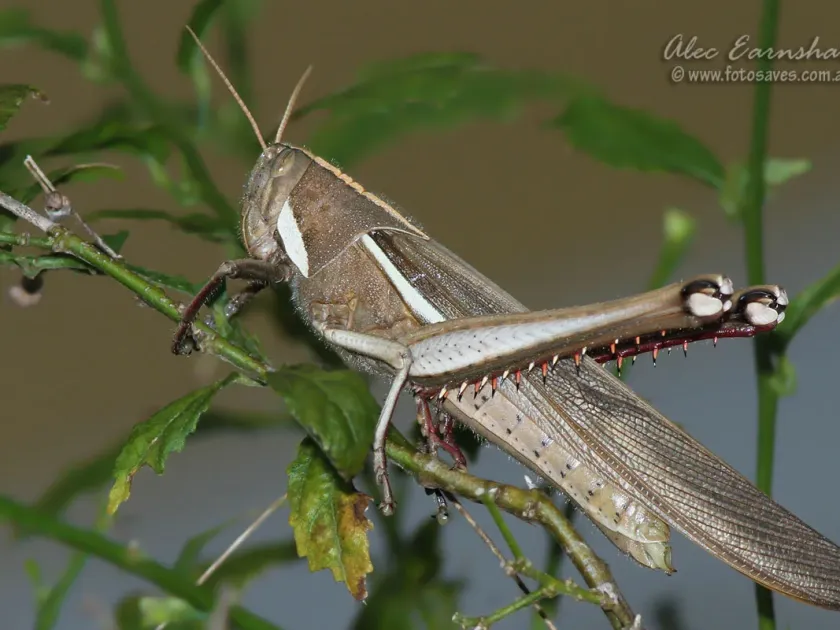
The yellow-striped locust (Schistocerca flavofasciata) is a member of the Acrididae family, within the order Orthoptera. This species is recognized by its robust build, powerful hind legs adapted for jumping, and wings capable of long-distance migration.
The insect derives its common name from the distinct yellow longitudinal stripe visible on its body. Body coloration can be variable, ranging from shades of green and brown to more vibrant yellow, depending on population density and life phase.
Nymphs develop through five distinct instars, steadily increasing in size. As they grow, their behavior may shift from solitary to gregarious, particularly when the population density reaches a critical threshold.
Morphological identification focuses on the structure of the pronotum and the shape of the elytra. These features allow agricultural inspectors to distinguish this locust species from other common grasshoppers in the field.
The life cycle relies on optimal soil moisture for egg incubation. Once hatched, the nymphs begin feeding immediately on the surrounding vegetation, growing rapidly if food sources are abundant.
What it damages
This species is a significant threat to various agricultural crops, showing a preference for cereals, maize, and sugar cane. In cases of outbreaks, the damage is severe and can lead to total crop failure.
Locusts feed aggressively on all aerial parts of the plants, including leaves, stems, and reproductive structures. At high densities, they are known to strip fields completely bare within a matter of hours.
Beyond the immediate physical loss of biomass, the injury caused to plants stresses them, making them susceptible to secondary pathogens and drought stress, even if the plant survives the initial feeding.
The feeding efficiency of Schistocerca flavofasciata is extremely high due to their voracious appetite and high metabolic rate. Their ability to move in large swarms allows them to devastate entire agricultural regions.
Economic losses are often catastrophic, necessitating emergency response measures. Preventive monitoring is essential to avoid the long-term impact on regional food supply stability.
When it appears
Locust activity is highly dependent on seasonal climate patterns, particularly the onset of warm, wet periods that follow a cooler or drier season. These conditions provide the necessary environmental triggers for egg hatching.
The peak activity of the adult phase typically occurs during the warmest months of the year, which coincide with the main vegetative growth of major cereal crops in many regions.
Swarming behavior is often observed when local resources are depleted, forcing the locusts to migrate over vast territories in search of fresh food sources.
Annual variations in rainfall can dramatically shift the timing of locust appearance, making it difficult to rely on calendar dates alone for predicting outbreaks.
Field scouting should prioritize areas with high humidity and succulent vegetation, as these environments are the most likely targets for early-stage infestations.
Signs of infestation
The first sign of infestation is the appearance of individual jumping nymphs on the edges of fields or in pastures, which are often overlooked until the population increases.
Visible feeding damage, such as ragged edges on leaves and stems stripped of their green tissue, is a clear indicator of locust presence in the crops.
Accumulations of frass (fecal matter) on the ground are a reliable indicator of high-density feeding sites. The presence of large numbers of shed nymphal skins is also a sign of recent maturation.
The distinct acoustic signature—a constant sound of clicking and grinding—is often the earliest warning sign for farmers before they actually see the swarm arriving.
Discovering egg pods buried in the soil during pre-planting inspections is a warning that a significant hatch is imminent, requiring pre-emptive control measures.
Control measures
Chemical control remains the most effective tool for managing outbreaks. Application of broad-spectrum insecticides, such as pyrethroids or organophosphates, is recommended upon detecting swarming nymphs.
Aerial spraying is the preferred method for large-scale infestations, allowing for rapid and precise application over vast agricultural lands before swarms take flight.
Integrated Pest Management (IPM) practices suggest deep plowing of fallow lands to destroy egg pods mechanically, which significantly reduces the potential for subsequent generations.
Biological control using specific entomopathogenic fungi is a sustainable alternative that can maintain pest populations at a low, non-economic level without harming the local ecosystem.
Monitoring programs involving satellite imagery and local scouting reports are crucial for timely interventions, ensuring that control measures are deployed early in the locust's development.
Taxonomy
- Latin name
- Schistocerca flavofasciata
- Order
- Orthoptera (locusts)
- Family
- Acrididae
- EPPO code
- SHICFL
Discussion
No discussions yet — be the first.