
South American locust
Schistocerca cancellata
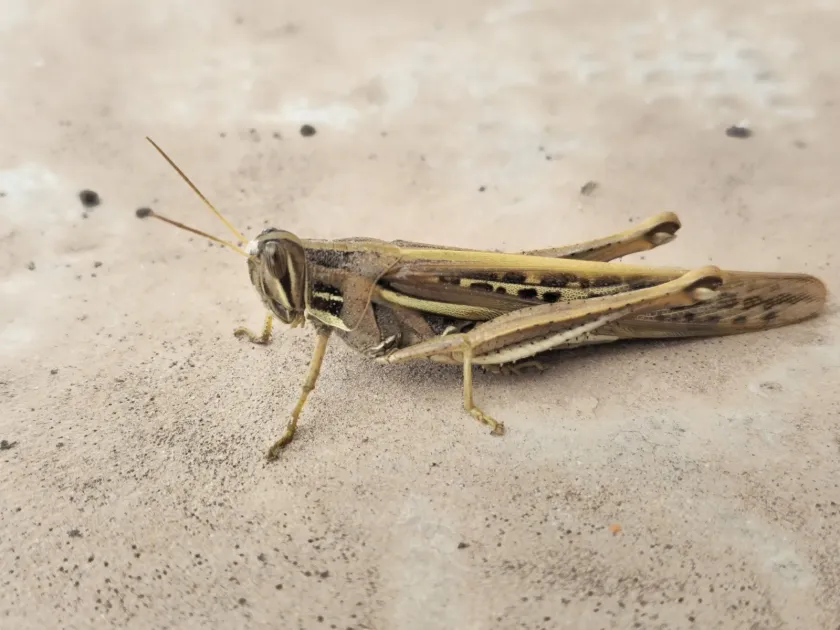
Description
How to identify
The South American locust is a member of the order Orthoptera and the family Acrididae. It is a highly polymorphic species known for its ability to transition between solitary and gregarious phases.
In the gregarious phase, the locust undergoes significant physiological and color changes, becoming darker and more active. This transition is usually triggered by high population density.
Adult insects are characterized by powerful legs for jumping and large, strong wings for flight. Their body size typically ranges between 50 to 80 millimeters depending on environmental conditions.
The female lays eggs in pods (egg-pods) within the soil, protected by a foamy secretion that hardens into a durable structure. This layer serves as a buffer against desiccation and extreme temperatures.
Nymphs resemble smaller versions of adults but lack functional wings. Throughout several instars, they grow and develop, often traveling in coordinated bands that cause massive vegetation loss.
What it damages
As a notorious polyphage, the South American locust feeds on a vast array of botanical species. It is particularly destructive to cereals such as maize, wheat, and sorghum, which are staple crops.
During massive outbreaks, the locust consumes all aerial parts of the plant, including leaves, stems, and flowers. This leads to the total destruction of the vegetation cover in affected areas.
Pastures and grasslands are also heavily impacted, causing significant shortages of forage for livestock. This creates secondary economic problems for regional agricultural sectors.
Sugarcane and various technical crops are frequently targeted due to their high biomass content. The damage inflicted prevents normal plant development and disrupts harvest cycles.
The cumulative effect of swarming leads to severe yield losses that can threaten regional food security. Recovery of the affected landscape often takes significant time and resources.
When it appears
The biological cycle of Schistocerca cancellata is heavily dictated by rainfall patterns. Sufficient soil moisture is essential for the activation of egg-pods and the hatching of nymphs.
Springtime usually marks the appearance of nymphs, making it the most vulnerable stage for the population. This is the optimal window for early intervention and monitoring efforts.
As summer approaches, the insects undergo metamorphosis into the adult phase. During this time, they gain the ability to fly long distances, allowing them to migrate into new agricultural regions.
Autumn brings the mating phase, where adults focus on laying the next generation's eggs in favorable soil conditions. The overwintering capacity of the eggs ensures the species' survival.
Environmental fluctuations can lead to variations in the number of generations per year. Proper record-keeping and climate analysis are crucial for predicting potential outbreaks.
Signs of infestation
Early identification of an infestation involves observing bands of nymphs moving through fields. They often cluster in areas with lush growth during the cooler morning hours.
The presence of fecal pellets on leaves and distinctive serrated damage on leaf margins serve as clear indicators of feeding activity. Stems may show signs of girdling or partial consumption.
Large swarms are often preceded by a distinctive buzzing sound created by thousands of flapping wings. An approaching swarm can obscure the horizon and cause a sudden drop in ambient light.
Searching for subterranean egg-pods provides evidence of a future generation. These structures can be identified by excavating small soil samples in previously infested sites.
Rapid disappearance of vegetation in a pattern of clear-cutting is a telltale sign of a locust outbreak. If no other pests are present, locust activity is the primary suspect for such damage.
Control measures
Chemical control remains the primary strategy for managing large-scale outbreaks. Timely application of insecticides at the nymphal stage is essential to prevent swarming.
Cultural methods, such as deep plowing of fields where eggs were laid, help destroy the egg-pods mechanically. This reduces the number of hatching nymphs significantly.
Biopesticides using entomopathogenic fungi offer a sustainable approach to suppressing locust populations without relying heavily on synthetic chemicals.
Regional cooperation and monitoring networks play a key role in tracking migrating swarms. Early detection allows for preventive measures that save crops from total loss.
- Targeted insecticide applications.
- Mechanical soil disturbance (plowing).
- Use of biological control agents.
- Satellite-based swarm monitoring.
Taxonomy
- Latin name
- Schistocerca cancellata
- Order
- Orthoptera (locusts)
- Family
- Acrididae
- EPPO code
- SHICCH
Discussion
No discussions yet — be the first.