
American grasshopper
Schistocerca americana
Description
How to identify
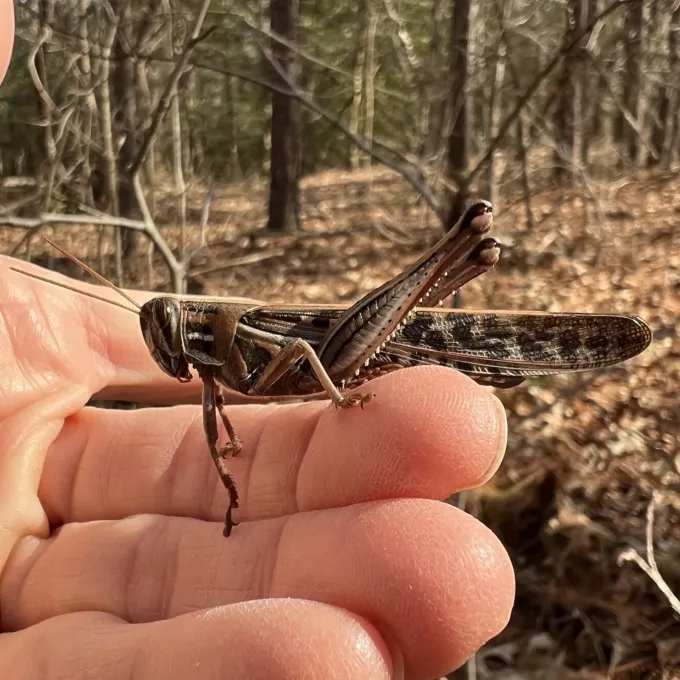
The American grasshopper (Schistocerca americana) is a member of the Acrididae family within the order Orthoptera.
This species is characterized by its large size, with adult specimens typically measuring between 40 and 60 millimeters in length.
Their coloration ranges from light tan to reddish-brown, often featuring darker markings that serve as camouflage against dried grasses and soil.
The lifecycle consists of egg, nymph (five instars), and adult stages, with nymphs gradually increasing in size and wing development over time.
They are strong fliers and are capable of migrating over long distances, which makes them highly effective at colonizing new agricultural areas.
What it damages
As a generalist herbivore, the American grasshopper poses a significant threat to a wide range of agricultural and horticultural crops.
Key crops at risk include corn, wheat, soybeans, and various forage grasses, where both nymphs and adults consume leaves and stems.
In orchards, this pest can damage fruit trees by feeding on young foliage, buds, and occasionally the skin of ripening fruits, affecting quality.
Small-scale vegetable farms are particularly vulnerable, as the high feeding rate of large populations can cause total crop failure in a matter of days.
Continued defoliation prevents proper energy storage in crops, directly impacting the final yield and overall plant health during the growing season.
When it appears
The timing of American grasshopper activity is heavily influenced by regional climate conditions, with multiple generations possible in warmer zones.
Adult populations are most visible and active during the peak summer months when temperatures are optimal for mating and egg deposition.
Nymph hatching usually follows periods of soil moisture, which are critical for the survival of early-instar nymphs during the spring season.
As the season shifts toward autumn, adults move to sheltered locations to overwinter, surviving in dense vegetation or soil crevices until spring.
Continuous monitoring is required from early spring through autumn to track the progression of the population and prevent major outbreaks.
Signs of infestation
The most noticeable sign of an infestation is the irregular, jagged leaf margins caused by the grasshoppers' mandibles during feeding.
Frass (fecal pellets) scattered on the soil surface or stuck to plant foliage serves as a primary indicator of active pest feeding in the field.
Visible "clumps" of nymphs at the edges of fields indicate that the insects are actively migrating and expanding their range of food sources.
Sudden thinning of the crop canopy or stripped stems in specific areas of the field often point to established feeding sites.
Observing the movement of grasshoppers as they jump or fly when disturbed in the field is a clear signal of high population density.
Control measures
Effective management requires an integrated approach that focuses on both chemical suppression and preventative cultural techniques.
Targeted insecticide applications are most effective when applied to young nymphs before they develop wings and become highly mobile.
- Deep cultivation of soil to disturb and kill overwintering egg pods.
- Effective weed control on field margins to reduce favorable habitats.
- Promoting biological diversity to encourage natural predators like birds and wasps.
- Using biological pesticides based on insect-specific fungi when possible.
- Regular scouting of high-risk areas to enable early intervention before population spikes.
By managing vegetation in surrounding areas and maintaining healthy crop vigor, growers can significantly reduce the attractiveness of their fields to grasshoppers.
Taxonomy
- Latin name
- Schistocerca americana
- Order
- Orthoptera (locusts)
- Family
- Acrididae
- EPPO code
- SHICAM
Discussion
No discussions yet — be the first.