
Schistocerca alutacea
Schistocerca alutacea
Description
How to identify
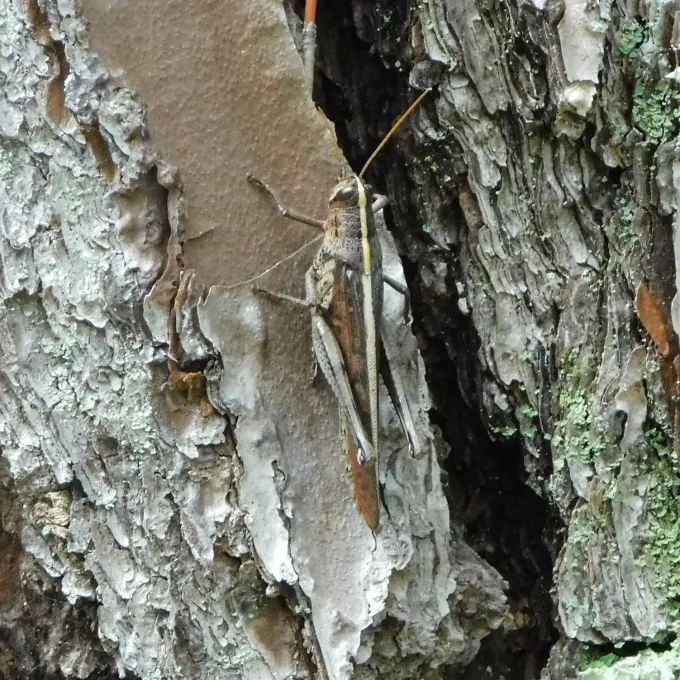
Schistocerca alutacea, known as the leather-colored bird grasshopper, belongs to the order Orthoptera and the family Acrididae. This species is characterized by a leathery texture and coloration ranging from yellowish-brown to olive.
A distinctive feature of this species is a pale stripe that runs along the dorsal part of the pronotum and continues along the length of the elytra. Adults are large, making them highly visible within agricultural landscapes.
The head is large and equipped with strong, chewing mouthparts adapted for consuming fibrous plant tissues. The compound eyes are laterally positioned, providing a wide field of vision for predator detection.
The hind legs are robust and specialized for jumping, which makes mechanical control or physical capture of the adults challenging for farmers and field workers.
Nymphs resemble smaller versions of adults, lacking fully developed wings and exhibiting less intense coloration, progressing through several instars before reaching the mature stage.
What it damages
Damage is caused by both nymphs and adults, as they are generalist feeders. They consume a wide variety of herbaceous plants, wild grasses, and various cultivated crops.
When populations reach high densities, they can pose a significant threat to pastures, feeding on green foliage and reducing the nutritional quality of forage for livestock.
During migration, these grasshoppers may invade cereal, legume, and vegetable fields, causing mechanical destruction of stems, leaves, and other vegetative parts.
Young sprouts and leaves are particularly susceptible, often suffering from heavy feeding that leads to significant leaf area loss, sometimes resulting in complete skeletonization.
Mass outbreaks, especially during prolonged droughts when alternative food sources are scarce, can lead to severe economic losses for agricultural producers.
When it appears
The activity of Schistocerca alutacea is heavily influenced by regional climate conditions and temperatures. The life cycle generally peaks during the summer months when high heat accelerates development.
Eggs overwinter in the soil, protected from unfavorable environmental conditions. Hatching of nymphs begins in the spring once soil temperatures reach an optimal threshold.
Nymphs undergo several developmental stages, feeding and growing actively throughout the season. Population density usually peaks in mid-summer, coinciding with the active growth phase of many crops.
Adults remain active until late autumn, when falling temperatures and night frosts force them to cease feeding and end their life cycle.
The rate of generation development varies depending on soil moisture, as rainfall levels directly affect the survival rate of egg pods buried in the soil substrate.
Signs of infestation
The first sign of infestation is the presence of irregular-shaped holes in leaves, often with jagged edges, as the pests feed unevenly across the leaf surface.
During morning or evening hours, increased activity is observed, with the insects jumping or flying away in large numbers when disturbed by machinery or human presence.
Small, dark, cylindrical fecal pellets are frequently found on stems and the soil surface, serving as clear indicators of a resident grasshopper population.
Careful field inspection often reveals damaged apical growing points, which indicates intense feeding pressure on developing plant tissues during early stages.
The audible stridulation of males on sunny days provides indirect evidence of high population densities of Schistocerca alutacea within the affected area.
Control measures
Effective management requires an integrated approach combining cultural practices and chemical interventions to keep populations below the economic injury level.
- Deep fall plowing to destroy egg-laying sites and reduce winter survival.
- Rigorous management and removal of weeds along field margins.
- Application of approved contact-stomach insecticides when threshold levels are exceeded.
- Monitoring nymph populations during early stages to ensure timely action.
- Biological control using entomopathogenic fungi to suppress population growth.
Taxonomy
- Latin name
- Schistocerca alutacea
- Order
- Orthoptera (locusts)
- Family
- Acrididae
- EPPO code
- SHICAL
Discussion
No discussions yet — be the first.