
Desert locust
Schistocerca
Description
How to identify
The desert locust (Schistocerca gregaria) is a member of the Acrididae family and is widely considered the most dangerous migratory pest in the world.
These insects exhibit phase polyphenism, meaning they can transform from solitary individuals into highly social, swarming insects when environmental conditions trigger a population explosion.
Adult locusts are strong flyers, capable of traversing entire continents by riding wind currents, making them a transboundary threat that requires international cooperation.
Their anatomy is built for survival; they have powerful hind legs for jumping and highly developed sensory organs that allow them to coordinate their movements within a swarm.
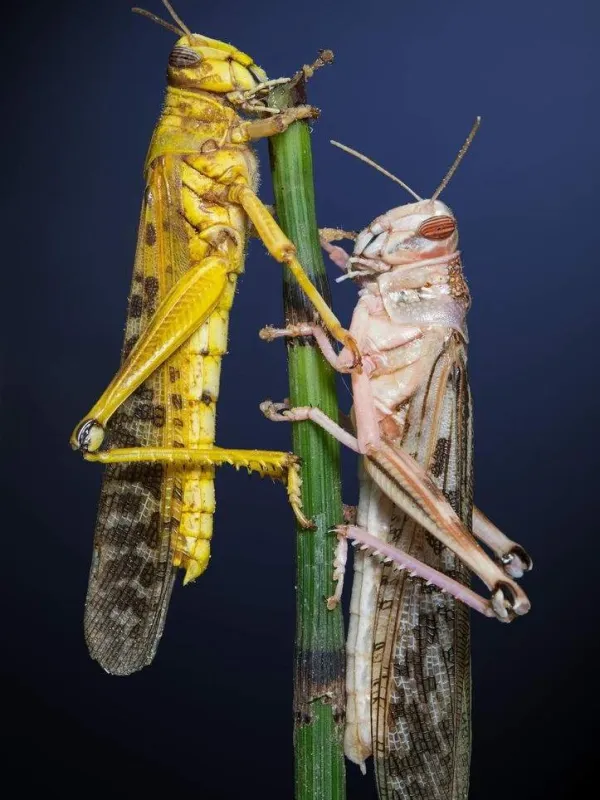
The transition to the gregarious phase changes their coloration to bright yellow or pink, acting as a warning signal and a social marker within the massive locust clouds.
What it damages
Desert locusts are polyphagous, meaning they consume a wide variety of plant species, including almost all vital agricultural crops such as wheat, rice, corn, and forage grasses.
A single swarm can span several square kilometers and consume an amount of food equivalent to the daily needs of thousands of people, leading to massive food insecurity.
Beyond destroying leaves, locusts strip bark from trees and consume flower buds, preventing any chance of crop recovery and leaving fields completely devastated.
The economic impact is catastrophic, affecting both subsistence farmers and large-scale commercial operations, which often struggle to contain the rapid spread of the pest.
In addition to food crops, they heavily impact rangelands, which causes the destruction of livestock feed sources and further cripples the economy of affected rural regions.
When it appears
The life cycle of the desert locust is intricately linked to rainfall, which provides the necessary soil moisture for eggs to hatch and the subsequent vegetation for nymphs to feed.
When rains occur in arid regions, the locusts take advantage of the sudden abundance of food to breed rapidly, leading to the creation of hopper bands.
Migration patterns are seasonal and rely on shifting wind directions, allowing the swarms to move between summer and winter breeding grounds in different hemispheres.
A single generation can develop in just a few weeks under optimal conditions, enabling the population to grow exponentially in a very short timeframe if unchecked.
Cooler temperatures can slow down development, but they do not eliminate the threat, as eggs can remain dormant in the soil for months, waiting for favorable conditions.
Signs of infestation
The most alarming sign is the presence of hopper bands—dense groups of wingless nymphs that move across the terrain like a flowing tide of insects.
Visual inspection of the field will show shredded plant tissues, skeletonized leaves, and heavy damage to stems, often accompanied by the sound of thousands of chewing mandibles.
The sky darkening during the day is a clear indication that a mature swarm has arrived, as the density of insects can be thick enough to obscure sunlight.
Exuviae, the discarded skins from the molting process, found on plants or the soil surface are clear indicators that a population is actively growing in that specific area.
Freshly laid egg pods in sandy soil are a critical sign that a new generation is imminent, necessitating immediate identification and control measures before hatching occurs.
Control measures
Effective management requires a proactive strategy that focuses on finding and treating locust breeding grounds before swarms can form and migrate.
Current control measures rely heavily on the targeted application of chemical insecticides, which are applied via aircraft or vehicles to suppress populations in early stages.
Biopesticides utilizing specific fungal pathogens are becoming a viable alternative to chemical methods, providing a more environmentally friendly approach to long-term control.
- Remote sensing and satellite imagery to track rainfall and vegetation growth.
- Strategic spraying of infested areas to kill nymphs before they develop wings.
- Public awareness campaigns to report sightings immediately.
- International surveillance networks to share real-time locust movement data.
Integrated pest management strategies are essential to combine mechanical, chemical, and biological approaches, ensuring the long-term sustainability of agricultural production.
Taxonomy
- Latin name
- Schistocerca
- Order
- Orthoptera (locusts)
- Family
- Acrididae
- EPPO code
- SHICSP
Discussion
No discussions yet — be the first.