
Yellow dung fly
Scathophaga stercoraria
Description
How to identify
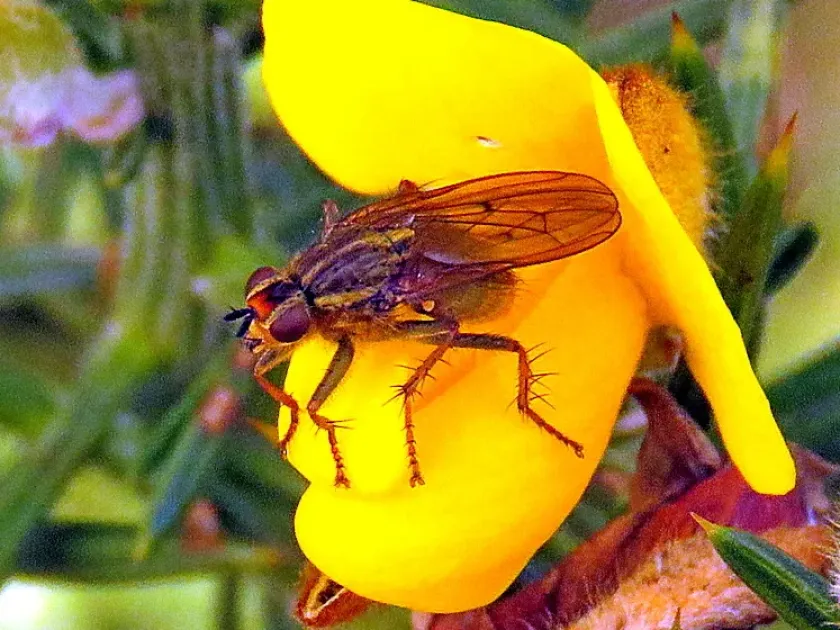
The yellow dung fly (Scathophaga stercoraria) is a member of the Scathophagidae family within the order Diptera. It is easily recognized by its dense, golden-yellow hair covering its body.
Adult flies range from 5 to 10 mm in length. Males are typically more vibrant and hairier than females, featuring striking yellow-orange coloration that gives the species its common name.
The eyes are large and separated by a broad frons. The wings are hyaline or slightly tinged with yellow at the base, and the legs are robust, facilitating movement on dung and vegetation.
The larvae are white or pale yellow, legless, and typically found developing within livestock feces, which serves as their primary food source during the juvenile stage.
This species is highly adaptable and can be found across various temperate climates, particularly near pastures and livestock farms where manure is abundant.
What it damages
The larvae of the yellow dung fly are saprophagous and feed solely on animal excrement; they do not consume living plant tissues or cause direct damage to crops.
Adult flies are active predators that hunt other small insects, including potential pests, thereby providing a minor ecological service as natural biological control agents.
The primary concern for farmers is the potential for mechanical contamination of produce with excrement if large swarms of flies settle on low-growing vegetables or fruits.
While they are not phytophagous, the presence of these flies in large numbers near crops can be a nuisance and may influence overall hygiene standards in fields.
Given that they do not attack crop tissues, they are not classified as primary agricultural pests, and intervention is rarely required in broad-acre farming.
When it appears
Adults emerge very early in the spring, often becoming active as soon as temperatures rise above freezing, making them some of the first insects seen in the field.
The species reproduces throughout the warmer months, with the duration of the lifecycle—from egg to adult—highly dependent on ambient temperature and moisture levels.
Peak activity is typically observed during mid-summer, coinciding with higher livestock activity and the availability of fresh manure for egg-laying.
Under ideal conditions, a generation can complete its development in approximately 2 to 3 weeks, allowing for multiple broods within a single season.
As autumn progresses and temperatures drop, adults enter diapause or perish, marking the end of the breeding cycle until the following spring.
Signs of infestation
The most reliable sign of the yellow dung fly is the presence of adult flies aggregating around fresh cow dung or other livestock waste in pastures.
Digging into the manure substrate often reveals the characteristic legless larvae, confirming the active use of the site for reproduction.
The presence of small, dark, or yellow-tinted fecal spots on plant foliage near manure sites indicates high fly activity in the immediate vicinity.
Absence of typical pest symptoms—such as leaf mining, skeletonization, or stem boring—clearly distinguishes this fly from actual plant-consuming pests.
Visual identification of the distinct, hairy, golden-colored adult flies on vegetation is usually sufficient to identify the species on a farm.
Control measures
Management of the yellow dung fly is rarely necessary from a crop protection perspective, as they are not primary pests of field or garden crops.
To reduce their presence, the most effective strategy is the proper management and removal of livestock manure from fields and near production areas.
Maintaining sanitary conditions around livestock facilities discourages the flies from establishing breeding grounds in close proximity to crop fields.
Biological control agents, such as parasitoid wasps that target fly larvae, can sometimes be used in enclosed livestock facilities to regulate populations.
Broad-spectrum insecticide applications are discouraged, as they may harm beneficial insects and predatory species that provide more significant agricultural benefits.
Taxonomy
- Latin name
- Scathophaga stercoraria
- Order
- Diptera (flies)
- Family
- Scathophagidae
- EPPO code
- SCPEST
Discussion
No discussions yet — be the first.