
Cereal fly
Cordilura pubera
Description
How to identify
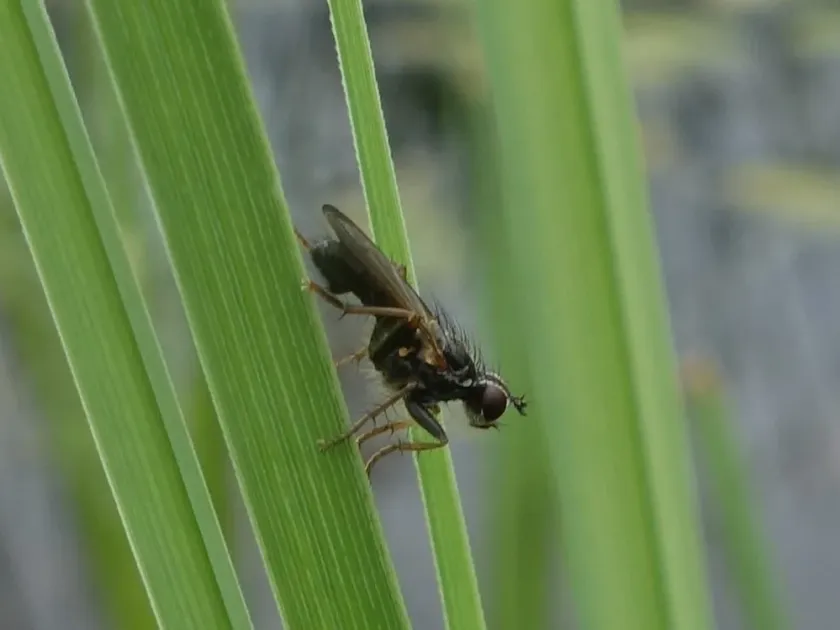
The cereal fly (Cordilura pubera) belongs to the Scathophagidae family. The adult insect measures approximately 5–7 mm in length and is easily recognizable by its dense body pubescence.
The coloration of the adults ranges from grayish-brown to yellowish-brown. The wings are transparent with a slight yellowish tint at the base, which is a key identification feature for this species.
The larvae are cylindrical, legless, and white or yellowish in color, reaching up to 10 mm in length. They possess a specialized mouthpart designed for feeding on plant tissues.
The pupal stage occurs within a brown puparium, which is typically found in the soil or among crop residues, providing a protective barrier against environmental fluctuations.
The development of this pest is highly dependent on climate, particularly temperature and humidity levels, which dictate the timing of adult emergence each spring.
What it damages
The primary hosts for Cordilura pubera are cereal crops, including winter and spring wheat, rye, and barley. The damage is most severe during the early vegetative stages.
Larvae bore into the stem and tunnel toward the growth point. This feeding activity causes the central leaf of the shoot to wither and eventually die.
Plants damaged during the tillering stage often fail to develop normally, resulting in stunted growth and a significant reduction in grain yield potential.
Adult flies also cause damage by feeding on plant sap. Their feeding punctures on leaves can act as entry points for secondary fungal and bacterial infections, further weakening the plant.
High populations of the cereal fly can lead to substantial economic losses, especially in thin or weakened crops where the pest can concentrate its damage.
When it appears
Adult emergence typically begins in early spring, usually in April or May, coinciding with the regrowth of winter cereals and the germination of spring-sown crops.
Females lay eggs individually on the leaves of young cereal plants. The larvae hatch and migrate to the stem base, where they begin feeding inside the plant.
The peak activity and damage period usually occurs in late May and early June, when environmental conditions are optimal for the insect's life cycle.
Once feeding is complete, the larvae move into the soil to pupate. The species typically produces one generation per year, spending the winter in the pupal stage.
The life cycle is closely synchronized with the phenology of cereal crops, ensuring that larvae have an immediate food source upon hatching.
Signs of infestation
The first noticeable sign of infestation is the yellowing and wilting of the central leaf of the shoot, while the outer leaves remain temporarily green.
Upon inspecting an affected shoot, one can often find internal tunneling, larval excrement, and the larva itself inside the stem base.
Affected plants appear stunted and lag significantly behind the healthy portions of the crop. In some cases, the plant may attempt to produce side shoots to compensate for the primary stem death.
Visible patches of thinning or chlorotic vegetation in a field often indicate a localized infestation that requires immediate attention.
The presence of brown, seed-like puparia in the soil near the base of the damaged plants provides confirmation of the pest's involvement.
Control measures
Crop rotation is the most effective cultural practice to disrupt the cereal fly's life cycle and prevent population buildup in fields.
Deep autumn plowing is recommended to bury crop residues and soil-dwelling puparia, which significantly reduces the survival rate of the next generation.
Ensuring optimal sowing dates allows crops to grow vigorously, enabling them to pass through the most susceptible developmental stages as quickly as possible.
If monitoring reveals that the economic threshold is reached, the application of systemic insecticides during the adult emergence phase is highly effective.
Regular field scouting using yellow sticky traps is a recommended strategy to determine the exact timing for intervention and to minimize chemical usage.
Taxonomy
- Latin name
- Cordilura pubera
- Order
- Diptera (flies)
- Family
- Scathophagidae
- EPPO code
- CDLRPU
Discussion
No discussions yet — be the first.