
Locust
Acrididae
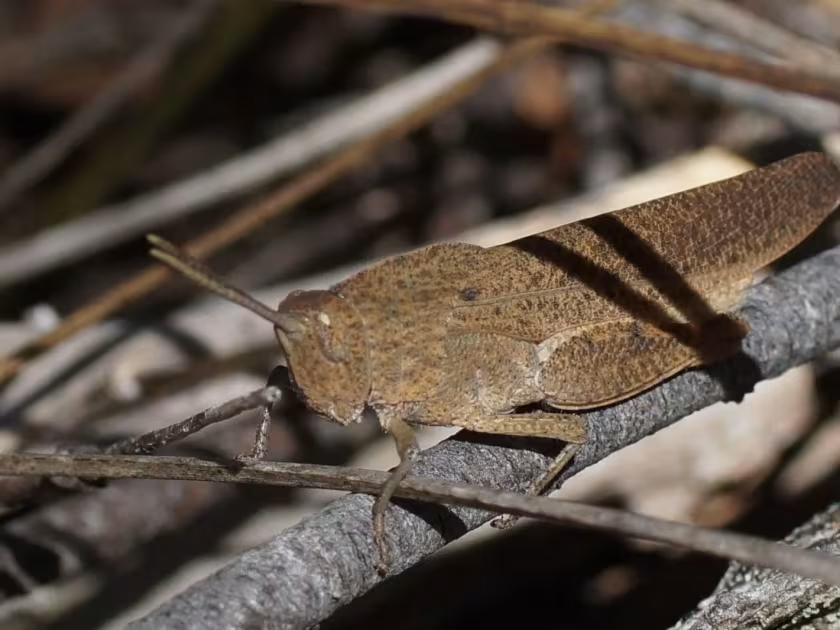
Description
How to identify
Locusts (Acrididae) are a family of short-horned grasshoppers known for their capacity to undergo behavioral changes and form massive swarms.
They possess strong biting mouthparts, which enable them to consume a wide variety of plant tissues including leaves, stems, and fruits.
Adult locusts have highly developed wings and powerful hind legs, making them capable of both short-distance jumps and long-distance flight.
These insects often exhibit cryptic coloration that blends with the landscape, allowing them to remain inconspicuous until swarm density increases.
The transition from a solitary phase to a gregarious phase is the defining characteristic of true locust species, which creates significant agricultural threats.
What it damages
Locusts are voracious polyphagous pests capable of causing devastating damage to almost all crops, including cereals, legumes, and industrial plants.
Wheat, maize, barley, and rice crops are particularly vulnerable, as locust swarms can strip entire fields in a matter of hours.
Vegetable gardens and orchards are also at risk, with the insects consuming leaves, buds, flowers, and even soft parts of tree bark.
In addition to direct destruction of the harvest, locusts damage the plant's ability to recover, often leading to total yield failure.
Large swarms can also cause significant damage to grazing pastures, leading to secondary economic impacts on livestock production.
When it appears
The life cycle begins in spring when eggs, which have overwintered in the soil, hatch in response to increasing temperatures and moisture.
During the early summer, nymphs pass through several developmental stages, feeding intensely and growing larger before reaching the winged stage.
By mid-summer, adults reach maturity and may begin to form swarms if population density crosses specific thresholds.
The late summer and autumn periods are dedicated to mating and laying eggs in soil pods to ensure the survival of the next generation.
Most species produce one to two generations per year, with the overwintering egg stage being the most critical point for preventative management.
Signs of infestation
An initial sign of infestation is the presence of nymph clusters feeding on vegetation along field margins or in abandoned pastures.
Defoliation, which involves missing leaf tissue and shredded edges, is a clear indicator that a locust population is active in the area.
The presence of large amounts of insect droppings (frass) under foliage provides visual evidence of a high feeding rate.
Audible sounds, such as rustling or clicking noises, often indicate the presence of large numbers of insects moving through the canopy.
Increased activity of predators, such as birds or predatory wasps, circling or congregating in a specific field often marks a locust hotspot.
Control measures
Successful management of locust populations relies heavily on early detection through systematic field surveys and monitoring programs.
Tilling and plowing of known egg-laying sites can destroy egg pods, significantly reducing the population density before hatching occurs.
Chemical control using insecticides is most effective when applied during the early nymph stages before the insects develop full flight capabilities.
Biological control, including the use of fungal pathogens like Metarhizium, offers an environmentally friendly alternative to chemical pesticides.
- Monitoring breeding areas during the spring
- Applying contact or systemic insecticides
- Utilizing natural enemies and biological agents
Taxonomy
- Latin name
- Acrididae
- Order
- Orthoptera (locusts)
- Family
- Acrididae
- EPPO code
- 1ACRIF
Discussion
No discussions yet — be the first.