
Root mealybug
Ripersiella kondonis
Description
How to identify
The root mealybug Ripersiella kondonis belongs to the Pseudococcidae family within the order Hemiptera. It is a specialized subterranean pest that thrives in the root zones of various potted plants and greenhouse crops.
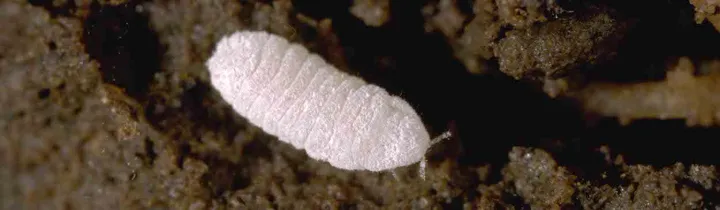
Adult females are small, ranging from 1 to 2.5 mm in length. Their bodies are oval and flattened, covered with a distinct white, powdery waxy secretion that acts as a defensive shield against predators and environmental stress.
These insects are rarely seen above the soil surface. They live in colonies attached to the roots, where they feed on sap. Males are rarely encountered, as they are winged and short-lived, serving only to fertilize the sedentary females.
The life cycle is completed within the soil environment. Females deposit eggs in loose, cottony masses of waxy filaments. A single female can produce a significant number of eggs, leading to rapid colonization if conditions are favorable.
Identification is mainly possible through careful examination of the root system during repotting. The presence of these pests is indicated by small, white, woolly or salt-like clusters clinging to the roots and around the root collar of the host plant.
What it damages
Ripersiella kondonis primarily targets ornamental plants, succulents, cacti, and various flowering indoor crops. The pest's feeding behavior significantly weakens the host plant by depleting essential nutrients.
As they feed, root mealybugs inject toxic enzymes into the plant tissue. This disrupts the plant's ability to transport water and minerals, leading to stunting, yellowing, and eventually the death of the root system.
The punctures created by the feeding insects often become entry points for secondary fungal and bacterial pathogens. These infections cause root rot, which often leads to the total collapse and death of the plant.
For large specimens or valuable collections, the damage manifests as a persistent lack of vitality. The plant may fail to produce new leaves or flowers and may appear to suffer from chronic dehydration despite regular care.
In greenhouse environments, these pests can cause severe economic losses by damaging nursery stock. Due to their hidden nature, they can spread easily between pots if hygiene protocols are not strictly followed.
Signs of infestation
The primary symptom of a root mealybug infestation is a sudden or progressive decline in plant health. The plant exhibits wilting or drooping symptoms that do not recover even after proper watering, indicating a failed root system.
On the soil surface, white powdery residue or thin webbing may sometimes be visible near the edge of the pot. In some cases, the soil may appear to pull away from the pot walls as the root volume decreases due to tissue death.
Stunted growth, lack of new shoot formation, and chronic chlorosis are strong indicators of nutrient deficiency caused by root damage. The plant may also become loose in the substrate due to the loss of root anchorage.
Upon removing the plant from its container, the root ball might look unhealthy, dry, or greyish. Closer inspection will reveal the telltale white, woolly masses clustered along the main roots or near the base of the stem.
Consistent lack of response to fertilizers and lack of new root growth during the growing season should trigger an investigation for subterranean pests, specifically looking for Ripersiella kondonis.
Control measures
Effective control of the root mealybug requires a rigorous approach focusing on sanitation and systemic treatment. The infested soil must be discarded, and the plant must be repotted into clean, sterilized media.
Systemic insecticides, particularly those containing imidacloprid or similar neonicotinoids, are the most effective treatment. These are applied via soil drenching, ensuring the poison reaches the roots where the insects are feeding.
Prevention is key in managing this pest. All new plants should be quarantined for several weeks before being introduced to a collection. Always use clean, sterilized tools and pots to prevent the transport of eggs and nymphs.
- Thorough removal of all infested soil and dead root parts.
- Application of systemic insecticide as a soil drench.
- Sterilization of pots and tools using heat or chemical disinfectants.
- Strict quarantine procedures for all newly acquired plant material.
Follow-up treatments are essential, as systemic chemicals may not kill all eggs in a single application. Repeat the treatment 10–14 days later to target newly hatched nymphs, ensuring the complete eradication of the pest colony.
Taxonomy
- Latin name
- Ripersiella kondonis
- Order
- Hemiptera (bugs, aphids, leafhoppers)
- Family
- Rhizoecidae
- EPPO code
- RHIOKO
Discussion
No discussions yet — be the first.