
Root mealybug
Rhizoecus caladii
Description
How to identify
The root mealybug (Rhizoecus caladii) is a small insect belonging to the family Pseudococcidae. These pests are extremely difficult to detect as they complete their entire life cycle underground.
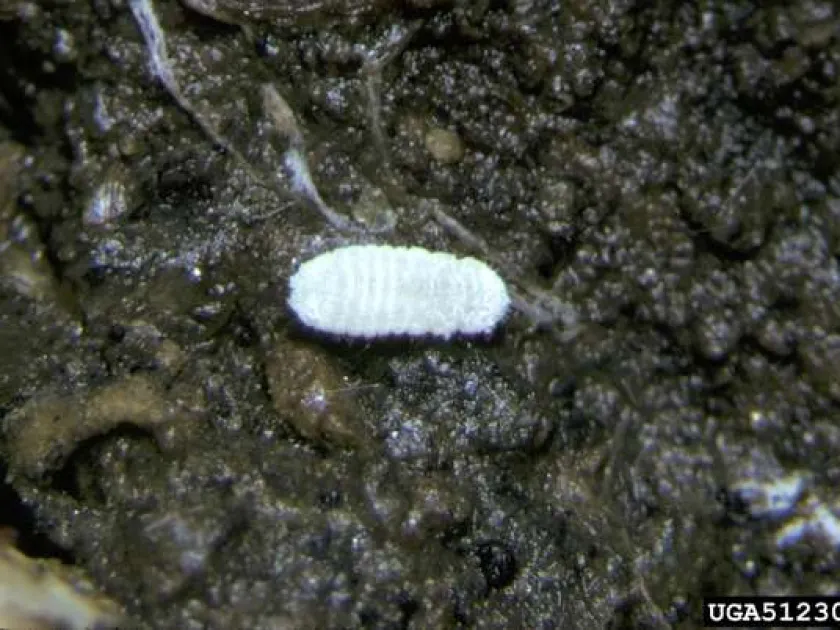
Adult insects are typically 1–3 mm long, oval-shaped, and covered with a white, waxy, powdery secretion that protects them from soil moisture and natural predators.
Unlike surface-dwelling mealybugs, the root mealybug stays within the root zone, often anchoring itself to the root hairs or the main root system of potted plants.
The nymphs, or crawlers, are mobile and move through the soil pores to spread to new parts of the root system or exit through drainage holes to infest neighboring plants.
These pests thrive in porous, well-draining potting mixes, which is why they are frequently observed in containers containing succulents, palms, and other greenhouse crops.
What it damages
Rhizoecus caladii damages plants by inserting its stylets into root tissues to feed on plant sap. This process removes vital nutrients and weakens the plant's structural integrity.
The feeding damage creates entry points for various soil-borne pathogens, including fungi and bacteria, which often lead to secondary root rot and complete plant collapse.
Visible symptoms on the foliage include stunted growth, chlorosis, and general wilting. Because the damage happens at the roots, adding more water often makes the situation worse by encouraging rot.
If left untreated, a heavy infestation can lead to the total destruction of the root ball, causing the plant to loose its anchorage in the pot and eventually die.
Professional nurseries often face significant economic losses due to this pest, as it can be easily transported via trade in infested soil and potting materials.
Signs of infestation
The most common sign is a plant that appears thirsty and wilted despite being well-watered. This discrepancy is a key indicator of root health issues caused by pests.
Visual confirmation involves lifting the plant out of its pot. If infested, you will see white, cottony, wax-like masses adhering to the roots and the inside walls of the container.
The plant may exhibit signs of nutrient deficiency, such as yellowing leaves or a lack of new growth, even when fertilizer is being applied regularly.
In severe cases, you may notice small, pale insects crawling on the surface of the soil or near the drainage holes after a thorough watering, as the water displaces them from the root zone.
The soil may also appear to lose its structural connection with the roots, becoming loose or crumbly because the roots have been decimated by the feeding activity of the colony.
Control measures
Eradication is challenging and requires a systematic approach. The most effective method is to bare-root the plant, discard the old soil, and treat the roots with a systemic insecticide.
Systemic insecticides, such as those containing imidacloprid or dinotefuran, are highly effective as they are absorbed by the plant and make the sap toxic to the mealybugs.
Strict sanitation practices are crucial. All infested pots and tools should be cleaned and sanitized with hot water or appropriate chemical agents to remove any remaining crawlers or eggs.
Quarantine new plant acquisitions for at least one month. During this time, inspect the roots or keep the plant isolated to ensure no hidden infestation is introduced to the main collection.
- Systemic insecticide soil drenches.
- Repotting into fresh, clean potting mix.
- Sanitizing containers and greenhouse surfaces.
- Regular monitoring of root health during routine maintenance.
Taxonomy
- Latin name
- Rhizoecus caladii
- Order
- Hemiptera (bugs, aphids, leafhoppers)
- Family
- Rhizoecidae
- EPPO code
- RHIOCL
Discussion
No discussions yet — be the first.