
Amorphophallus root mealybug
Rhizoecus amorphophalli
Description
How to identify
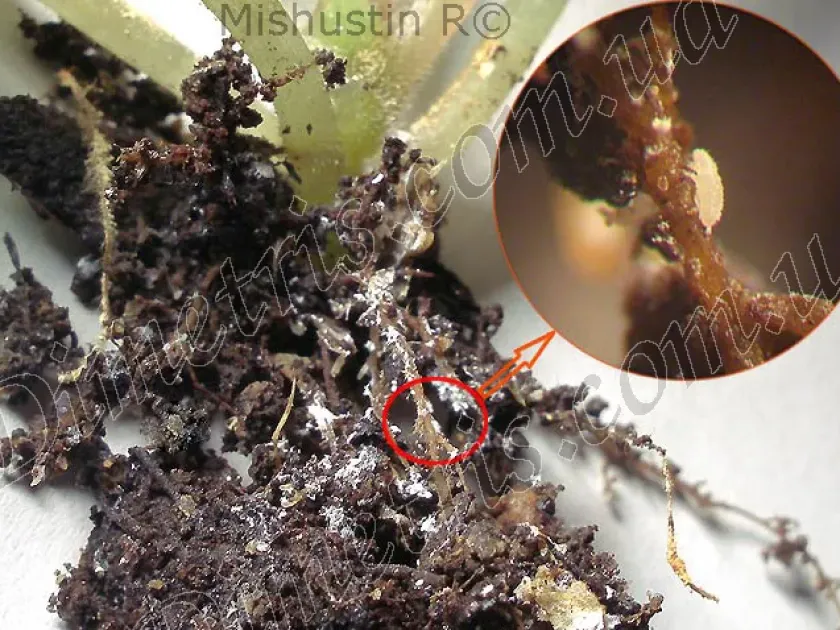
The Amorphophallus root mealybug (scientific name Rhizoecus amorphophalli) belongs to the family Pseudococcidae. It is a tiny, soil-dwelling insect that specifically targets the root systems and tubers of various plant species.
Adult bugs are about 1.5 to 2.5 mm long, with oval bodies covered in a white, powdery wax secretion. This coating makes them look like small bits of white mold or perlite particles, making them very hard to detect.
Unlike foliar mealybugs, this species spends its entire life cycle underground. They move slowly through the soil, using their sucking mouthparts to feed on the sap of the plant's roots and tubers.
The mobile crawler stage is responsible for the infestation spreading between pots. They can be transmitted via contaminated potting mix, irrigation water, or tools used for multiple plants.
This pest is a significant threat to aroids, especially the genus Amorphophallus, often causing slow, progressive decline in health that is difficult to diagnose without checking the roots.
What it damages
The damage is caused by both adults and nymphs feeding on the root sap. This results in nutrient and water deficiency, leading to severe stress for the host plant.
Root feeding often creates open wounds that serve as entry points for pathogenic bacteria and fungi, which quickly lead to soft rot of the tuber and root death.
Common symptoms include stunted growth, yellowing foliage, and a lack of new leaf production. The plant appears thirsty even when the soil is properly moist.
In cases of heavy infestation, the root system may be completely destroyed, causing the plant to lose its connection to the soil and eventually perish.
The destruction of the tuber's outer layer and the growing point significantly reduces the plant's ability to survive dormancy and sprout successfully in the next growing season.
When it appears
Root mealybugs can thrive year-round in indoor and greenhouse environments where temperature and soil moisture levels are relatively constant.
Their reproduction rate increases significantly during the spring and summer months when warmer temperatures accelerate their metabolic cycles.
During cooler periods, their activity slows down, but they do not enter true dormancy and continue to feed at a lower intensity if the plant is kept warm.
New infestations are most commonly introduced during repotting if contaminated soil is used or if new, infected plants are added to an existing collection.
Because generations overlap, a single plant can harbor eggs, nymphs, and adults simultaneously, necessitating prolonged and consistent treatment programs.
Signs of infestation
The most visible sign of an infestation is the appearance of white, cottony, or waxy masses on the surface of the roots or the tuber when the plant is removed from its pot.
The presence of fine, white, irregular granules scattered through the soil that cannot be washed away is a strong indicator of a root mealybug colony.
If the plant exhibits persistent wilting and leaf drop despite regular watering, the roots should be inspected immediately for pest presence.
An unpleasant smell coming from the pot, often linked to secondary rot, is a sign that the root system has been severely compromised by feeding damage.
A general lack of vigor and failure to bloom or grow despite optimal light and fertilization levels often suggests a hidden root-zone issue.
Control measures
Effective control requires a combination of sanitation, soil replacement, and the application of systemic chemical insecticides to reach the hidden insects.
- Remove the plant from the pot and wash all soil from the roots and tuber.
- Prune severely damaged roots or necrotic areas of the tuber.
- Drench the root ball in a systemic insecticide solution (e.g., imidacloprid).
- Repot the plant into a fresh, sterile potting medium.
- Isolate the infected plant from the rest of the collection to prevent further spreading.
Systemic insecticides are the most effective method because they are absorbed by the plant and make the root sap toxic to the mealybugs.
It is crucial to repeat the soil drench treatment at least twice, spaced 10–14 days apart, to eliminate new nymphs that hatch from eggs not affected by the initial treatment.
Taxonomy
- Latin name
- Rhizoecus amorphophalli
- Order
- Hemiptera (bugs, aphids, leafhoppers)
- Family
- Rhizoecidae
- EPPO code
- RHIOAP
Discussion
No discussions yet — be the first.