
Root mealybug
Rhizoecus americanus
Description
How to identify
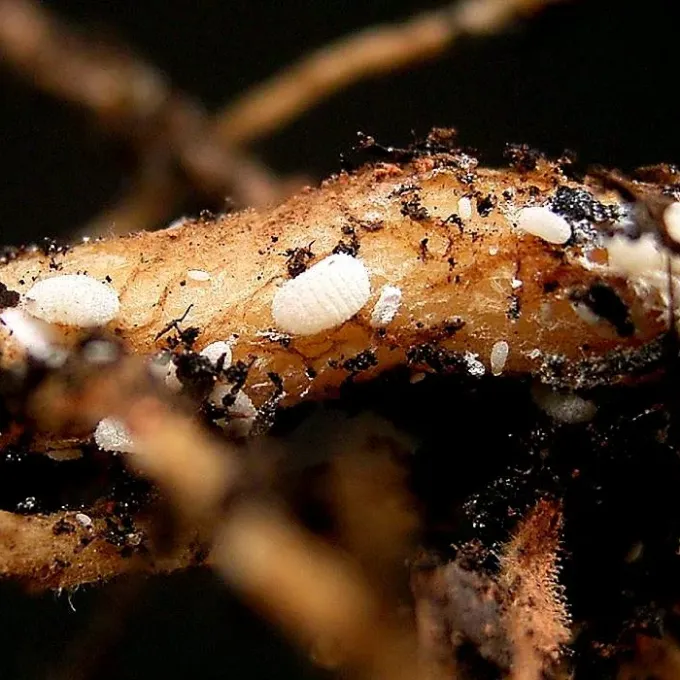
The root mealybug (Rhizoecus americanus) is a small, sap-sucking insect belonging to the family Pseudococcidae. Adult insects are oval-shaped, measuring 2–3 mm, and are covered in a white, waxy secretion that looks like fine white powder or cotton wool fibers.
Unlike common mealybugs found on leaves, this species is strictly subterranean. It lives permanently in the soil, attached to the root system of host plants, where it remains largely motionless for most of its life cycle.
The nymphs, known as crawlers, are the only mobile stage. They are highly active and capable of moving through the soil, spreading the infestation between pots or throughout a nursery environment during irrigation.
These pests thrive in warm, dry, and loose soil conditions. Under such environments, their reproduction cycle accelerates significantly, allowing them to establish dense colonies around the roots within a short period.
Females produce small egg sacs made of waxy, thread-like filaments directly within the soil. This structure serves as a protective barrier against external environmental stress and many contact-based pesticides, making complete eradication a complex task.
What it damages
Root mealybugs primarily infest indoor houseplants, particularly cacti, succulents, ferns, and various ornamental plants in greenhouse environments. Young, recently transplanted plants are especially susceptible to heavy infestations.
The insect feeds on plant sap, injecting enzymes that damage root tissues. This activity stunts the root development and reduces the plant's ability to absorb water and essential nutrients from the substrate.
As the root system becomes compromised, the plant shows signs of severe stress, including stunted growth, leaf yellowing, and loss of turgor. Even when adequately watered, the plant may appear permanently wilted.
The feeding sites often develop necrotic lesions, which provide an entry point for secondary soil-borne pathogens. Bacterial and fungal infections often follow a mealybug infestation, leading to root rot and total plant collapse.
Left unmanaged, the infestation leads to the gradual decline of the plant. Because the pest is hidden from view, visible signs of damage often appear only when the infestation has already reached a critical stage.
Signs of infestation
One of the earliest indicators is a sudden and unexplained loss of vigor in an otherwise healthy plant. Growth stops entirely, and the plant fails to respond to regular watering and fertilization.
If the root ball is inspected, a characteristic white, cottony residue is visible on the roots and the inner surfaces of the pot. These clumps are often mistaken for fungal growth, but a closer look reveals the immobile insects inside.
On the soil surface, especially near the edges of the pot, one may observe white, grainy specks. These are often dead scales or wax deposits left behind by the insect population as they move through the substrate.
The plant may exhibit signs of nutrient deficiency, such as chlorosis, due to the damaged root hair cells. In severe cases, the soil may feel loose or detached from the root ball, as the insects destroy the fine root architecture.
- Sudden wilting despite moist soil.
- White cotton-like masses in the root zone.
- Stunted or completely arrested growth.
- General yellowing of leaves.
Control measures
The most effective strategy involves complete removal of the contaminated substrate. All soil must be discarded, and the roots should be gently cleaned of any debris to ensure no hidden eggs or nymphs remain.
After cleaning, the root system should be soaked in a systemic insecticide solution. Systemic products are crucial here, as they are absorbed by the plant and provide long-lasting protection against internal feeders.
The original pot should be thoroughly disinfected or replaced entirely. Using a fresh, sterile potting mix is mandatory to prevent the immediate re-establishment of the colony from residual eggs in the old soil.
A second application of the systemic treatment, administered 7–10 days after the initial cleanup, is recommended to target any nymphs that might have hatched from eggs during the interim period.
Preventive measures include careful inspection of roots during any repotting session and avoiding prolonged drought in succulents, as dry soil creates the perfect habitat for Rhizoecus americanus to thrive.
Taxonomy
- Latin name
- Rhizoecus americanus
- Order
- Hemiptera (bugs, aphids, leafhoppers)
- Family
- Rhizoecidae
- EPPO code
- RHIOAM
Discussion
No discussions yet — be the first.