
Long-snouted stink bug
Rhynchocoris longirostris
Description
How to identify
The long-snouted stink bug (Rhynchocoris longirostris) belongs to the Pentatomidae family. Adult specimens feature the classic shield-shaped body and a green coloration that allows them to blend perfectly with plant foliage.
The primary morphological characteristic of this species is its exceptionally long rostrum (snout), which extends well beyond the end of the abdomen. This specialized organ is evolved for piercing the thick skin of fruits and the stems of host plants.
Adult bugs are medium-sized with colors ranging from light to yellowish-green. Their dorsal surface is often marked with minute dark punctures, providing additional camouflage in the orchard environment.
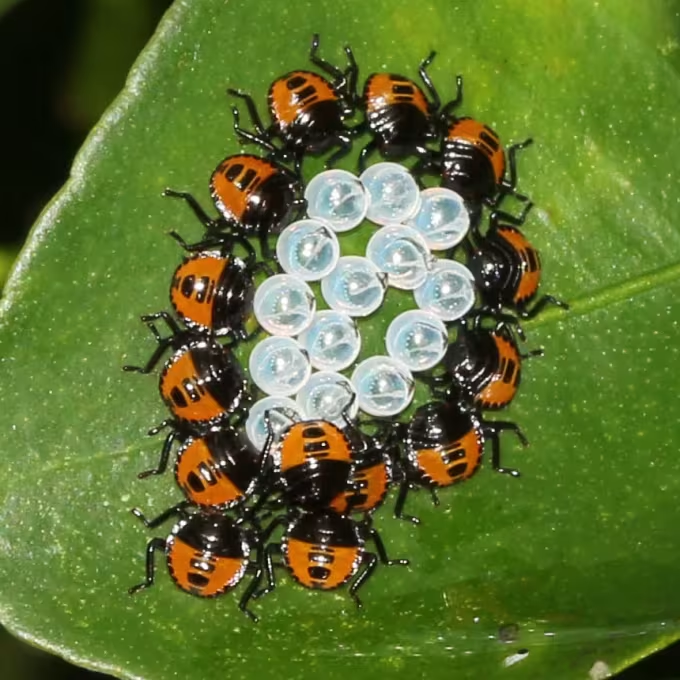
Nymphs of this species undergo several developmental stages. Throughout these stages, their appearance gradually matures to resemble the adult, often starting with more vivid or variegated patterns in younger instars.
Systematically, this insect is classified within the order Hemiptera. It represents a significant threat to commercial orchards, particularly those located in tropical and subtropical regions.
What it damages
Citrus fruits, including lemons, oranges, and mandarins, are the primary targets of the long-snouted stink bug. It is also capable of infesting various other orchard trees found within its geographic range.
Both adults and nymphs feed by inserting their long rostrums into young shoots, leaves, and developing fruit. This feeding process causes severe sap depletion, weakening the host plant's overall vitality.
When young fruit is punctured, it frequently deforms, ceases to grow properly, and often drops prematurely. This results in direct yield losses, which can be devastating for commercial growers.
Feeding punctures also act as entry points for secondary fungal and bacterial infections. These pathogens can cause necrotic spots and localized decay on the fruit skin and underlying tissues.
In cases of high pest density, the long-snouted stink bug can cause widespread fruit drop, leading to significant economic losses and potential degradation of orchard health over several seasons.
When it appears
The activity level of the long-snouted stink bug is heavily dependent on ambient temperatures. Populations typically peak during the active growing season of host trees in warmer months.
The species life cycle includes an overwintering stage. During the colder months, adult bugs enter a state of diapause, seeking shelter under tree bark or within leaf litter on the orchard floor.
As temperatures rise in the spring, the overwintering adults emerge to begin feeding and mating. This emergence usually correlates with the flush of new vegetative growth on fruit trees.
Egg clusters are typically deposited on the underside of leaves. The hatching of nymphs coincides with the period when young fruits are forming, making them highly vulnerable to feeding pressure.
Multiple generations can be produced within a single season, leading to a steady increase in population numbers that often reaches its maximum intensity by mid-to-late summer.
Signs of infestation
The most immediate sign of an infestation is the appearance of small, dark, indented punctures on the surface of the fruit. These marks are direct results of the bug's long rostrum insertion.
Leaves on attacked branches may exhibit signs of yellowing, curling, and early senescence. High levels of infestation can lead to stunted growth across the affected parts of the tree canopy.
Visual spotting of adult bugs resting on citrus branches, especially during the cooler hours of the morning or evening, is a primary confirmation of their presence in the orchard.
Inspecting the undersides of leaves will often reveal egg batches laid in uniform, neat rows. This is a critical indicator of the initial establishment of a new generation in the orchard.
A distinct, pungent odor released by the bug's scent glands when disturbed is another reliable diagnostic sign that a significant population of these pests is present in the foliage.
Control measures
Effective management of the long-snouted stink bug requires an integrated approach combining cultural and chemical tactics. Regular monitoring is essential to catch infestations before they escalate.
- Manual collection and destruction of adult bugs during the morning hours when they are less active.
- Maintaining clean orchard floors through weed control to eliminate potential overwintering sites for the pests.
- Application of systemic or contact insecticides when monitoring indicates that population density has exceeded economic thresholds.
- Encouraging biological control by protecting and promoting the activity of natural predators and parasitoids.
- Optimizing irrigation and fertilization schedules to ensure trees are healthy and more resilient to pest pressure.
When utilizing chemical interventions, it is vital to adhere strictly to recommended application rates and pre-harvest intervals to ensure that the final fruit remains safe for consumer markets.
Taxonomy
- Latin name
- Rhynchocoris longirostris
- Order
- Hemiptera (bugs, aphids, leafhoppers)
- Family
- Pentatomidae
- EPPO code
- RHCRLO
Discussion
No discussions yet — be the first.