
Cotton shield bug
Rhynchocoris humeralis
Description
How to identify
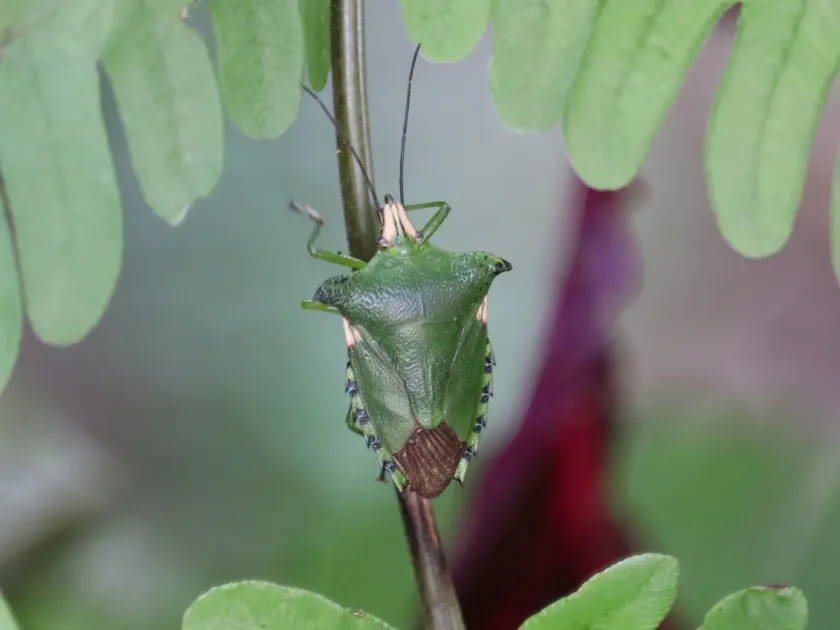
The cotton shield bug (Rhynchocoris humeralis) belongs to the order Hemiptera and the family Pentatomidae. These insects are easily recognized by their distinct shield-shaped body and prominent humeral angles on the pronotum.
Adults typically exhibit a greenish-yellow to brown coloration, which provides excellent camouflage against leaves and stems. They possess a specialized piercing-sucking mouthpart designed to feed on plant vascular tissues.
The nymphal stages are smaller and often more vibrantly colored than adults, lacking fully developed wings. They undergo several molts before reaching the reproductive adult phase.
The insect thrives in warm climates, where environmental conditions support multiple generations per year. They overwinter in sheltered areas, such as leaf litter, bark, or field debris.
Given their reproductive capacity, these bugs can rapidly colonize agricultural fields, making early detection critical for maintaining population levels below the economic threshold.
What it damages
The primary host for this pest is cotton, though it frequently attacks various citrus, ornamental, and fruit-bearing trees. Both nymphs and adults feed by inserting their proboscis into plant tissues.
Feeding on reproductive structures such as flower buds and young bolls is particularly destructive. It causes premature shedding of fruit, which directly reduces the overall harvest volume.
When the bug feeds on developing cotton bolls, it creates puncture wounds that lead to malformed fibers and lower quality lint, rendering the harvest less valuable commercially.
Puncture sites serve as entry points for secondary pathogens like fungi and bacteria, which cause rot and tissue decay within the plant, exacerbating the damage done by the insect itself.
Prolonged feeding on vegetative parts leads to stunted growth and reduced plant vigor, making the crop more susceptible to environmental stressors and other pests.
Signs of infestation
Initial signs of infestation appear as small, whitish spots on leaves, which gradually develop into necrotic patches where the bug has extracted cell sap.
Direct sightings of insects, especially on the underside of leaves or clustered near developing bolls, confirm their presence. They are typically most visible during the early morning.
A sudden, inexplicable drop of flower buds and young bolls is a major indicator of infestation, often caused by the insect feeding at the base of the fruit stem.
A distinct, pungent odor may be present in areas with high insect density, as these bugs release defensive secretions from their scent glands when disturbed.
Evidence of excrement, appearing as small dark droplets on leaves or boll surfaces, is a clear sign that the population has been actively feeding in the vicinity.
Control measures
Cultural control is the first line of defense; this includes deep plowing after harvest to bury and destroy overwintering sites, and removing debris where the bugs hide.
Effective weed management is essential, as many common weeds serve as secondary hosts and reservoirs that allow the bug population to survive during the off-season.
Biological control methods involve supporting natural enemies, such as parasitic wasps and predatory insects, which can keep bug populations in check without the use of harsh chemicals.
When infestation levels exceed the threshold, targeted application of systemic insecticides may be necessary to protect the crop during critical growth stages.
- Deploying pheromone traps for population monitoring.
- Implementing crop rotation to break the insect's life cycle.
- Applying border sprays to prevent mass migration into the field.
Taxonomy
- Latin name
- Rhynchocoris humeralis
- Order
- Hemiptera (bugs, aphids, leafhoppers)
- Family
- Pentatomidae
- EPPO code
- RHCRHU
Discussion
No discussions yet — be the first.