
Rhynchocoris
Rhynchocoris
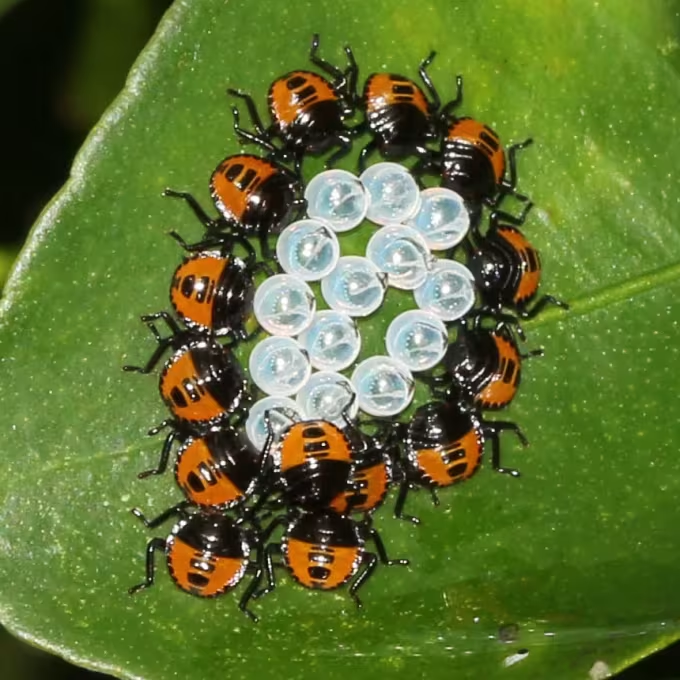
Description
How to identify
Rhynchocoris is a genus of insects belonging to the Pentatomidae family, commonly known as stink bugs. These insects are characterized by a shield-shaped body, which is a hallmark of the Pentatomidae family and provides a distinct visual identifier.
They possess a piercing-sucking mouthpart, scientifically known as a rostrum, which they use to penetrate plant tissues and extract sap. Adults often display protective coloration ranging from green to brown, enabling them to camouflage perfectly against foliage.
The life cycle involves incomplete metamorphosis, progressing through egg, nymphal, and adult stages. Nymphs pass through several instars, gradually developing wing pads and becoming more similar to the adult form in appearance.
These bugs are equipped with scent glands located on the thorax, which emit pungent chemicals when the insect is disturbed or threatened. This defensive mechanism is highly effective against many avian and invertebrate predators.
As members of the order Hemiptera, they are well-adapted to surviving on woody plants and shrubs, where they can maintain stable populations by feeding on various plant reproductive parts.
What it damages
Rhynchocoris species are primarily recognized as pests of citrus crops, including oranges, mandarins, and lemons. They show a strong preference for the succulent tissues of developing fruit and tender shoots.
Feeding activity involves the insertion of the proboscis into the fruit, where the bug injects salivary enzymes to liquefy the contents. This process leads to localized tissue necrosis, which manifests as darkened spots on the fruit surface.
Heavy infestations can cause the premature abscission of fruit, leading to significant yield losses for growers. Even if the fruit remains on the tree, the physical damage and deformation reduce its market value.
Furthermore, the puncture wounds created during feeding can serve as entry points for secondary pathogens, such as fungi or bacteria, leading to fruit rot during the post-harvest stage.
Persistent feeding by a large population of these bugs stunts the overall growth of young branches, impacting the tree's health and future bearing capacity for several subsequent seasons.
When it appears
The emergence of Rhynchocoris typically coincides with the arrival of warmer weather in spring, when citrus trees are entering their active growth and flowering phases.
The early spring period is the most critical time for monitoring as overwintered adults move from their sheltered locations to begin feeding and laying eggs on the new flush of growth.
Population peaks are generally observed in mid-summer, as the temperature and humidity conditions become optimal for the development of nymphal stages, which are the most voracious feeders.
As temperatures begin to drop in the autumn, adult activity decreases significantly. The insects start seeking suitable crevices under tree bark or deep within leaf litter to undergo diapause during the winter months.
Orchard managers must stay vigilant during the fruit-set period, as the synchronization between the pest's life cycle and the tree's development makes this the high-risk window for damage.
Signs of infestation
The most reliable sign of a Rhynchocoris infestation is the presence of small, dark necrotic punctures on the surface of developing citrus fruit, often accompanied by slight depressions in the skin.
An unusual amount of fruit drop, specifically young fruit found scattered under the canopy, is a strong indicator that a significant population of the pest is active in the orchard.
A distinctive, pungent odor emitted when foliage is disturbed is a hallmark of stink bug presence and can be used as a practical detection method during field scouting.
Deformation of the fruit, such as uneven development or the appearance of bumps and ridges, confirms that the feeding injury occurred during the early stages of fruit enlargement.
Direct sightings of nymphs or adults on the undersides of leaves or clustered near the fruit peduncle confirm an active infestation that requires immediate attention.
Control measures
Effective management requires an integrated pest management (IPM) approach that emphasizes consistent monitoring and the timely application of control measures to prevent economic damage.
Chemical control, utilizing selective insecticides, is most effective when targeted at the nymphal stages before they reach maturity. Timing of application is crucial to maximize efficacy while protecting beneficial insects.
Cultural practices, such as maintaining a clean orchard floor and regular pruning, play a vital role in reducing the number of suitable overwintering sites and increasing airflow within the canopy.
Preserving natural enemies, such as egg parasitoids, is essential for long-term population suppression. Minimizing the use of broad-spectrum pesticides helps to maintain these beneficial populations.
- Regular visual monitoring of fruit and foliage.
- Application of insecticides focused on young nymphs.
- Sanitary pruning to improve orchard canopy ventilation.
- Control of weeds that serve as alternative host plants.
Taxonomy
- Latin name
- Rhynchocoris
- Order
- Hemiptera (bugs, aphids, leafhoppers)
- Family
- Pentatomidae
- EPPO code
- RHCRSP
Discussion
No discussions yet — be the first.