
European bitterling
Rhodeus amarus
Description
How to identify
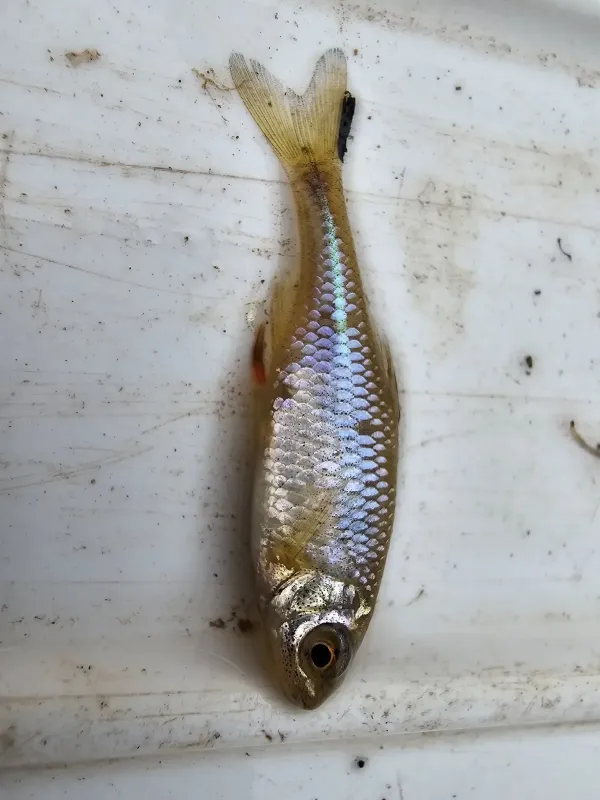
The European bitterling (Rhodeus amarus) is a small freshwater fish belonging to the family Cyprinidae, order Cypriniformes. It is a compact, deep-bodied fish typically growing to about 8–10 cm in length.
The species is characterized by its silver-colored body with a distinct greenish-blue lateral line. During the breeding season, males develop vivid, brilliant colors, with deep reds on their bellies and bright blue markings.
It is crucial to clarify that the European bitterling is a fish species living entirely in water. It is not an insect, a plant pathogen, or a pest that affects agricultural crops.
The biology of this species is highly specialized as it relies on freshwater mussels. Female bitterlings use an elongated ovipositor to deposit eggs safely inside the gills of living bivalve mussels.
This species is widely found in slow-moving rivers, canals, and ponds throughout Europe. It thrives in habitats where the water quality is clean and clear.
What it damages
The European bitterling does not damage plants or agricultural crops. It has no biological mechanism to consume, parasitize, or infect terrestrial crops or garden plants.
Its diet consists mainly of algae, detritus, and tiny planktonic organisms. It spends its entire life cycle submerged in water, preventing any physical contact with agricultural fields.
There is no evidence or historical record of this fish causing economic damage. Any confusion regarding its status as a "pest" likely stems from a linguistic mix-up with invasive weeds.
Specifically, the term "bitterling" (or "gorchak" in Slavic languages) is often confused with the invasive weed Acroptilon repens, which is indeed a serious agricultural threat. These are two completely different organisms.
In aquaculture, it might be categorized as a "weed fish" due to its low market value, but this is restricted to fish farming and does not concern plant cultivation or pest control.
Control measures
As the European bitterling is not a pest, there are no control measures required or recommended for this species in agriculture or gardening.
No herbicides, insecticides, or biological control agents should ever be used against this fish. Such actions would cause significant damage to the aquatic environment and violate environmental regulations.
In aquaculture environments where the population needs to be managed, the most effective method is to remove or restrict the host mussels required for the bitterling’s reproductive cycle.
Maintaining a healthy, balanced water ecosystem is the best approach to ensure that no single species dominates. Proper pond management practices are sufficient for maintaining population equilibrium.
The European bitterling is often considered a protected species in various regions due to its role as an indicator of clean water and its unique symbiotic relationship with mussels.
Taxonomy
- Latin name
- Rhodeus amarus
- Family
- Cyprinidae
- EPPO code
- RODEAM
Discussion
No discussions yet — be the first.