
Schneider
Alburnoides bipunctatus
Description
How to identify
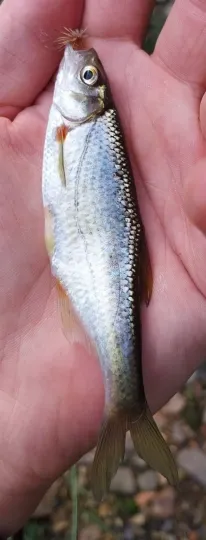
The Schneider (Alburnoides bipunctatus) is a small freshwater fish belonging to the family Cyprinidae. It is characterized by its slender body, silver scales, and a distinctive dark dotted line along its lateral side, which makes it easily identifiable.
Adult specimens typically reach a length of 10 to 12 centimeters. The body shape is more compressed compared to its relatives, with a metallic luster that gives the fish a shimmering appearance under direct sunlight.
As a rheophilic species, the Schneider prefers running waters with strong currents, often found in rivers and streams with gravel or rocky bottoms. They gather in schools to navigate the water column efficiently.
Taxonomically, it is categorized within the order Cypriniformes. While it plays a natural role in river ecosystems, its presence in managed aquaculture ponds often leads to conflicts over resources with commercially valuable species.
The fish has a semi-inferior mouth structure, which allows it to feed on a variety of surface and mid-water food sources, making it a highly adaptable competitor in various aquatic environments.
What it damages
In aquaculture, the Schneider acts as a food competitor to commercial species like carp or trout. It feeds primarily on zooplankton, which is essential for the healthy growth and development of young farmed fish.
Beyond competition, Schneider populations can consume the eggs of other fish species, leading to significant losses in natural spawning success within managed ponds or reservoirs where mixed populations might exist.
High population densities of this species can deplete the natural feed supply in a pond, leading to reduced growth rates and lower weight gain for the intended crop of commercial fish.
The economic impact of the Schneider is primarily linked to its role as a "weed" fish, requiring additional labor and management resources to clear the pond population periodically to maintain high yields.
Furthermore, their presence in irrigation canals can lead to the accidental introduction of unwanted species into farming systems, necessitating the use of specialized filtration and water screening equipment.
When it appears
Schneider activity increases significantly during the spring months as water temperatures rise, typically starting in April, marking the beginning of their peak metabolic activity and reproductive cycle.
The spawning period occurs between May and June, when the fish migrate to shallow areas with gravel beds to release their eggs. During this time, they are most visible and vulnerable to population control efforts.
Summer is a period of intense feeding activity, where the fish utilize the entire water column to exploit available food resources, including insects and plankton, reaching peak population growth.
As water temperatures drop in the autumn, the fish consolidate into deeper, more stable areas of the water body to prepare for the winter period, reducing their foraging movements significantly.
During the winter months, Schneider enters a state of minimal activity, congregating in deep, quiet pockets to survive the cold, which makes direct intervention during this season ineffective.
Control measures
The most effective management strategy involves the systematic use of fine-meshed nets during pond harvesting to remove Schneider before introducing new commercial stocks into the system.
Physical barriers, such as high-quality intake screens, are essential to prevent the entry of Schneider from natural water sources into irrigation systems or closed aquaculture pond networks.
Biological control, which includes the stocking of native predator species like northern pike or zander, can effectively regulate the number of smaller cyprinids and keep the population at manageable levels.
Implementing a strict pond drying and liming schedule between production cycles ensures the elimination of residual eggs and larvae, preventing rapid re-infestation in the upcoming season.
- Installing fine-mesh intake filters.
- Regular harvesting of weed fish stocks.
- Using biological predators to manage population size.
Taxonomy
- Latin name
- Alburnoides bipunctatus
- Family
- Cyprinidae
- EPPO code
- ALBSBI
Discussion
No discussions yet — be the first.