
Root mealybug
Rhizoecus falcifer
Description
How to identify
The root mealybug (Rhizoecus falcifer) is a small insect belonging to the family Pseudococcidae. Unlike its above-ground relatives, it spends its entire life cycle in the soil.
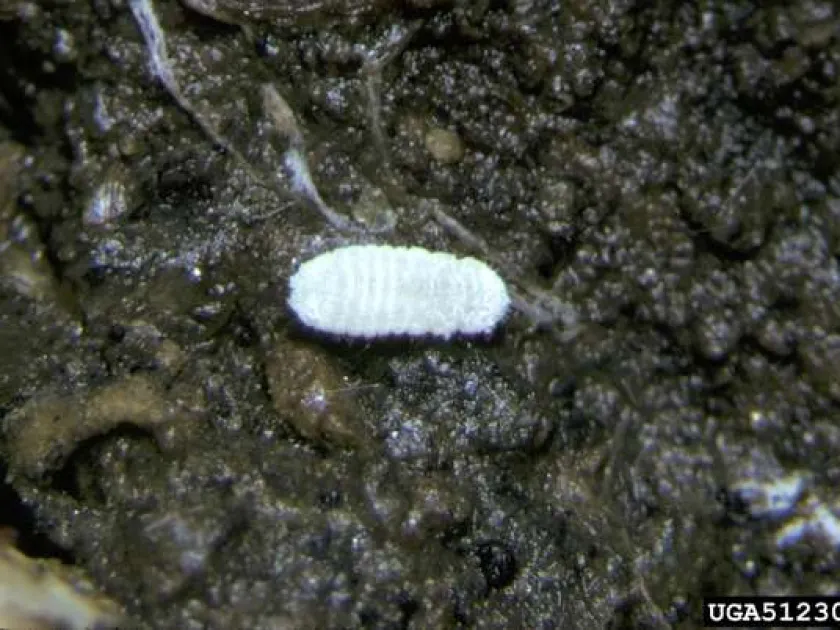
Adult individuals are approximately 2 to 3 millimeters long, possessing an oval body covered with a characteristic white, powdery, or waxy substance that repels water.
They are primarily found in the root zone of container-grown plants, where they cluster around roots to feed on plant sap.
The life cycle includes the egg stage, several larval instars (crawlers), and the adult stage. The crawlers are mobile and move through the soil to reach healthy roots.
Because they live underground, they are often difficult to detect until the plant starts showing severe signs of decline.
What it damages
The pest causes damage to various greenhouse and ornamental plants, including cacti, succulents, ferns, and several tropical foliage species.
By sucking sap from the roots, they deprive the plant of vital nutrients and moisture, which leads to stunted growth and loss of overall vigor.
The feeding activity creates small wounds on the roots, which serve as entry points for pathogenic fungi and bacteria, leading to further root decay.
Affected plants often stop producing new growth and may exhibit leaves that yellow and wilt, even if the soil appears to be properly hydrated.
In cases of severe infestation, the root system is systematically destroyed, leading to the rapid collapse and death of the entire plant.
When it appears
In interior environments such as homes, offices, or heated greenhouses, root mealybugs can thrive and reproduce all year round.
Their development is highly dependent on temperature, with optimal reproduction occurring in warm conditions typical of many indoor plant settings.
Seasonal fluctuations in light and temperature may slightly affect the rate of population growth, but the insects remain active in the soil at all times.
Dry and loose potting soil allows for easier movement of the crawlers, enabling them to spread from one pot to another if they are kept close together.
Regular inspections are necessary regardless of the season, as the damage is cumulative and can easily go unnoticed during the plant's dormant phase.
Signs of infestation
A primary indicator is the plant’s failure to respond to watering, appearing chronically thirsty despite moist soil conditions.
When removing a plant from its pot for inspection, look for white, cottony, or fuzzy masses adhering to the sides of the container or the roots themselves.
The plant may exhibit yellowing or wilting leaves, and the foliage may lack its usual lustre, signaling poor nutrient transport from the root system.
In some cases, small white specks resembling mold or mineral deposits can be observed on the surface of the soil or near the drainage holes.
Significant infestations often result in the plant becoming loose in the pot, as the root system has been severely compromised or eaten away.
Control measures
Management involves a combination of chemical and cultural practices to effectively reduce the pest population in the root zone.
The most effective chemical control method is the application of systemic insecticides that are taken up by the roots, making the plant tissues toxic to the pests.
For severe infestations, it is highly recommended to discard the old soil, wash the roots, and repot the plant in fresh, high-quality potting mix.
- Use systemic insecticides (such as those containing imidacloprid).
- Thoroughly sanitize pots and tools before reusing them.
- Quarantine all new plant additions to prevent initial infestations.
- Practice regular root inspections during routine plant maintenance.
Repeat treatments are essential to manage future generations that emerge from eggs, which are often protected from initial contact insecticide applications.
Taxonomy
- Latin name
- Rhizoecus falcifer
- Order
- Hemiptera (bugs, aphids, leafhoppers)
- Family
- Rhizoecidae
- EPPO code
- RHIOFA
Discussion
No discussions yet — be the first.