
Coffee root mealybug
Rhizoecus coffeae
Description
How to identify
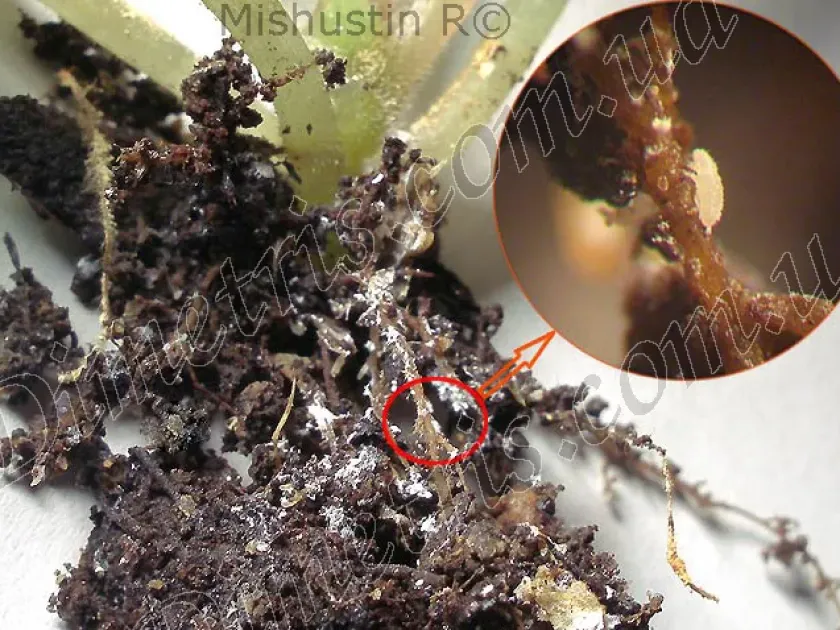
The coffee root mealybug (Rhizoecus coffeae) is a subterranean insect from the Pseudococcidae family. Measuring only 2–3 mm, these pests are characterized by their elongated bodies covered in a white, powdery wax that protects them while living in the soil.
Unlike their aerial counterparts, these mealybugs spend their entire life cycle below ground, clustering on the roots of host plants. Their cryptic behavior makes them invisible to casual inspection, often going undetected until the plant shows significant stress.
The female mealybug lays her eggs within fluffy, white wax sacs located in the soil or directly on the root surface. These sacs act as nurseries, shielding the offspring from environmental stressors.
Larvae, known as crawlers, are highly mobile and can travel through soil pores to colonize new roots or move into neighboring pots, making them a major challenge for plant collectors and greenhouse managers.
Their population growth is rapid in stable, warm, and humid environments, often reaching high densities before any outward signs of infestation are visible to the grower.
What it damages
The coffee root mealybug infests a wide range of plants, including coffee trees, palms, cacti, succulents, and various greenhouse ornamentals. They are a persistent problem in managed indoor environments where soil remains consistently moist.
By piercing the roots and feeding on plant sap, these insects disrupt the plant's ability to absorb water and nutrients. This damage leads to stunted growth, yellowing leaves, and in severe cases, the eventual death of the plant.
Young plants and seedlings are particularly vulnerable, as their root systems lack the maturity and mass to survive heavy infestations. The weakened tissue also becomes a primary entry point for secondary soil-borne fungi and bacteria.
Economic losses in the ornamental plant trade are significant due to the rigorous inspection and quarantine requirements needed to keep facilities free of Rhizoecus coffeae.
The primary danger lies in the stealth of the pest; by the time the above-ground plant shows visible signs of decline, the root system is often severely compromised.
Signs of infestation
The first indicator of an infestation is a persistent lack of vigor in a plant that receives adequate water and light. Affected plants may stop growing and appear chronically wilted.
When removed from the pot, the root system often displays white, woolly deposits or small waxy clumps clinging to the roots or the interior surfaces of the container. These are the mealybug colonies and their egg sacs.
The soil itself may appear to contain white, powdery material that does not wash away with water. This is essentially the waxy residue produced by the insects during their life cycle.
Secondary infections, such as root rot, may develop as a consequence of the mealybug damage. The roots may appear darkened, necrotic, or fragmented, and in some cases, emit an unpleasant odor.
If a plant remains stagnant despite proper care, growers should gently unpot it to inspect the root ball for any white, cotton-like masses, especially if the plant has not been repotted in a long time.
Control measures
Successful management begins with a complete change of substrate. Infected plants should be carefully removed from their pots, and the root system must be thoroughly washed to eliminate all traces of the old soil, larvae, and eggs.
Applying systemic insecticides that are taken up by the roots is an effective strategy. Drenching the soil with products containing imidacloprid or similar active ingredients can effectively kill the insects as they feed on the sap.
Biological control, using predatory mites or entomopathogenic nematodes, can provide sustainable relief in controlled environments like greenhouses, provided the climate is suitable for these beneficial organisms.
Prevention is the best defense. All new plants should be quarantined for several weeks and inspected for subterranean pests before being introduced to a collection. Using sterile, high-quality potting mixes is also recommended.
- Thoroughly wash roots during repotting.
- Use systemic insecticides for soil drenching.
- Quarantine new plants to prevent cross-contamination.
- Sanitize pots and tools after dealing with an infested plant.
Taxonomy
- Latin name
- Rhizoecus coffeae
- Order
- Hemiptera (bugs, aphids, leafhoppers)
- Family
- Rhizoecidae
- EPPO code
- RHIOCO
Discussion
No discussions yet — be the first.