
Rhammatocerus pictus
Rhammatocerus pictus
Description
How to identify
Rhammatocerus pictus is a member of the Acrididae family within the Orthoptera order. This species is recognized for its adaptive physical characteristics that allow it to thrive in various grassland and agricultural environments.
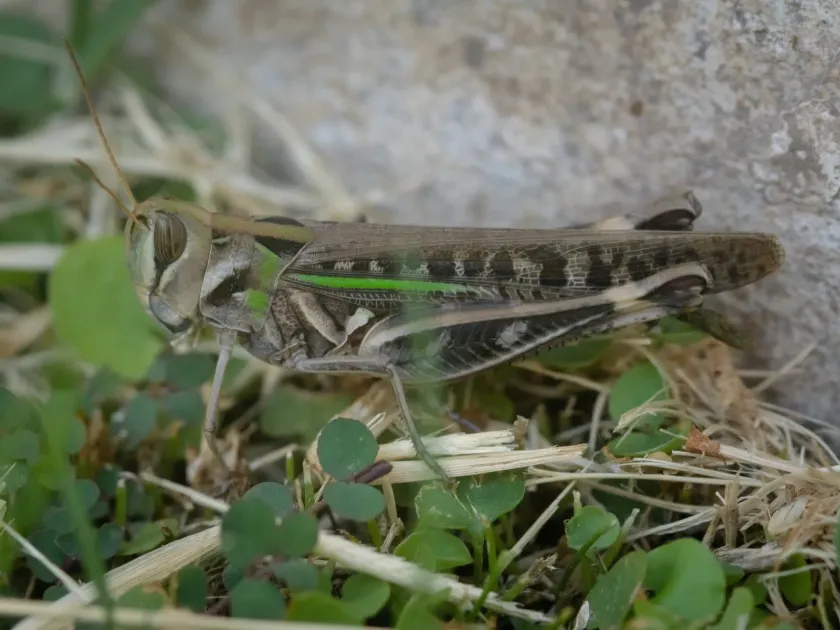
Adults possess streamlined bodies with strong hind legs adapted for jumping, as well as powerful wings. Their coloration, featuring mottled patterns, provides excellent camouflage among dry stems and foliage.
The nymphal stages resemble miniature adults, though they lack fully developed wings. Throughout their development, they undergo several molts, progressively increasing in size and physiological maturity.
Morphological identification focuses on the structure of the pronotum and the specific venation patterns of the tegmina. These traits are essential for distinguishing this species from other related grasshoppers.
The life history involves egg deposition in soil within protective structures known as pods. These eggs are highly resistant to environmental stressors, ensuring the species' survival through adverse conditions.
What it damages
As a polyphagous insect, Rhammatocerus pictus poses a significant threat to various agricultural crops. Cereal crops, particularly wheat, corn, sorghum, and millet, are among its primary food sources.
The pest consumes green tissue, including leaves, stems, and stalks. Heavy infestations can lead to total defoliation, which severely hampers the plant's photosynthetic capacity and potential yield.
Pastures and rangelands also suffer extensively, as the grasshopper population competes directly with livestock for forage. This leads to diminished biomass availability for cattle and other animals.
The damage is particularly severe during the high-density stages of the population. Rapid consumption by swarms can leave an entire field barren in a matter of days if left unmanaged.
Furthermore, feeding damage creates entry points for fungal and bacterial pathogens, leading to secondary plant diseases. This compound effect significantly worsens the overall agricultural output.
When it appears
The life cycle is closely synchronized with seasonal weather patterns. Egg hatching typically occurs in early spring, triggered by rising soil temperatures and moisture levels.
Development from nymph to adult progresses through the late spring and early summer. During this time, the nymphs require a consistent supply of food to facilitate their rapid growth.
Adult emergence usually peaks in mid-summer. These mature, winged individuals are capable of long-distance movement, allowing them to invade new territories and crop fields.
Late summer and autumn are characterized by mating and oviposition. Females select suitable soil sites to lay their eggs before the onset of cooler temperatures.
Winter is spent in the egg stage, buried beneath the soil surface. The eggs enter a state of diapause, waiting for the return of favorable spring conditions to begin the next generation.
Control measures
Monitoring programs are the cornerstone of effective management. Regular scouting of field edges and grassy corridors helps identify infestation clusters before they spread.
Mechanical control, such as autumn tillage, is highly recommended. Breaking up the soil destroys egg pods, effectively reducing the potential population density for the following year.
Chemical control is utilized when populations exceed established economic thresholds. Applying insecticides during the early nymphal stages is most effective, as the insects are less mobile.
Integrated Pest Management (IPM) strategies include the rotation of insecticide modes of action to prevent the development of resistance within the grasshopper population.
Promoting a healthy environment for natural predators, such as birds and parasitoid wasps, provides a sustainable way to keep populations in check without constant pesticide reliance.
Taxonomy
- Latin name
- Rhammatocerus pictus
- Order
- Orthoptera (locusts)
- Family
- Acrididae
- EPPO code
- RHAEPI
Discussion
No discussions yet — be the first.