
Rhammatocerus
Rhammatocerus
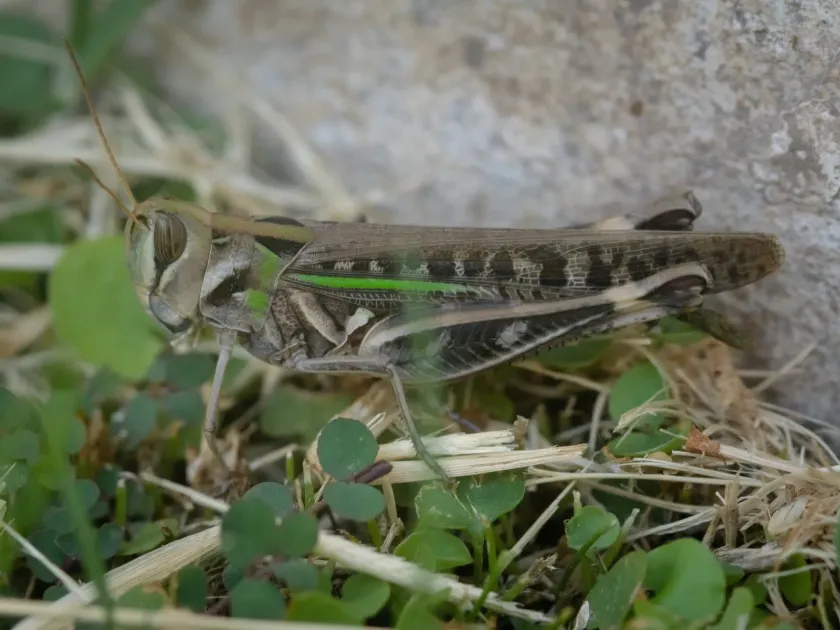
Description
How to identify
Rhammatocerus is a genus of grasshoppers belonging to the Acrididae family within the order Orthoptera. These insects are known for their strong jumping legs and specialized mouthparts designed for chewing vegetation.
The appearance of adults typically includes cryptic coloration, which helps them blend into grasses and crops, making visual detection difficult during the early stages of infestation.
The life cycle consists of three main stages: egg, nymph, and adult. Eggs are laid in the soil within protective pods, which provides a high survival rate during harsh seasonal conditions.
Nymphs resemble smaller, wingless versions of adults. They progress through several developmental stages before reaching their final winged form, gradually increasing their consumption of plant material.
Accurate species identification often requires professional entomological examination of male genitalia, as different species within the genus share very similar morphological traits.
What it damages
Rhammatocerus acts as a significant pest for many agricultural crops. It shows a strong preference for cereal crops, including maize, wheat, barley, and rice, causing extensive damage to leaves and stems.
Beyond cultivated crops, these grasshoppers feed on diverse pasture grasses, creating competition for food resources in areas where livestock grazing is essential.
During outbreaks, these pests exhibit swarm-like behavior, where massive numbers of insects consume all accessible green biomass in a field, leaving behind decimated stalks.
The damage is not limited to the vegetative parts of the plant; they frequently attack reproductive organs like heads or tassels, significantly reducing grain yield and overall crop quality.
The level of destruction depends heavily on population density. High numbers lead to rapid migration, causing the pest to spread across vast agricultural landscapes if not contained.
When it appears
The seasonal activity of Rhammatocerus is determined by climatic cues. The emergence of nymphs typically begins in spring as soil temperatures rise, triggering egg hatching.
The peak period of feeding activity coincides with the vegetative phase of major cereal crops, meaning the most critical damage occurs when plants are trying to establish their biomass.
Adults are most active during the warmest summer months. During this period, their mobility increases significantly, allowing them to traverse large areas in search of fresh vegetation.
Generally, the species completes one generation per year, although favorable climatic conditions can sometimes accelerate developmental stages in certain regions.
By autumn, adult activity decreases significantly. After completing reproduction and laying eggs for the following year, the adult population dies off, completing the annual cycle.
Signs of infestation
The primary sign of infestation is irregular or notched leaf edges, which are caused by the feeding activity of the nymphs and adults as they consume the plant tissue.
Significant amounts of insect excrement (frass) found on the soil surface or trapped within plant leaves are strong indicators of a large local population density.
A noticeable reduction in plant density or the presence of completely bare stems in specific sections of the field serves as a late-stage warning of severe infestation.
An auditory sign of their presence is the noise generated in the field, as the insects jump or fly in large numbers when disturbed by machinery or human movement.
Visual identification of the insects themselves, especially when grouped together on lower leaves, confirms the pest presence before widespread damage becomes irreversible.
Control measures
Effective management of Rhammatocerus requires an integrated approach that focuses on prevention and timely intervention to maintain populations below the economic damage threshold.
Cultural control is a primary method; deep plowing or harrowing of soil after harvest is highly effective at destroying egg pods buried in the ground, preventing the next generation's emergence.
Chemical control should be applied strictly based on monitoring data, targeting nymphs of earlier developmental stages, as they are more susceptible to standard insecticides.
Monitoring using traps and systematic field scouting allows farmers to detect infestations early, enabling localized treatment rather than broad-spectrum spraying across entire fields.
Biological control methods, such as utilizing naturally occurring entomopathogenic fungi, are increasingly used to suppress grasshopper populations in an environmentally friendly manner.
Taxonomy
- Latin name
- Rhammatocerus
- Order
- Orthoptera (locusts)
- Family
- Acrididae
- EPPO code
- RHAESP
Discussion
No discussions yet — be the first.