
Ramburiella
Ramburiella
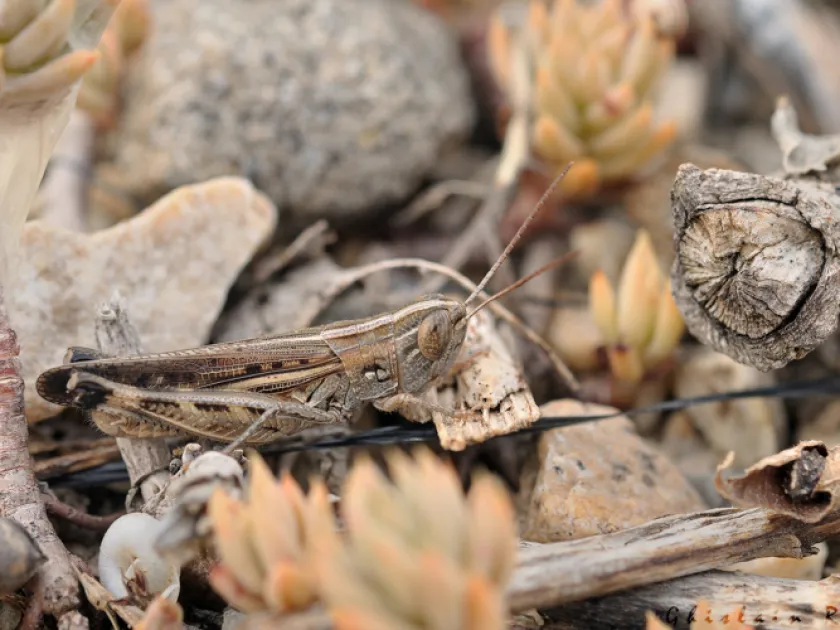
Description
How to identify
Ramburiella is a genus of insects belonging to the family Acrididae, commonly known as short-horned grasshoppers. These insects possess a robust morphology with specialized hind legs designed for jumping, which is a characteristic feature of the order Orthoptera.
Adult insects, or imagoes, typically exhibit cryptic coloration, allowing them to blend into the dry vegetation and soil of their habitat. They possess well-developed wings, enabling them to move across significant distances to forage for food or find suitable breeding sites.
The head of the insect is equipped with strong, biting mouthparts capable of masticating tough plant tissues. Entomologists identify specific species within this genus by examining morphological traits such as the shape of the pronotum and the structure of the genitalia.
Nymphs of Ramburiella resemble the adults but are smaller and lack fully functional wings. The development from the nymph stage to the adult involves several molting stages, with each stage showing an increase in size and morphological development.
These grasshoppers are primarily diurnal, showing peak activity during warm, sunny hours. They favor open, arid, or semi-arid environments where vegetation is sparse, making them a common sight in steppe landscapes and agricultural fields.
What it damages
Ramburiella are polyphagous pests, meaning they feed on a wide range of host plants, including both wild grasses and various agricultural crops. Cereal crops such as wheat, barley, and millet are particularly susceptible to their feeding habits.
Besides cereals, these pests also damage forage grasses and legumes, posing a significant threat to pastures and hayfields. During outbreaks, they can cause extensive damage to large areas of farmland, leading to severe economic losses.
Feeding occurs at all life stages of the insect. Nymphs often feed on tender leaves, whereas older nymphs and adults are capable of devouring thick stems and foliage, leaving very little behind in heavily infested areas.
Severe infestations reduce the photosynthetic capacity of the plants, which hinders growth and grain development. In extreme cases, the entire plant may be consumed, resulting in total crop failure within the infested patches of the field.
The mechanical damage caused by their biting mouthparts also creates entry points for secondary pathogens. This increases the risk of plant diseases, such as fungal or bacterial infections, further compromising the overall quality of the harvest.
When it appears
The life cycle of Ramburiella is typically univoltine, meaning there is one generation per year. They overwinter in the egg stage, which are laid by females in the soil within protective structures known as egg pods.
Nymph emergence typically occurs in the spring when soil temperatures reach optimal levels. This timing is critical, as it often aligns with the early growth stages of cereal crops, providing an abundant food source for the developing nymphs.
The growth phase, passing through several instars, lasts for several weeks. As the nymphs grow, their nutritional requirements increase, leading to progressively higher levels of damage to the surrounding vegetation.
Adults usually appear in the second half of the summer. During this phase, they are most mobile and can migrate to new areas, spreading the infestation. This period is also when mating and subsequent egg-laying take place.
The life cycle concludes in the autumn, as adults die off with the onset of colder temperatures. The eggs remain dormant in the soil throughout the winter, waiting for the return of favorable spring conditions to begin the next cycle.
Signs of infestation
The primary sign of a Ramburiella infestation is the presence of irregular, notched edges on leaf blades. Unlike diseases, these bite marks are distinctively jagged, indicating the work of mechanical feeders with gnawing mouthparts.
The accumulation of frass (insect excrement) on leaves and the soil surface serves as another clear indicator of active feeding. Observing the insects themselves, which jump or fly away when disturbed, is the most direct way to confirm their presence.
In highly infested fields, distinct patches of depleted vegetation appear. These bare patches expand rapidly as the insect population moves across the field in search of fresh food sources.
Early morning monitoring is the best strategy for detection. During this time, lower temperatures make the nymphs less active, allowing agronomists to accurately estimate the population density and decide on intervention thresholds.
Damage to the grain heads (spikes) during the milk-ripening stage is a sign of a late-season or severe infestation. This level of damage often necessitates urgent management to prevent further yield loss.
Control measures
Integrated management of Ramburiella combines cultural and chemical approaches. Deep autumn plowing is a highly effective cultural practice, as it disrupts the egg pods and exposes them to environmental stress and predators.
Crop rotation and diligent weed management on field margins significantly reduce the availability of breeding sites and food resources. Planting crops at optimal times can also help them outpace the development of the pest.
Chemical control, using insecticides, should be implemented when population counts exceed the economic threshold. It is crucial to target the younger nymph stages, as they are more susceptible to treatment and smaller in number per unit of area.
Biological control options, such as using entomopathogenic fungi, are becoming increasingly relevant. These methods offer a more environmentally friendly alternative but require specific humidity and temperature conditions to be effective.
- Regular monitoring of fields using sweep nets to assess pest density.
- Elimination of weeds along roadsides and uncultivated edges.
- Application of approved insecticides according to local agricultural regulations.
- Localized treatment of breeding hot spots to minimize total pesticide usage.
Taxonomy
- Latin name
- Ramburiella
- Order
- Orthoptera (locusts)
- Family
- Acrididae
- EPPO code
- RAMBSP
Discussion
No discussions yet — be the first.