
Human flea
Pulex irritans
Description
How to identify
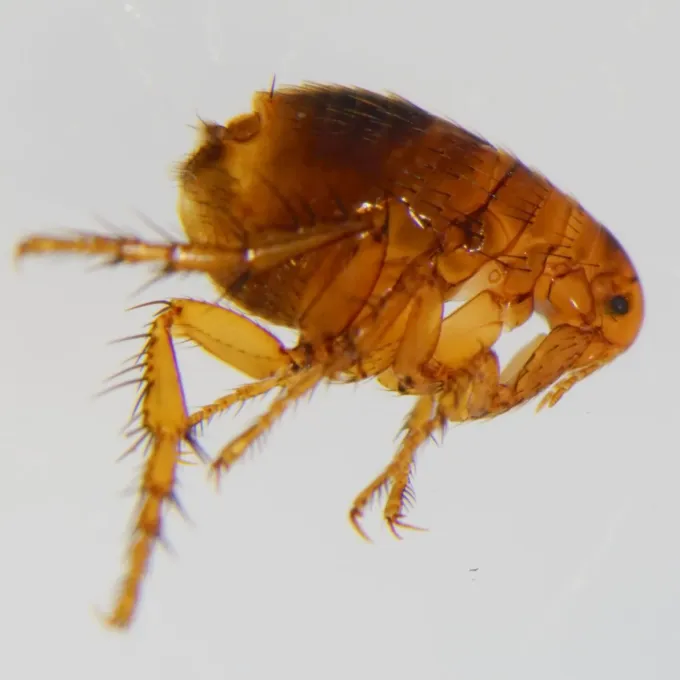
The human flea (Pulex irritans) is a member of the order Siphonaptera and the family Pulicidae. It is a wingless, blood-sucking insect characterized by a laterally flattened body adapted for rapid movement.
Adults measure between 2 and 4 mm in length and possess a dark brown color. Their mouthparts are strictly modified for piercing the skin and feeding on the blood of warm-blooded hosts.
The larvae are small, legless, worm-like organisms that thrive in organic debris, dust, or animal bedding. They feed on decaying organic matter rather than any parts of living plants.
Pupae develop within a silk cocoon, which is typically masked by dust or soil particles, making them very difficult to locate in a farm environment.
It is crucial to clarify that Pulex irritans is not a phytophagous insect. It does not feed on crops and is not categorized as a plant pest in agricultural science.
What it damages
This species does not cause any damage to crops, vegetables, or trees. Its host range is limited to humans, dogs, cats, and pigs.
For an agronomist, the presence of these fleas is purely a sanitary issue regarding farm workers' health and general animal welfare.
Unlike flea beetles (Chrysomelidae), which pose a severe threat to seedlings, the human flea has no enzymatic ability to digest plant tissues.
No agricultural economic damage occurs; therefore, field pest control protocols are inapplicable and unnecessary for this specific insect.
The presence of human fleas should not be confused with horticultural pests, and treating fields with insecticides for this purpose is ineffective and environmentally hazardous.
When it appears
The activity of human fleas is closely related to temperature and humidity levels within farm buildings or households.
In temperature-controlled environments, such as barns or livestock housing, the breeding cycle can occur year-round without a clear seasonal break.
In outdoor settings, population peaks occur during warmer months when mammal hosts are more mobile and accessible for infestation.
Cold temperatures significantly slow down the insect's metabolism, causing them to enter a state of dormancy until conditions improve.
High humidity is essential for larval survival in the substrate, which explains why flea populations often spike following periods of rain or in poorly ventilated sheds.
Signs of infestation
The most common sign of infestation is the appearance of painful, itchy bites on the legs of farm personnel and workers.
Infestations can be confirmed by inspecting dark corners, floor cracks, and bedding areas for accumulated organic debris containing larvae.
The presence of "flea dirt," which resembles tiny black pepper grains, is a reliable indicator of active flea populations in a facility.
Restless behavior among livestock, especially around resting areas, often points to a widespread parasite problem.
- Bites on human skin.
- Accumulation of black excrement in floor crevices.
- Agitated behavior in livestock.
Control measures
Management of the human flea relies on strict sanitary practices and professional pest control inside agricultural buildings.
Regular deep cleaning and the removal of organic dust and animal bedding are the most effective ways to eliminate larval developmental sites.
Approved indoor insecticides should be used on surfaces to kill adult fleas, following all safety protocols for livestock and humans.
Treating animals with veterinary-approved flea control products is a critical step in preventing the spread of the parasite throughout the farm.
Preventative measures include blocking access to barns for wild animals and rodents, which often serve as carriers for flea infestations.
Taxonomy
- Latin name
- Pulex irritans
- Family
- Pulicidae
- EPPO code
- PULXIR
Discussion
No discussions yet — be the first.