
Dog flea
Ctenocephalides canis
Description
How to identify
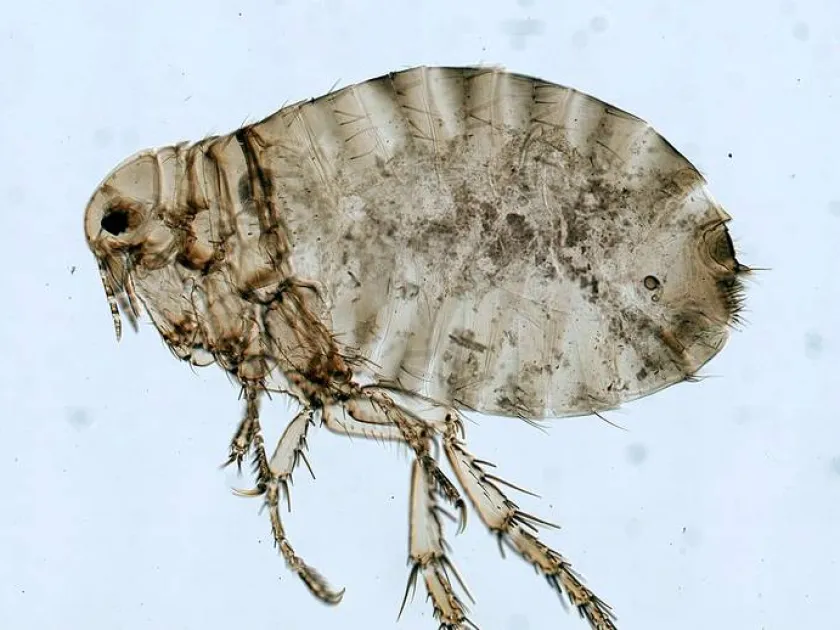
The dog flea (Ctenocephalides canis) is a flightless insect belonging to the order Siphonaptera and the family Pulicidae. Its body is laterally compressed, enabling it to move rapidly through animal fur.
Adults range from 1 to 3 mm in length and possess powerful hind legs adapted for jumping. They have piercing-sucking mouthparts specifically designed to feed on the blood of warm-blooded hosts.
The coloration of the adult flea ranges from dark brown to black. A key diagnostic feature is the presence of combs (ctenidia) on the head and thoracic segments, which help the flea anchor itself in hair.
Larvae are small, legless, worm-like creatures with a whitish or yellowish appearance. They are covered in sparse bristles, making them difficult to spot in soil or debris.
The life cycle consists of four stages: egg, larva, pupa, and adult. The entire development process is dependent on the presence of suitable hosts within the environment.
What it damages
It is crucial to note that the dog flea is not a plant pest and does not cause damage to crops. It is classified as an ectoparasite primarily affecting livestock and working animals.
The main agricultural impact relates to the health and well-being of farm animals. Infestations lead to severe itching, skin irritation, and dermatitis, which negatively affect animal performance.
Flea infestations can lead to decreased productivity in working dogs and livestock due to constant stress and the potential transmission of pathogens and internal parasites, such as tapeworms.
The presence of fleas in farm outbuildings and storage areas can cause discomfort for human workers, impacting the overall efficiency of farm operations.
While not a direct threat to crop yield, the dog flea is an important hygiene pest that requires active management to maintain high standards of animal welfare on a farm.
When it appears
Dog flea activity is highly dependent on environmental temperature and humidity. The optimal temperature range for their rapid development is 18–25 degrees Celsius.
In temperate climates, flea populations peak during warmer months, thriving in outdoor kennels, shelters, and shaded areas where organic debris accumulates.
In heated agricultural buildings, the life cycle can continue year-round. Fleas do not typically enter a true hibernation but can remain in the pupal stage for several months during cooler periods.
The pupal stage is highly resistant to environmental stressors. Emergence of the adult flea is triggered by environmental cues such as vibrations and an increase in carbon dioxide levels.
These cues signal the approach of a potential host, ensuring that the adult flea emerges only when a meal source is likely to be nearby.
Signs of infestation
The most immediate sign of a flea infestation is behavioral changes in animals, characterized by frequent scratching, biting at the skin, or restlessness.
A visual inspection of animal bedding or nesting areas often reveals "flea dirt," which appears as tiny black specks resembling coal dust. These are the excrements of adult fleas.
Larvae may be found by inspecting cracks in floors, corners, or areas where organic dust and debris collect. They are photophobic and prefer protected, slightly humid environments.
The presence of jumping insects near animals is a definitive sign of infestation. Careful examination of a host's coat, especially near the tail base and belly, usually confirms the presence of adult fleas.
Secondary signs include allergic dermatitis, hair loss, and scabbing, which often develop as a result of the constant biting and the animal’s attempt to relieve the irritation.
Control measures
Effective control requires an integrated approach that targets both the adult fleas on the animals and the developmental stages in the environment.
Sanitation is the cornerstone of control. Frequent cleaning of living areas, including vacuuming floors and laundering bedding at high temperatures, significantly reduces the population of larvae.
Chemical control involves the use of approved insecticides on surfaces and veterinary-grade treatments applied directly to the animals to break the life cycle.
Treatment schedules must be strictly followed, as many insecticides do not kill the pupal stage, necessitating repeat applications to manage newly emerged adults.
- Apply professional-grade insecticides in animal housing and kennels.
- Regularly deworm livestock and dogs, as fleas are common vectors for tapeworms.
- Use repellents or systemic treatments on animals to prevent flea attachment.
- Keep farm premises dry and clean to eliminate habitats suitable for larvae.
Taxonomy
- Latin name
- Ctenocephalides canis
- Family
- Pulicidae
- EPPO code
- CTECCA
Discussion
No discussions yet — be the first.