
White-marked spider beetle
Ptinus raptor
Description
How to identify
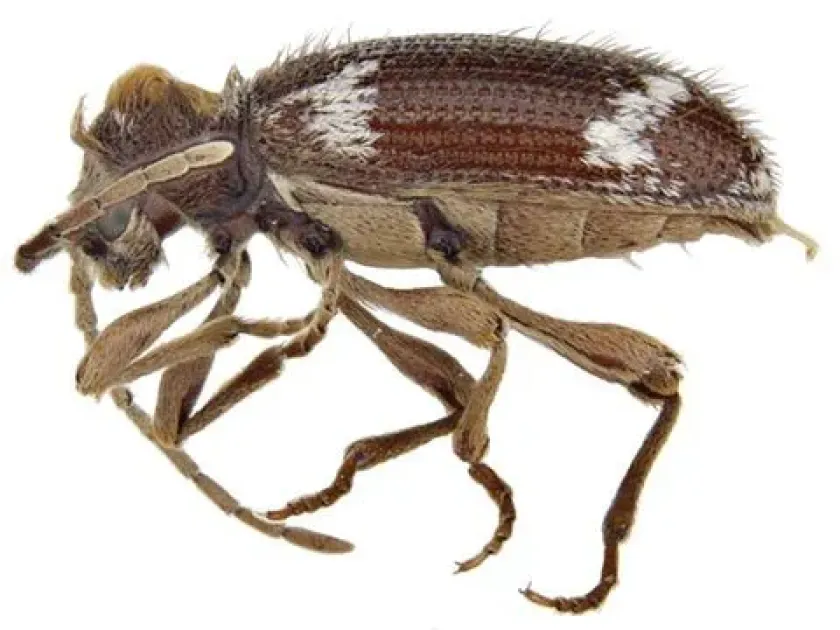
The white-marked spider beetle (Ptinus raptor) belongs to the order Coleoptera and the family Ptinidae. This small beetle is characterized by a rounded body, typically measuring between 2.5 and 4 mm in length.
Adult beetles have a brown or reddish-brown color. Their bodies are covered in hairs, giving them a distinct appearance. The name spider beetle derives from their long legs and the way they move, often mimicking spiders.
The larvae are whitish, with a curved body shape and a well-developed head capsule. They live inside the substrate, which makes detection during the early stages of infestation quite challenging.
The insect undergoes complete metamorphosis. Its life cycle consists of the egg, larva, pupa, and adult stages, with the larval stage being the longest and most destructive period of its development.
These beetles prefer dark and dry environments. They are photophobic, meaning they are most active at night or in the deep, unlit areas of warehouse facilities.
What it damages
This pest is a common inhabitant of warehouses, where it infests a wide range of agricultural products. Its primary food sources include grain crops, flour, and various cereals.
In addition to grain, the white-marked spider beetle readily consumes dried fruits, nuts, oilseeds, and confectionery products. It is frequently found in dry pet food and stored herbarium samples.
The pest can feed on organic debris and often compromises packaging to reach stored goods. Once introduced into a warehouse, it tends to infest old stocks and spread rapidly to new batches.
The most significant economic damage occurs through direct consumption of the product. Larvae bore into the interior of grains, leaving behind dust and excrement, rendering the product unfit for consumption.
Massive infestations lead to significant weight loss in stored goods. Furthermore, the insect's activity increases moisture levels in the substrate, creating ideal conditions for mold growth.
When it appears
In unheated warehouses, the development of the spider beetle slows down during winter months. The optimal temperature for rapid reproduction ranges between +20 and +25 degrees Celsius.
Given a stable microclimate, the pest can reproduce year-round. Generation turnover depends on the availability of food sources and the moisture level inside the storage facility.
Increased adult activity is observed during the spring and summer seasons, during which beetles may actively migrate across the warehouse. Monitoring efforts should be intensified during this time.
Pupation typically occurs within dense cocoons constructed by the larvae from food particles and their own secretions. These cocoons provide strong protection against external environmental factors.
The life cycle of a single generation takes about two to three months in favorable conditions, allowing the pest to build large, problematic populations if left unchecked.
Signs of infestation
A primary sign of infestation is the presence of small, rounded holes in the products, bored by the larvae. Accumulations of floury dust and silken cocoons can often be seen on the surface.
Detailed inspection of packaging often reveals empty larval skins and beetle fragments. A specific "musty" odor in the warehouse can also be a strong indicator of high-level infestation.
Adults are often found in warehouse corners, near bags on the floor, or within cracks in wooden structures. Their presence is easily detected using light traps or visual checks.
If large amounts of dust or "chaff" appear when screening a batch of product, this is a critical warning signal indicating significant damage caused by larval activity.
Finding live beetles on shelving units warrants immediate quarantine measures, as infestations can migrate across a storage facility with surprising speed.
Control measures
Maintaining high sanitary standards is crucial for preventing the spread of this pest. Regular cleaning of warehouses to remove dust, grain residues, and debris is a mandatory preventive measure.
Before storing new crops, facilities must undergo thorough disinfestation. Fumigation is effective for destroying the pest at all stages of its life cycle, including hidden individuals.
Controlling humidity within the storage facility is an effective method for suppressing population growth. Since spider beetles prefer moderately moist conditions, proper ventilation reduces risk.
Upon detecting infestation hotspots, affected products should be immediately isolated and heat-treated. In cases of severe damage, destruction or disposal of the batch is necessary.
- Regular monitoring using pheromone or sticky traps.
- Application of modern insecticides to treat warehouse surfaces.
- Sealing packaging to prevent insect access to products.
- Maintaining low temperatures in storage areas.
Taxonomy
- Latin name
- Ptinus raptor
- Order
- Coleoptera (beetles)
- Family
- Ptinidae
- EPPO code
- PTINRA
Discussion
No discussions yet — be the first.