
White-marked spider beetle
Ptinus fur
Description
How to identify
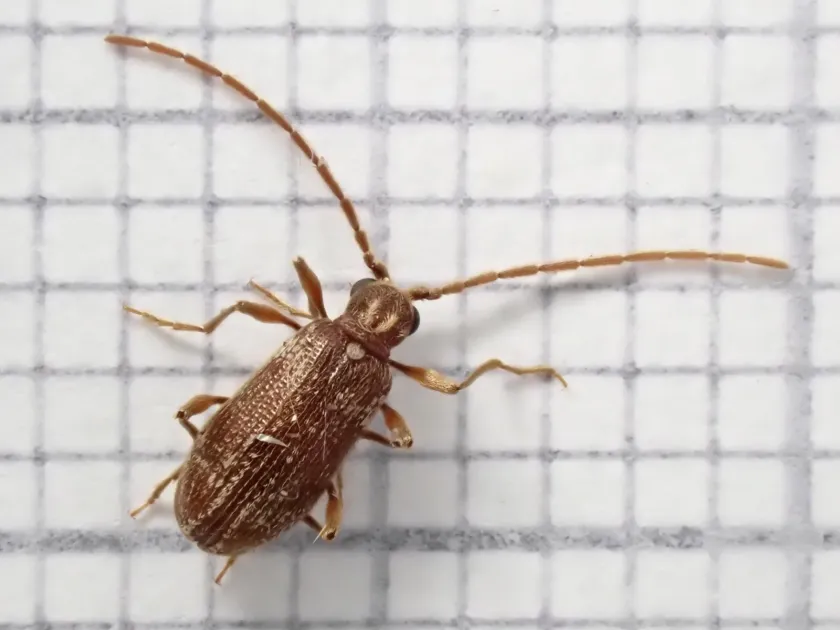
The white-marked spider beetle (Ptinus fur) is a small beetle belonging to the family Ptinidae (spider beetles) in the order Coleoptera. Adult beetles measure approximately 2 to 4 mm in length.
The species exhibits sexual dimorphism; males are more slender and elongated, while females are more rounded and globose. Their body color ranges from reddish-brown to dark brown or nearly black.
The elytra (wing covers) of the beetles are covered with dense hairs and scales, which often form distinct white markings or patches, giving the insect its common name.
Larvae are white, C-shaped, and grow to about 3–4 mm long. They are covered in fine, short hairs and are often found within the material they infest, feeding inside grains or seeds.
When disturbed, these beetles exhibit a "death-feigning" behavior, retracting their legs and antennae to look like inanimate objects or seeds, which serves as a defensive mechanism.
What it damages
As a significant stored-product pest, the white-marked spider beetle is polyphagous, attacking a wide variety of plant and animal-based products stored in warehouses or homes.
The larvae are responsible for the damage, as they bore into cereals, flour, seeds, pulses, nuts, and dry animal products, creating tunnels and consuming the nutrient-rich interior of the food.
Beyond agricultural grains, they are notorious for infesting wool, furs, dried insect collections, and herbarium specimens, which makes them a threat to both food storage and various archives.
Infested goods become contaminated with larval frass, webbing, and cast skins, rendering the products unfit for human consumption or processing.
High levels of infestation lead to the breakdown of grain structural integrity, increasing the risk of secondary mold development and self-heating within large grain bulks.
When it appears
In heated buildings, such as warehouses or residential pantries, the life cycle of Ptinus fur can continue year-round, provided that ambient humidity remains at a favorable level.
Development from egg to adult typically takes 3 to 4 months under optimal temperatures of 20–25°C, allowing for multiple generations to occur annually if conditions are met.
In unheated environments, activity is seasonal, with the beetles reaching their peak emergence and mating phase during the warmer months of late spring and summer.
The overwintering stage usually occurs as mature larvae within silk-like cocoons, which are constructed from food particles and debris in wall crevices or deep inside grain masses.
The ability to thrive in cool or dry environments makes this pest persistent, allowing it to survive in neglected areas of a storage facility for extended periods.
Signs of infestation
Visible signs of infestation include small, irregular holes in grain kernels or product packaging, often accompanied by thin webbing near the infested sites.
Fine dust, resembling flour or meal, accumulating beneath storage shelves or around bags is a common indicator of larval boring activity within the product.
Adult beetles are most visible during their nocturnal or crepuscular activity periods, when they may be found crawling on walls, ceilings, or the surface of stored containers.
A musty or unpleasant odor emerging from stored grain or foodstuffs often suggests that an internal pest population has reached a significant density.
Regular sifting of grain samples is the most reliable method for detecting hidden larvae, as it helps reveal the physical presence of the insects before massive damage occurs.
Control measures
Good sanitation is the most effective preventative measure; regularly cleaning debris, spills, and dust from storage areas removes potential breeding grounds for the beetles.
Maintaining low moisture levels in stored grains (below 14%) is critical, as the white-marked spider beetle requires a certain level of humidity to successfully complete its development.
Cold storage is highly effective; exposing infested materials to freezing temperatures for several days can kill all life stages, including larvae and eggs.
For industrial infestations, fumigation using phosphine or other approved gases is necessary to penetrate deep into grain bulks and eliminate hidden populations.
- Seal cracks in floors and walls to prevent shelter formation.
- Use pheromone-baited traps to monitor activity levels.
- Inspect incoming raw materials to prevent the introduction of the pest.
Taxonomy
- Latin name
- Ptinus fur
- Order
- Coleoptera (beetles)
- Family
- Ptinidae
- EPPO code
- PTINFU
Discussion
No discussions yet — be the first.