
Australian spider beetle
Ptinus clavipes
Description
How to identify
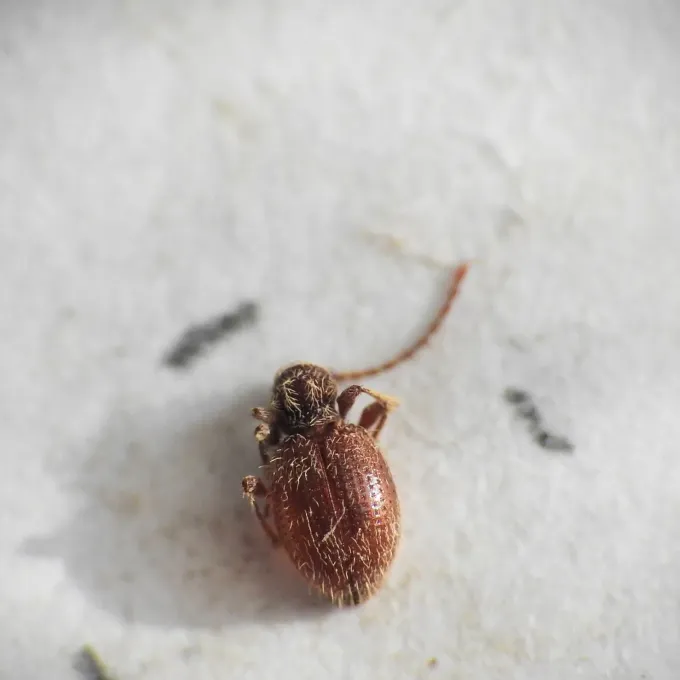
The Australian spider beetle (Ptinus clavipes) belongs to the order Coleoptera and the family Ptinidae. This insect is a small beetle, typically measuring between 2.5 and 4 mm in length, known for its distinctive humpbacked body shape.
The coloration of the beetle ranges from reddish-brown to dark brown. The body is covered with dense hairs, giving it a somewhat matte appearance, and its long legs allow it to move swiftly across surfaces.
Larvae are white, curved, and covered in sparse bristles, typical of spider beetle species. They spend their entire developmental period hidden inside the food substrate, feeding constantly to reach maturity.
The name "spider beetle" comes from its appearance, as they often resemble small spiders when viewed from above. They are also known for "playing dead" when threatened, retracting their limbs and remaining motionless.
These insects are primarily nocturnal or crepuscular, actively avoiding light during the day. They prefer to hide in dark, undisturbed cracks, crevices, or inside packaging materials within warehouses.
What it damages
The Australian spider beetle is a significant pest of stored products, causing damage to a wide variety of commodities. The larvae are the primary cause of damage as they burrow into food, feeding on the interior parts.
Commonly attacked items include grains, flour, bran, oatmeal, and processed cereal products. Furthermore, they frequently infest dried fruits, vegetables, medicinal herbs, and various seeds.
Spices, pasta, and even chocolate are susceptible to infestation if stored in non-airtight containers. The damage is characterized by internal tunneling and the presence of fine powder left behind by the feeding larvae.
Beyond direct feeding, the beetles contaminate stored items with their excrement, shed skins, and silk cocoons. This leads to substantial waste and the loss of commercial quality for the infested goods.
In household settings, this pest can infest pantries and kitchens, affecting long-term food supplies. Infested products often develop an unpleasant, musty odor and may harbor fungal growth stimulated by the larvae.
When it appears
The life cycle of the Australian spider beetle is strongly influenced by temperature and moisture levels. They thrive in environments with temperatures ranging from +20°C to +25°C.
In heated warehouses or residential buildings, these beetles can reproduce continuously throughout the year, resulting in multiple generations. In unheated conditions, their development slows down significantly.
Females lay their eggs on or near suitable food sources, including packaging surfaces or structural crevices. A single female can produce a large number of offspring over her lifespan.
The larval stage is the most prolonged phase, lasting several months. After the larvae complete their feeding, they pupate within a silk cocoon constructed from food particles and debris.
Adult activity peaks during the warmer months, during which time they are most likely to spread to new locations. Monitoring is especially crucial during these periods to prevent significant infestations.
Signs of infestation
The primary sign of an infestation is the presence of small, circular exit holes on the surface of packaging or within the grains themselves. These holes indicate that adults have emerged from the pupal stage.
If you inspect stored goods, you may find clumping caused by silk webbing spun by the larvae. The presence of dusty, flour-like debris is also a clear indicator of active feeding within the container.
A musty or moldy smell emanating from stored goods often serves as an early warning sign of pest activity. Finding adult beetles resting in dark, dusty corners or crevices confirms their presence.
Regular visual inspections of pantries, storage shelves, and transport containers are essential for early detection. Using a flashlight allows for better visibility in deep, dark corners.
Sieving samples of suspect grains or flour over a fine-mesh screen can help identify larvae or beetles that might not be visible upon initial surface inspection.
Control measures
Good sanitation is the most effective preventative measure against the Australian spider beetle. Keeping storage areas clean, dry, and free of food spills prevents the buildup of pest populations.
Fumigation is the standard professional method for managing heavy infestations in commercial storage facilities. It ensures that all life stages of the pest are eliminated from the treated products.
Storing commodities in hermetically sealed containers is a highly effective barrier. This prevents adults from entering to lay eggs and keeps larvae contained if an infestation occurs.
Controlling the environment by lowering storage temperatures or reducing humidity helps suppress beetle development. Proper aeration of grain before long-term storage is also recommended.
- Implement a strict "first-in, first-out" inventory rotation policy.
- Use pheromone traps for early detection and population monitoring.
- Dispose of severely infested products immediately to stop the spread to clean items.
Taxonomy
- Latin name
- Ptinus clavipes
- Order
- Coleoptera (beetles)
- Family
- Ptinidae
- EPPO code
- PTINCL
Discussion
No discussions yet — be the first.