
Mistletoe psyllid
Psylla visci
Description
How to identify
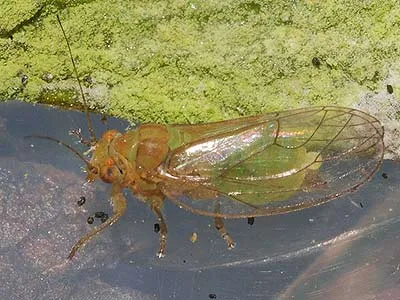
The mistletoe psyllid (Psylla visci) is a specialized insect species belonging to the family Psyllidae, commonly known as jumping plant lice. It is exclusively associated with the mistletoe plant (Viscum album).
Adult insects are small, featuring powerful hind legs designed for jumping. Their wings are transparent and held roof-like over the body, providing excellent camouflage against the host plant's foliage.
Larvae (nymphs) are flattened and often produce waxy secretions or filaments, which serve as a protective barrier against predators and environmental stress during their development.
The life cycle involves incomplete metamorphosis. Each stage of the insect is precisely synchronized with the growth phases of the mistletoe, ensuring a constant food supply.
Due to their highly specific habitat requirements, these insects are rarely found on any other plant species, making them a fascinating example of biological host specialization.
What it damages
The mistletoe psyllid feeds by extracting sap from the leaves and succulent stems of the mistletoe plant. This direct feeding deprives the parasite of essential nutrients.
High population densities can cause visible deformation of the mistletoe leaves, resulting in curling, chlorosis, and premature senescence of the affected plant tissues.
The constant drain of nutrients weakens the mistletoe, reducing its overall vitality and its ability to thrive on the host tree, although it rarely leads to the complete death of the mistletoe clump.
Feeding activities often leave behind sugary honeydew, which serves as a breeding ground for sooty mold fungi, further stressing the mistletoe's photosynthetic processes.
While the damage is detrimental to the mistletoe, it is often viewed as a natural regulatory mechanism that slightly limits the expansion of the mistletoe within a forest or orchard.
When it appears
The life cycle begins in early spring when nymphs emerge from eggs to coincide with the budding and active growth phase of the mistletoe.
During the summer months, nymphs are most active, congregating on the undersides of leaves to feed. Adults appear in late spring and early summer to mate.
As autumn approaches, the adults prepare for overwintering. They seek shelter in the crevices of the host tree bark or within the structure of the mistletoe plant itself.
The species survives the winter as eggs, which are remarkably hardy and well-protected by the plant tissues where they were deposited by the female.
The seasonal population peaks are influenced by temperature fluctuations and the availability of nutrient-rich sap within the mistletoe tissues.
Signs of infestation
The most reliable sign of a mistletoe psyllid infestation is the presence of white, waxy, thread-like filaments left behind on the mistletoe leaves and stems by the developing nymphs.
Infested mistletoe clumps often exhibit yellowing leaves, stunted growth, and visible curling of the foliage compared to healthy, uninfested plants.
Honeydew deposits, which appear as a sticky substance on the leaf surface, are often accompanied by the growth of black, velvety sooty mold.
If you tap or shake a mistletoe branch during a warm day, the jumping motion of disturbed adult psyllids is a clear indicator of their presence.
Small, localized necrotic spots on the leaves can also occur as a direct result of feeding wounds caused by the psyllid's mouthparts.
Control measures
In most professional or gardening contexts, control measures against the mistletoe psyllid are not deemed necessary due to the insect's limited and specific impact.
The primary method for removing psyllid populations is the mechanical removal of the mistletoe clumps themselves, which effectively eliminates their only food source.
Chemical control is generally avoided because it may negatively impact beneficial insects and birds that inhabit the trees, and because the mistletoe itself is the primary target for removal.
Promoting a healthy environment for natural predators, such as lady beetles and lacewings, helps keep psyllid populations at a sustainable, low level.
Regular tree inspection and the pruning of infected branches are the best practices for maintaining tree health and preventing the uncontrolled spread of mistletoe.
Taxonomy
- Latin name
- Psylla visci
- Order
- Hemiptera (bugs, aphids, leafhoppers)
- Family
- Psyllidae
- EPPO code
- PSYLVI
Discussion
No discussions yet — be the first.