
Elm sucker
Psylla ulmi
Description
How to identify
The elm sucker (Psylla ulmi) belongs to the order Hemiptera and the family Psyllidae. These are tiny, jumping insects that are specialized feeders on various species of elm trees (genus Ulmus).
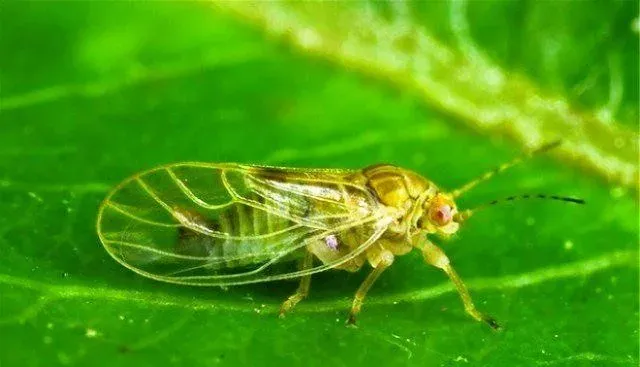
Adults are small, wedge-shaped insects, often green or brownish in color, which helps them camouflage against the leaves and bark of their host tree. They possess strong hind legs designed for jumping when disturbed.
The life cycle consists of the egg stage, five nymphal stages, and the adult stage. The species typically overwinters in the egg stage, with eggs deposited by females in cracks within the bark of young elm twigs.
Nymphs hatch in early spring during bud burst and immediately begin feeding on the sap of the emerging leaves. They are generally sedentary during the initial stages of development.
This pest is highly specific to elms, making its biological cycle strictly dependent on the phenological development of these trees throughout the growing season.
What it damages
Elm suckers target various elm species, including Ulmus glabra and Ulmus minor. They cause significant aesthetic and physiological damage, particularly to young trees in nurseries and urban areas.
Feeding by nymphs causes leaves to curl, twist, and form dense clusters. These deformations serve as shelters for the nymphs and protect them from weather and some predators.
The sap-sucking activity results in weakened growth of shoots, stunted tree development, and, in severe cases, premature leaf drop, which reduces the tree's overall vigor.
These insects produce copious amounts of honeydew, a sticky substance that falls on the foliage below. This leads to the growth of sooty mold, which creates a black film that blocks sunlight and inhibits photosynthesis.
Heavy infestations combined with sooty mold can significantly reduce the tree's health, making it more susceptible to other diseases, such as Dutch elm disease, which is a major threat to these trees.
When it appears
Activity begins in early spring as temperatures rise, triggering the eggs to hatch. This process is synchronized with the opening of elm buds to ensure an immediate food supply for the nymphs.
The most intense feeding period occurs throughout late spring and early summer, when nymphs are growing and producing large quantities of honeydew.
Adults emerge by mid-summer. They are much more mobile than the nymphs and disperse to different branches or adjacent trees for mating and feeding before the end of the season.
Generally, there is one generation per year, although favorable climatic conditions can extend the period of peak activity. Once the summer progresses, the population starts to decline.
In the autumn, adult females lay their eggs on the bark of twigs, which then remain dormant throughout the winter to repeat the cycle the following year.
Signs of infestation
The most obvious sign of infestation is the curling and malformation of young leaves. If you see clusters of twisted leaves on elm twigs, an elm sucker colony is likely present.
A sticky, shiny residue on the leaves and branches is a clear indicator of honeydew production, often accompanied by the presence of ants, which feed on the sweet liquid.
A black, sooty coating on the leaves is a secondary symptom, caused by sooty mold fungi growing on the honeydew excreted by the insects.
Upon closer inspection of the curled leaves, you may find the nymphs themselves, often surrounded by white, wool-like waxy secretions that protect their bodies.
Early-season yellowing of leaves and distorted shoot tips are reliable indicators that the population of elm suckers is high enough to justify control measures.
Control measures
The primary control strategy involves the application of systemic insecticides during the early spring, precisely when the eggs are hatching, before the leaves have fully curled.
Sanitation is also important; pruning and removing highly infested shoots during the early stages of infestation can help to suppress the growth of the population in young plantations.
Biological control plays a significant role in natural ecosystems. Encouraging natural predators like ladybirds, lacewings, and predatory bugs can help keep elm sucker populations below economic damage thresholds.
Maintaining the overall health of the trees through proper watering and soil management is crucial, as healthy trees are better equipped to withstand the stress caused by pest feeding.
In municipal or park settings, using horticultural oils can be an effective way to manage the overwintering eggs on the bark before they hatch in the spring.
Taxonomy
- Latin name
- Psylla ulmi
- Order
- Hemiptera (bugs, aphids, leafhoppers)
- Family
- Psyllidae
- EPPO code
- PSYLUL
Discussion
No discussions yet — be the first.