
Three-spotted psyllid
Psylla trimaculata
Description
How to identify
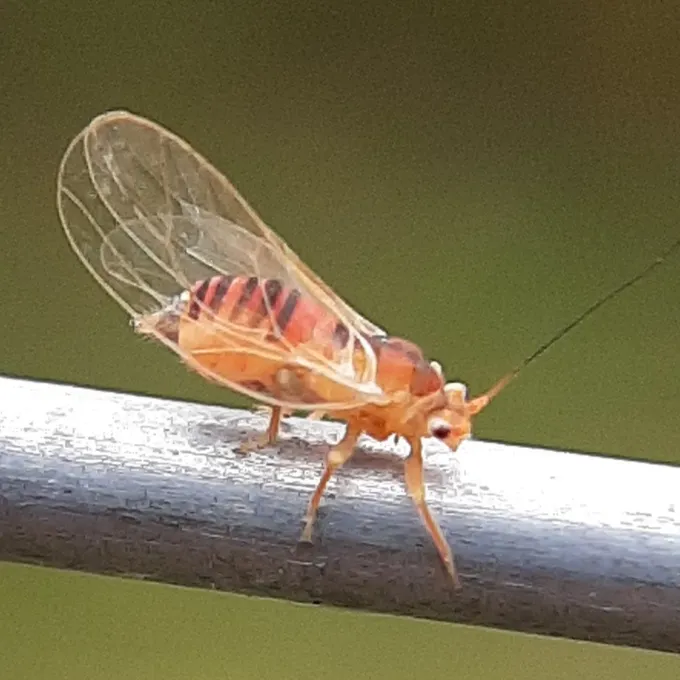
The three-spotted psyllid (Psylla trimaculata) belongs to the order Hemiptera and the family Psyllidae. This small insect is known for a distinctive pattern on its wings, which features three clear spots that are characteristic for the species identification.
Adult psyllids possess functional wings and powerful hind legs adapted for jumping, which helps them move quickly within the tree canopy. Their bodies are typically coloured in shades of green or brown, providing effective camouflage against foliage during the active growing season.
The nymphs of this species are wingless and often covered in a protective waxy substance, which acts as a shield against environmental stressors. Throughout their life cycle, they go through several stages of development, gradually maturing into adult insects.
Field identification involves inspecting the underside of leaves and growing shoots during the peak of sap flow. A common indicator of their presence is the secretion of honeydew, a sticky substance that attracts other insects and supports the growth of sooty mold.
Microscopic analysis of wing venation is the primary method for accurate species verification by researchers. Understanding their sensory organ placement on antennae allows for insights into how these pests effectively locate the most nutrient-rich parts of the host plant.
What it damages
The three-spotted psyllid primarily targets plants within the Rosaceae family, including apple and pear trees. They show a particular preference for young trees and nursery stock, where tender new growth provides optimal conditions for feeding and development.
The economic impact arises from the direct extraction of plant sap, which disrupts the nutrient transport within the tree. This continuous feeding stress inhibits the overall growth rate and weakens the physiological health of the plant.
Severe infestations manifest through leaf curling, yellowing, and premature senescence. The affected shoots may show stunted development or deformation, significantly reducing the tree's photosynthetic capacity throughout the spring and summer months.
The accumulation of honeydew on foliage fosters the growth of black sooty mold, which blocks sunlight from reaching the leaf surface. This further reduces the plant's ability to produce energy and can affect fruit quality and yield in productive orchards.
In addition to physical damage, Psylla trimaculata can act as a vector for various plant pathogens. The transmission of diseases during feeding makes this pest a significant concern in integrated pest management programs for fruit cultivation.
When it appears
The life cycle of the three-spotted psyllid is highly dependent on the host plant's phenology, typically starting in early spring with bud burst. Overwintering adults emerge from sheltered locations in the bark or leaf litter as temperatures rise.
Egg-laying occurs on young shoots and buds, ensuring that the emerging nymphs have immediate access to nutrients. The spring generation usually experiences rapid growth due to the high concentration of nutrients found in the sap of new growth.
During the summer, the species can complete multiple generations depending on climatic variables such as temperature and humidity. These factors dictate the intensity and speed of population expansion within the orchard ecosystem.
As autumn approaches, adult psyllids begin to seek out overwintering sites. They typically utilize cracks in tree bark or accumulations of organic debris to survive the winter, entering a state of dormancy until the return of spring warmth.
Effective monitoring throughout the season is crucial for timely pest control. Tracking the timing of each generation's emergence allows agronomists to apply interventions when the pest is most vulnerable, minimizing overall crop damage.
Signs of infestation
One of the earliest indicators of an infestation is the curling and stunted growth of terminal shoots. Trees may visually appear stressed, with foliage losing its healthy turgor and vitality in the affected sections of the canopy.
Small colonies of nymphs are often found on the underside of leaves, protected by characteristic white, cotton-like waxy secretions. These colonies are easily visible if the canopy is inspected thoroughly during the growth phase.
The presence of a sticky, glistening substance on the leaves and branches is a critical sign of a large population density. This residue quickly turns black due to the rapid colonization by sooty mold fungi, creating a visually obvious mess.
Abnormal drop of fruitlets or yellowing of leaf margins can also signal significant damage. If left unmanaged, these stressors can lead to a marked decrease in the tree's vigor and its ability to produce fruit in the subsequent season.
Using yellow sticky traps provides a reliable way to monitor the activity and population density of the psyllid. Consistent evaluation of these traps allows growers to respond early and prevent the pest from reaching critical levels.
Control measures
A comprehensive control strategy involves both cultural and chemical management techniques. Proper pruning, balanced fertilization, and maintaining high tree health help to increase the plant's resilience against psyllid-related stress.
Chemical control involves the strategic application of insecticides when nymphs are at their most vulnerable stages. It is important to rotate chemical classes to prevent the development of resistance and to avoid spraying during bloom to protect essential pollinators.
Biological control focuses on enhancing the populations of natural predators like ladybugs, lacewings, and parasitic wasps. Creating habitats for these beneficial insects is a sustainable way to maintain psyllid populations below economic injury levels.
Sanitation practices, including the removal of old, loose bark and the disposal of fallen leaves, are effective in reducing available overwintering sites. This is a fundamental component of integrated pest management for Psylla trimaculata.
- Apply systemic insecticides during the nymphal development phase.
- Use horticultural mineral oils during dormancy to suppress overwintering populations.
- Regularly use yellow sticky traps for monitoring flight activity.
- Promote beneficial insect populations to provide natural biological suppression.
Taxonomy
- Latin name
- Psylla trimaculata
- Order
- Hemiptera (bugs, aphids, leafhoppers)
- Family
- Psyllidae
- EPPO code
- PSYLTR
Discussion
No discussions yet — be the first.