
Birch psyllid
Psylla striata
Description
How to identify
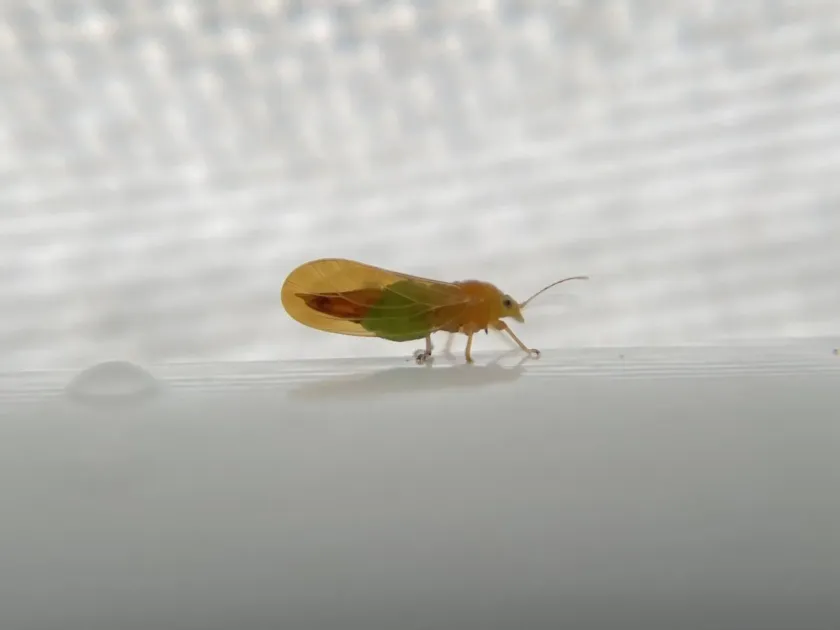
The birch psyllid (Psylla striata) is a small insect belonging to the family Psyllidae, often referred to as jumping plant lice. These insects are characterized by powerful hind legs that allow them to leap long distances when threatened.
Adults typically measure between 3 and 4 millimeters in length. Their coloration ranges from yellowish-green to brown, often featuring dark longitudinal stripes on the thorax, which provides excellent camouflage against the bark and leaves of their host plant.
The nymphs are flattened and often covered in a waxy, protective secretion. They remain relatively sedentary, spending most of their developmental stage feeding on the undersides of leaves, protected from direct sunlight and predators.
The eggs are small and elongated, usually deposited by females in crevices of the bark or near bud scales. This strategic placement protects them during the winter, allowing for rapid colonization in the spring.
The life cycle involves incomplete metamorphosis, moving from egg to nymph and finally to adult. Depending on environmental conditions, they can produce multiple generations within a single growing season.
What it damages
The primary host of Psylla striata is the birch tree (Betula spp.). During periods of high population density, these insects can colonize entire trees, concentrating their efforts on young, succulent leaves.
By piercing the leaf tissues and extracting phloem sap, psyllids disrupt the tree's metabolic functions. This feeding leads to leaf curling, chlorosis, and the development of necrotic spots on the foliage.
Severe infestations weaken the tree significantly, making it more susceptible to environmental stressors and drought. The overall aesthetic value of the tree is compromised as the canopy loses its density and healthy green color.
The presence of honeydew secreted by nymphs is a major indirect cause of damage. This sugary substance coats the leaves, promoting the growth of sooty mold, which blocks photosynthesis and further stresses the plant.
In addition to direct damage, birch psyllids are known vectors for various phytoplasmas and plant viruses, posing a silent threat to the longevity of young birch stands and decorative plantings.
When it appears
The lifecycle begins with the spring emergence, which is synchronized with the budburst of birch trees. Newly hatched nymphs immediately seek out tender, developing leaves to begin their feeding cycle.
Population levels often peak during the warmer months, specifically from late spring through mid-summer. Favorable climatic conditions can lead to overlapping generations, resulting in a continuous presence of the pest.
Late summer marks the transition phase. Adults begin to search for suitable overwintering sites, typically retreating into deep bark cracks or other protected crevices on the trunk to survive the winter temperatures.
Agronomic observation is most critical during the initial foliage expansion phase. Detecting the presence of early-stage nymphs allows for targeted interventions before the population reaches damaging levels.
While the pest is primarily active during the growing season, monitoring for physical signs of damage should continue throughout the summer to determine the need for late-season mitigation.
Signs of infestation
Curling or deformation of young leaves is the most common diagnostic sign of a birch psyllid infestation. When leaves look twisted or puckered, it often indicates the presence of nymphs feeding underneath.
Sticky honeydew deposits on the leaves are a clear indicator of psyllid activity. These deposits often attract secondary visitors like ants, which provide clues to the gardener about the location of the infestation.
The development of a black, soot-like substance on the leaf surface confirms the presence of sooty mold, which thrives on the honeydew. This is a sign of a high-density population that requires immediate attention.
Reduced shoot growth and premature leaf drop are physical manifestations of the tree's exhaustion. If the tree lacks its usual vigor, it may be struggling with a heavy psyllid load.
Visual identification of the adults is possible by gently shaking the branches. The insects will jump and scatter, making them easily visible against the green foliage if one knows what to look for.
Control measures
Effective control strategies focus on integrated pest management. Encouraging natural predators, such as lady beetles, lacewings, and parasitic wasps, can keep psyllid populations in check without chemical intervention.
When chemical control is necessary, systemic insecticides applied during the early nymph stage are most effective. These chemicals travel through the vascular system of the tree, reaching the sap-feeders efficiently.
Pruning and removal of heavily infested branches can help reduce the overall population pressure in the tree canopy. This practice also improves air circulation, which creates a less favorable microclimate for the psyllids.
Maintaining tree health through proper watering and fertilization is essential. Healthy trees exhibit a higher degree of natural resistance to sucking insects and recover faster from feeding damage.
- Regular inspection of birch canopies during bud opening.
- Application of systemic insecticides for severe outbreaks.
- Promotion of predatory insect habitats in the garden.
- Sanitary pruning of infested foliage and shoots.
Taxonomy
- Latin name
- Psylla striata
- Order
- Hemiptera (bugs, aphids, leafhoppers)
- Family
- Psyllidae
- EPPO code
- PSYLSR
Discussion
No discussions yet — be the first.