
Hawthorn psyllid
Psylla peregrina
Description
How to identify
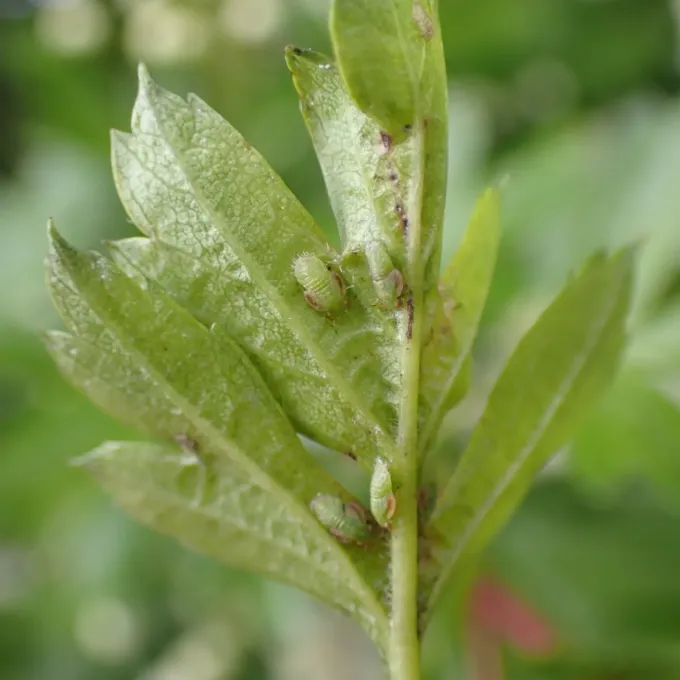
The hawthorn psyllid (Psylla peregrina) belongs to the Psyllidae family. It is a small insect, typically measuring 3–4 mm in length, known for its strong, jumping hind legs.
The adult form varies in color from greenish to brownish-yellow, providing effective camouflage against the foliage of host plants during the growing season.
They possess transparent wings that are held roof-like over the body when at rest, which is a classic morphological characteristic of this insect family.
Nymphs are often covered in a characteristic white, waxy secretion that resembles cotton wool, serving as a protective shield against predators and environmental stress.
Eggs are typically laid in late summer or autumn near the buds of host trees, where they remain dormant throughout the winter until the spring warmth triggers hatching.
What it damages
The hawthorn psyllid primarily targets hawthorn (Crataegus) species and pear trees, though it may occasionally affect other members of the Rosaceae family.
These insects feed by piercing plant tissues and extracting sap, which deprives the young shoots of essential nutrients and disrupts normal physiological development.
Infested leaves often exhibit severe curling, deformation, and chlorosis, significantly reducing the plant's photosynthetic capacity and overall vigor.
Stunted growth is a common outcome, as the energy that should be directed toward vertical growth is instead wasted on responding to the physiological stress of the infestation.
The excretion of honeydew by the psyllids promotes the growth of sooty mold, which creates a dark, unsightly coating on leaves and interferes with gas exchange.
When it appears
The life cycle is closely synchronized with the phenology of host plants, ensuring that nymphs emerge exactly when fresh, tender growth is available to sustain them.
Hatching typically occurs in early spring as the buds begin to burst, coinciding with the most rapid period of tissue expansion in the host plants.
After several molting stages, nymphs mature into winged adults, which are then capable of dispersal to colonize other susceptible trees in the surrounding area.
Depending on the climatic conditions and the regional temperature profile, the insect may complete one or several generations over the course of a single growing season.
As temperatures begin to drop and autumn approaches, the adults lay eggs that will survive the winter, effectively resetting the cycle for the following year.
Signs of infestation
The presence of white, cotton-like waxy deposits in leaf axils and on young shoots is the most diagnostic sign of a hawthorn psyllid infestation.
Distorted, crinkled, or rolled leaves are clear indicators of feeding activity, especially when these symptoms appear on the newest, most succulent growth.
The accumulation of sticky honeydew on the foliage often leads to the development of black sooty mold, which is easily visible to the naked eye.
Close inspection of the branch tips often reveals sedentary, wingless nymphs hidden beneath their white, waxy protective coverings.
General unthriftiness and a noticeable reduction in annual shoot elongation are key signs that the tree is under pressure from a significant psyllid population.
Control measures
Proper horticultural management, including regular pruning and thinning of the canopy, is essential to improve airflow and reduce microclimatic conditions favored by the pest.
Early spring applications of dormant oils or contact insecticides can effectively target overwintering eggs, preventing the infestation from gaining a foothold.
Systemic insecticides are generally effective during the vegetative stage, as they are absorbed by the plant and provide long-term protection against sap-sucking insects.
Supporting local populations of natural enemies, such as lacewings and ladybirds, provides a sustainable way to keep psyllid numbers below the economic threshold.
Regular scouting throughout the spring is critical; early detection allows for targeted spot treatments, which minimizes the need for widespread chemical applications.
Taxonomy
- Latin name
- Psylla peregrina
- Order
- Hemiptera (bugs, aphids, leafhoppers)
- Family
- Psyllidae
- EPPO code
- PSYLPE
Discussion
No discussions yet — be the first.