
Boxelder psyllid
Psylla negundinis
Description
How to identify
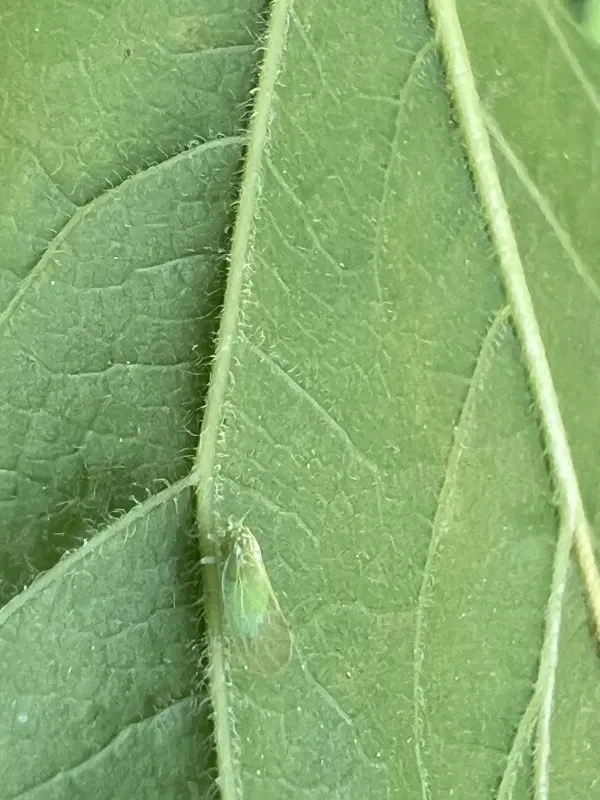
The boxelder psyllid (Psylla negundinis) is a small insect belonging to the family Psyllidae, commonly known as jumping plant lice, within the order Hemiptera.
Adult psyllids are typically green or yellowish in color, featuring transparent wings that they hold roof-like over their bodies when at rest.
Nymphs are often found on the undersides of leaves, sometimes covered in a waxy or filamentous substance that acts as a protective layer against predators and the environment.
The life cycle involves incomplete metamorphosis, where nymphs undergo several molts before reaching adulthood without a pupal stage.
Eggs are typically laid in the crevices of bark or near bud scales, where they remain throughout the winter until conditions become favorable for hatching.
What it damages
The primary host for this species is the boxelder maple (Acer negundo), which is widely distributed across urban landscapes and parklands.
These insects feed by piercing plant tissues with their stylets and sucking out the sap, which causes the foliage to lose nutrients and vigor.
Severe infestations can lead to premature leaf drop, causing the tree to look sparse and unthrifty during the peak of the growing season.
As they feed, they excrete a sticky substance known as honeydew, which can accumulate on leaves and branches, creating a mess under the tree canopy.
Constant sap depletion stunts the growth of young shoots and reduces the overall cold hardiness of the tree, making it susceptible to winter injury.
When it appears
The activity begins in early spring as temperatures rise, coinciding with the opening of tree buds, which provide a vital food source for the newly hatched nymphs.
The population reaches its maximum density during late spring and early summer, when multiple overlapping generations may be present on the tree.
As autumn approaches, the development cycles slow down, and the final generation prepares to enter diapause, often moving to sheltered areas on the tree.
Consistent monitoring is required throughout the months of May and June to detect the first signs of infestation and apply control measures effectively.
Environmental conditions, particularly mild winters and warm springs, significantly influence the population dynamics and potential damage severity.
Signs of infestation
The most visible sign of infestation is the curling, yellowing, and deformation of leaves, which often become crinkled or distorted due to the feeding activity.
Honeydew accumulation creates a shiny, sticky layer on the leaves, which frequently promotes the growth of sooty mold, a black, crusty fungus.
Presence of the insects themselves is a clear indicator; a quick shake of the branches will often cause adults to jump or fly away, revealing their presence.
Discoloration of the leaf margins and premature drying of foliage are indicative of heavy pressure and significant sap removal.
- Distorted, curled leaves.
- Sticky honeydew on foliage.
- Sooty mold accumulation.
- Active jumping insects when branches are disturbed.
Control measures
Systemic insecticides are generally the most effective method for managing boxelder psyllids, as they are absorbed into the vascular system of the tree.
Pruning out heavily infested shoots in early spring can help reduce the population base, though this is more practical for smaller or younger trees.
Encouraging natural predators such as lady beetles, lacewings, and minute pirate bugs can help maintain natural equilibrium and suppress outbreaks.
Horticultural oils or insecticidal soaps can be used to treat early infestations by suffocating the nymphs before they cause widespread leaf damage.
Proper tree maintenance, including adequate watering and avoiding excessive nitrogen fertilization, helps the tree resist the negative effects of the psyllid.
Taxonomy
- Latin name
- Psylla negundinis
- Order
- Hemiptera (bugs, aphids, leafhoppers)
- Family
- Psyllidae
- EPPO code
- PSYLNE
Discussion
No discussions yet — be the first.