
Alder psyllid
Psylla jucunda
Description
How to identify
The alder psyllid (Latin Psylla jucunda) is a small insect species belonging to the order Hemiptera and the family Psyllidae. These insects are commonly known as jumping plant lice due to their powerful hind legs.
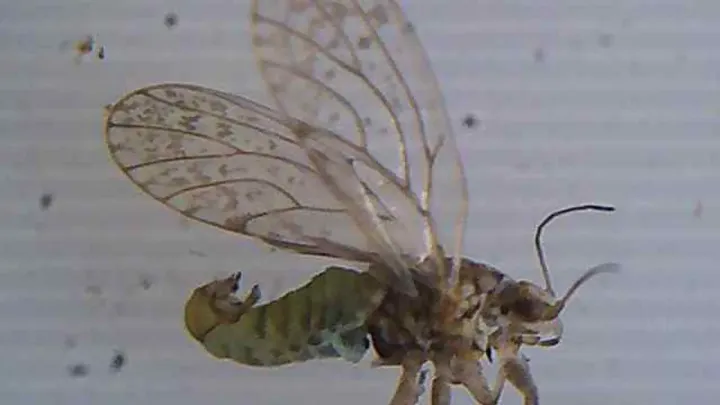
Adult specimens are characterized by clear wings, typically held roof-like over the body when at rest. They possess a specialized piercing-sucking mouthpart designed for feeding on plant phloem.
The life cycle includes egg, nymphal stages, and adult. Nymphs often secrete a protective waxy substance, which acts as a barrier against predators and environmental stress.
Morphologically, adults show significant variation across seasons, often blending in with the bark or foliage color. Their ability to jump quickly makes them difficult to catch or observe in detail.
Precise identification is usually performed by entomologists examining the wing venation patterns and the structure of the male genitalia, as many psyllid species are morphologically cryptic.
What it damages
Alder trees (genus Alnus) are the primary host plants for the alder psyllid. Both nymphs and adults feed on the nutrient-rich sap of young shoots and developing leaves.
Feeding activities cause localized cell damage, leading to the distortion of leaf tissues. This process redirects the plant's resources away from healthy growth and development.
Significant infestations can lead to a noticeable reduction in annual tree vigor. The foliage may show signs of chlorosis and, in severe cases, the tree may shed leaves prematurely during the summer months.
Continuous sap withdrawal weakens the host plant, making it significantly more susceptible to secondary environmental stresses, such as drought or secondary fungal infections.
In nursery environments, uncontrolled psyllid populations can lead to stunted growth of seedlings, negatively impacting their marketability and survival rates upon transplanting.
When it appears
The emergence of the alder psyllid aligns with the spring flush of alder buds. Adults become active as soon as temperatures rise enough for the insects to break their winter dormancy.
The peak period of nymphal activity occurs from late spring through mid-summer. During this window, the population grows rapidly through successive generations if environmental conditions remain favorable.
The number of generations per year is heavily dependent on regional climate. In warmer southern latitudes, the species may complete more life cycles compared to those in northern areas.
As autumn approaches, adult activity declines. The insects seek overwintering sites, typically finding shelter within bark crevices or other protected microhabitats to survive the winter.
Winter survival is primarily achieved by the adult stage, which allows the species to respond quickly to early spring warming before their host trees even fully leaf out.
Signs of infestation
The most prominent sign of infestation is the curling and distortion of new leaves. Affected foliage often looks crinkled and fails to expand fully.
Psyllids produce large amounts of honeydew, a sticky sugary secretion. This substance covers the leaves and branches, creating a perfect substrate for sooty mold fungi to grow.
- Distorted, curled, or crinkled leaves.
- Sticky honeydew residue on foliage and bark.
- Black sooty mold growth covering the leaves.
- Premature leaf drop during the peak growing season.
- Sudden jumping activity when branches are disturbed.
Under close inspection, the undersides of the leaves often reveal small, stationary nymphs encased in their protective secretions, arranged along the leaf veins.
In cases of heavy infestation, the entire canopy of the tree can take on a dark, soot-covered appearance, which significantly reduces the tree's photosynthetic efficiency.
Control measures
For large-scale management, systemic insecticides are the most effective method, as they are absorbed by the tree and provide long-lasting protection against sap-feeding insects.
Integrated Pest Management (IPM) practices prioritize early detection. Regular monitoring in early spring allows for spot-treatments before the population reaches an uncontrollable level.
Cultural control measures, such as proper tree nutrition and the removal of dead or infested branches, can significantly improve tree health and resilience against attacks.
Promoting the presence of natural predators, including lacewings, lady beetles, and parasitic wasps, is a sustainable way to maintain psyllid populations below the threshold of damage.
In home garden settings, consistent washing of foliage with water or insecticidal soap can physically remove nymphs and disrupt their development cycle without harsh chemicals.
Taxonomy
- Latin name
- Psylla jucunda
- Order
- Hemiptera (bugs, aphids, leafhoppers)
- Family
- Psyllidae
- EPPO code
- PSYLJU
Discussion
No discussions yet — be the first.