
Hawthorn psyllid
Psylla crataegi
Description
How to identify
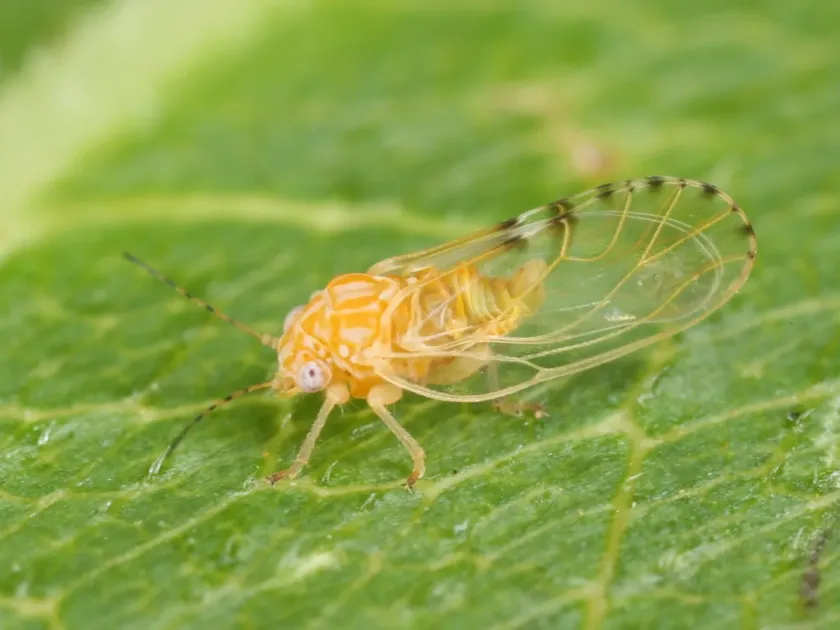
The hawthorn psyllid (Psylla crataegi) is a member of the Psyllidae family. Adult insects measure approximately 3-4 mm in length and possess wings, allowing for significant mobility during the active season.
Larvae are flattened and often covered in a waxy secretion, which acts as a protective shield against environmental stress and predators. This waxy substance makes them appear like small, static scales on the foliage.
Eggs are typically laid in bark crevices near buds. They are small and oval, undergoing a color change from white to yellowish as they approach the hatching stage.
The life cycle is tightly synchronized with the phenology of the host plant. There is generally one generation per year, though development speed depends on local climatic variables.
The insect possesses highly developed sensory systems, enabling it to locate the most tender parts of the plant, such as emerging buds, for initial colonization.
What it damages
While primarily affecting hawthorn species, this psyllid also targets other Rosaceae crops, including pear, apple, and rowan, causing significant physiological stress.
Damage is caused by both larvae and adults extracting sap from young leaves and shoots, leading to nutrient depletion and reduced growth vigor of the host plant.
Feeding often results in severe leaf curling and distortion. This stress hampers the tree's ability to store energy, negatively impacting future bud development and overall yield.
The secretion of honeydew by the larvae provides an ideal substrate for the growth of sooty mold. This dark fungal layer blocks sunlight, significantly reducing photosynthetic efficiency.
Heavy infestations during the flowering period can cause premature drop of blossoms and fruitlets, leading to major economic losses in orchards if left untreated.
When it appears
Activity begins in early spring, synchronized with the bud-burst phase. This is the most critical period for monitoring as the young larvae emerge and remain relatively unprotected.
The active feeding phase continues throughout late spring and early summer. Moderate temperatures (18-22°C) are optimal for the rapid growth and spread of the psyllid population.
By late summer, the insect activity shifts towards preparing for the overwintering phase. Adults may migrate or remain on the host plant to lay eggs in protected sites.
The severity of the following season's infestation is largely determined by the success of egg overwintering, which is favored by mild winter conditions.
Effective management strategies require consistent monitoring from early spring through to autumn to capture the dynamics of the pest population throughout its life cycle.
Signs of infestation
The most prominent sign of infestation is the characteristic curling and twisting of young leaves at the tips of terminal shoots, often referred to as leaf crinkling.
Close inspection of the underside of leaves reveals colonies of larvae encased in waxy, white, flocculent secretions, which are often sticky to the touch due to honeydew.
The presence of sooty mold—a black, velvet-like substance on the leaves and stems—is a strong indicator of an established infestation and secondary fungal growth.
Reduced shoot elongation and stunted growth in young trees are common symptoms of chronic psyllid feeding, even if the insects themselves are not immediately visible.
- Leaf curling and deformation.
- Sticky honeydew residues.
- Waxy larval secretions on leaf undersides.
- Sooty mold growth.
- Stunted terminal growth.
Control measures
The primary control method involves early spring insecticide applications, specifically targeting the period before bloom when larvae are most exposed and vulnerable.
Sanitation practices, such as the pruning and destruction of infested shoot tips, effectively reduce the local population density of the pest within the garden.
Integrated pest management (IPM) encourages the use of beneficial insects, such as lady beetles and lacewings, which are natural predators of psyllids and help maintain balance.
Maintaining optimal tree health through proper fertilization and irrigation strengthens the plant's natural resilience against psyllid-induced physiological stress.
For commercial orchards, the use of yellow sticky traps is a standard practice for monitoring adult movement and timing the application of protective treatments.
Taxonomy
- Latin name
- Psylla crataegi
- Order
- Hemiptera (bugs, aphids, leafhoppers)
- Family
- Psyllidae
- EPPO code
- PSYLCR
Discussion
No discussions yet — be the first.